


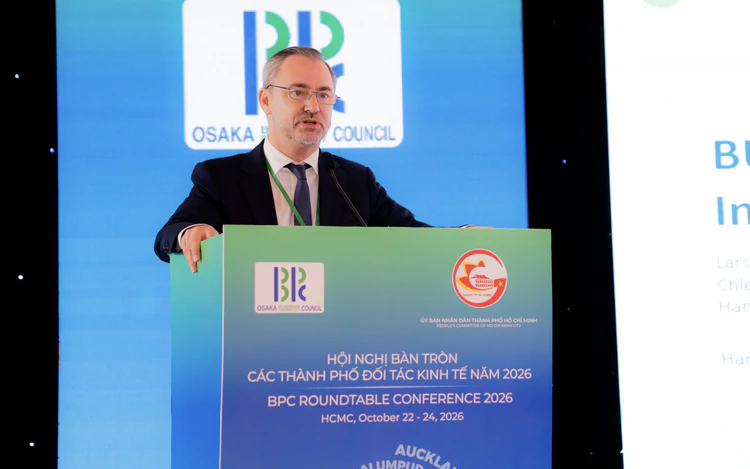
Lars Anke from the Hamburg Chamber of Commerce speaks at the 2026 Business Partner City (BPC) Roundtable Conference in Ho Chi Minh City on October 23, 2026. Photo: Ngoc Duc / Tuoi Tre
The 2026 Business Partner City (BPC) Roundtable Conference opened in Binh Duong Ward, Ho Chi Minh City on Friday morning, with the municipal People’s Committee co-hosting the event alongside Japan’s Osaka BPC Council.
Speaking to Tuoi Tre (Youth) online newspaper on the sidelines of the conference, representatives of the business communities in Germany’s Hamburg and Australia underscored the growing importance of city-to-city partnerships in an increasingly interconnected global economy.
Lars Anke, a representative of the Hamburg Chamber of Commerce, said cooperation between cities is crucial as it helps businesses on both sides understand how each other’s markets operate.
“Such partnerships act as a catalyst for knowledge transfer, helping Vietnamese businesses gain a clearer picture of the German and European markets, while enabling our businesses to better understand Vietnam’s growing and increasingly important market,” he said.
Hamburg and Ho Chi Minh City share several key characteristics, he said.
Both are port cities and major logistics hubs, with growing interests in innovation and the energy transition.
These commonalities create opportunities for cooperation in maritime transport, logistics, shipping, energy and artificial intelligence, Anke said.
They also make the exchange of experience between the two cities particularly valuable.
Hamburg’s businesses have extensive experience in environmental protection, digitalization, automation and international trade, while Vietnamese firms possess strong knowledge of their domestic market and are known for their dynamism.
“I believe there is a great deal that both sides can learn from each other,” he said.
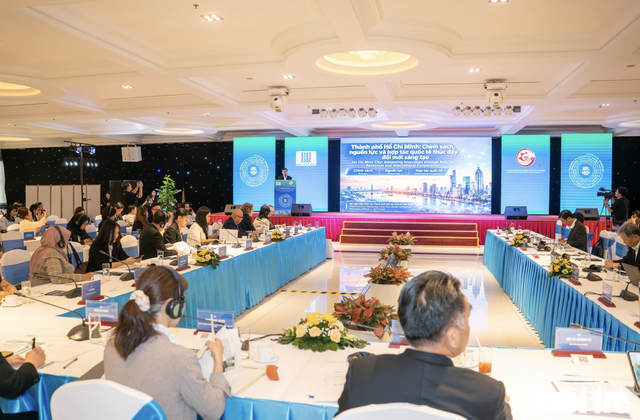
A general view of the 2026 Business Partner City Roundtable Conference in Ho Chi Minh City on October 23, 2026. Photo: Ngoc Duc / Tuoi Tre
Three-way partnership model can drive innovation
Anke also highlighted the potential of the ‘triple helix’ model, which brings together government, universities and businesses to promote innovation–an approach Vietnam has been actively seeking to advance.
Hamburg has successfully applied this model through industry clusters spanning life sciences and materials, aviation, wind technology and energy storage.
The clusters serve as both platforms and incubators for startups, helping them grow while providing pathways into domestic, European and international markets, according to Anke.
He believes Ho Chi Minh City could benefit from adopting a similar approach.
“During my previous visit to Vietnam, I was genuinely impressed by the universities and research institutes here,” he said.
“They have many young people who are motivated, eager to learn and keen to develop solutions for the future.”
Also, Vietnamese businesses were equally dynamic, modern and innovative.
The remaining piece of the puzzle is the government, whose role is to establish the foundations and networks that bring researchers and businesses together.
Anke considers this collaboration essential to developing sustainable solutions to the challenges of the 21st century.
However, he cautioned that innovation covers a broad range of fields, making it important for Ho Chi Minh City to identify clear priorities.
The city should assess which sectors are most important to its development and which already have a strong foundation, then focus on consolidating and expanding those strengths, he said.
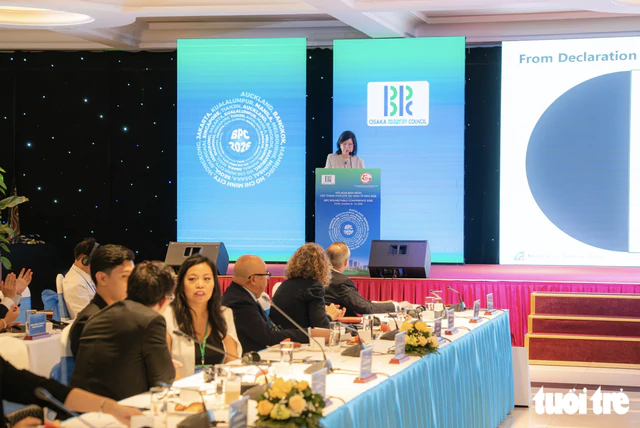
A representative from the Australian Industry Group (Ai Group) speaks at the 2026 Business Partner City Roundtable Conference in Ho Chi Minh City on October 23, 2026. Photo: Ngoc Duc / Tuoi Tre
City partnerships open path to enter new markets
Shirley Ng, an executive at the Australian Industry Group (Ai Group), said city-to-city partnerships played a key role in connecting businesses and enabling them to learn from one another’s solutions to major economic challenges.
“It is about learning, sharing and exchanging,” she said.
The green economy is one area where this cooperation could deliver tangible benefits.
Businesses first need a solid understanding of the green economy, Ng said, noting that Australian companies have accumulated valuable experience that they can share with Vietnamese counterparts.
Such partnerships can also help businesses navigate unfamiliar markets.
Australia is a vast country with a relatively small population but a high-value economy, Ng explained.
Meanwhile, Australian businesses often lack a clear understanding of how to enter overseas markets, including whom to approach and how to establish commercial relationships.
“When they look at a supply chain and see a reliable destination, they want to become part of it, but they then face other challenges,” she said.
Language barriers and a lack of familiarity with local business practices can complicate market entry.
Businesses therefore need to leverage established networks to understand how markets operate and identify suitable partners.
Ng also emphasised Ho Chi Minh City’s importance as a supply chain partner.
“Ho Chi Minh City is a very important supply chain partner. Businesses can start small, but in doing so, they can become stronger links in the supply chains serving partner countries,” she said.
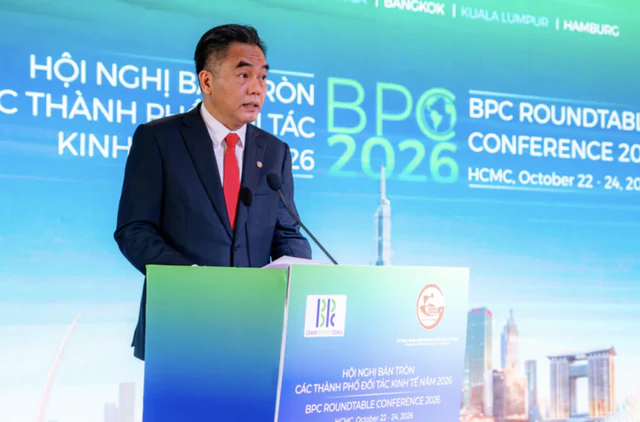
Ho Chi Minh City vice-chairman Nguyen Loc Ha speaks at the 2026 Business Partner City Roundtable Conference in Ho Chi Minh City on October 23, 2026. Photo: Ngoc Duc / Tuoi Tre
Ho Chi Minh City pledges to be reliable partner
Speaking at the closing session of the conference, Nguyen Loc Ha, vice-chairman of the Ho Chi Minh City People’s Committee, said the city had consistently regarded international integration and cooperation as important drivers of development.
“As we enter a new stage of development, Ho Chi Minh City remains committed to being a reliable and responsible partner, ready to work alongside fellow BPC member cities,” he said.
“In the coming period, we hope to further strengthen cooperation in key areas, including innovation, green and sustainable industrial development, and urban development oriented towards public transport.”
Initiated in 1988 by the Osaka administration, the BPC network aims to boost economic links between cities and help small and medium-sized enterprises expand internationally.


Max: 1500 characters
There are no comments yet. Be the first to comment.