


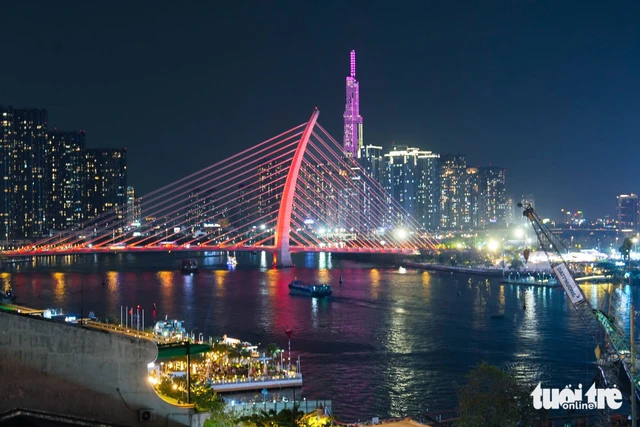
Ho Chi Minh City could generate significant revenue from its nighttime economy. Photo: Huu Hanh / Tuoi Tre
Tourism remains a key pillar, contributing roughly one-third of Ho Chi Minh City’s GRDP.
In 2026, the municipal Department of Tourism targets around 11 million international visitors, 50 million domestic travelers, and total tourism revenue of VND330 trillion (US$12.5 billion).
Nighttime economy a full ecosystem
Late at night, Thuy Duong, a resident of Cau Kieu Ward, is still awake caring for her child.
She opens a food delivery app and orders fried chicken. Within 30 seconds, a driver accepts the order, and about half an hour later, it arrives.
Behind such a simple transaction lies a synchronized system: restaurants still open, digital platforms running, drivers on the road, traffic flowing, and most importantly, customers still active.
At the same time, many central areas of the city remain brightly lit, serving both dine-in customers and online orders, reflecting a service ecosystem that operates well beyond office hours.
According to experts, the nighttime economy is not limited to night markets or beer streets.
It encompasses a wide range of activities, including dining, entertainment, cultural experiences, sightseeing, and shopping tailored for after dark, especially for visitors with limited daytime schedules.
However, Nguyen Nguyet Van Khanh, marketing and communications director at Vietravel, said Ho Chi Minh City’s evening economy remains underdeveloped, rather than a fully commercialized and scalable tourism product system.
A key bottleneck is the lack of structured after-dark offerings that can be 'packaged' and sold.
Meanwhile, a representative of Vina Group noted that the city has strong potential for a nighttime economy, especially as international arrivals to Vietnam and Asia continue to rise.
However, current development is still small-scale, focused on standalone services, and lacking clear direction in planning, investment, and human resources.
With its advantages as a rapidly expanding megacity, Ho Chi Minh City has the opportunity to build not just a nightlife destination, but a diverse, in-depth, and iconic nighttime tourism ecosystem.
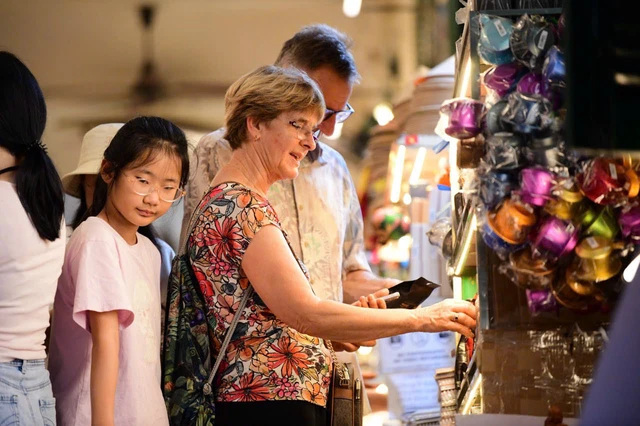
After a day of sightseeing, visitors often spend their evenings shopping and enjoying entertainment. Photo: Quang Dinh / Tuoi Tre
Toward an international nighttime tourism ecosystem
From a practical standpoint, Vietravel emphasized that the core of a true evening economy lies in creating 'packaged' products with clear concepts, fixed timeframes, transparent pricing, and booking options.
These are essential for tour operators to design and distribute to customers.
Equally important is strong identity.
If nightlife offerings revolve solely around drinking streets or basic entertainment, the city will struggle to differentiate itself from regional peers.
Instead, the city should shift its focus toward cultural, artistic, and immersive urban experiences, which can extend visitor stays, increase spending, and encourage repeat visits.
Amid Ho Chi Minh City's expanding development space, nighttime tourism products should also be designed with a broader approach.
"It is possible to develop itineraries that combine urban, industrial, and cultural experiences in Binh Duong with coastal and resort offerings in Vung Tau, creating a seamless experience that spans both day and night," said Van Khanh from Vietravel.
This approach could also help lengthen visitor stays instead of focusing on isolated attractions.
Pham Huy Binh, director of the Ho Chi Minh City Department of Tourism, said the city is working on key solutions, including improving the legal framework for the sharing economy (such as Airbnb and Online Travel Agencies – OTAs), smart tourism, and particularly the nighttime economy.
At the same time, the city is promoting high-value tourism products, supporting businesses in developing new offerings such as creative industrial tours, medical tourism, AR/VR applications, river tourism, helicopter tours, and nighttime tourism.
Nighttime economy: Driving growth in Ho Chi Minh City
To identify bottlenecks and unlock resources for the nighttime economy, Tuoi Tre (Youth) newspaper and the Ho Chi Minh City Food Association will co-host a thematic seminar titled 'Nighttime economy: Driving Growth in Ho Chi Minh City' on Wednesday in Ho Chi Minh City.
The event takes place as Ho Chi Minh City is drafting a special urban law and a resolution on specific policy mechanisms, creating opportunities for the city to proactively plan, attract investment, and develop its evening economy.
The seminar will bring together government officials, policymakers, leading economists, the Ho Chi Minh City Food Association, and representatives of major companies such as Vietravel, Satra, and Viettel.
Discussions will focus on spatial planning, diversifying culturally distinctive arts and entertainment products, and gathering direct feedback from businesses on policies for developing the nighttime economy.
The event is expected to showcase successful international models and propose effective pilot roadmaps, helping position the night economy as a new growth engine for the city.









Max: 1500 characters
There are no comments yet. Be the first to comment.