



Karin Tegmark Wisell, Sweden’s Ambassador for Global Health, speaks with Tuoi Tre News during her trip to Ho Chi Minh City as part of the Sweden-Vietnam Health Week 2026 on November 18, 2026. Photo: Thanh Hiep / Tuoi Tre
The Sweden-Vietnam Health Week 2026, held in Bac Ninh Province, Hanoi and Ho Chi Minh City from November 16 to 18, marked 50 years of healthcare cooperation between the two countries while opening up discussions and setting directions for future collaboration to address challenges facing the healthcare sector.
“These issues are intermingled,” she said, pointing to the effects of climate change, including rising temperatures, and disease outbreaks such as the COVID-19 pandemic as challenges that put pressure on healthcare systems.
In addition, hospital overcrowding, driven by factors such as migration, an influx of patients during disease outbreaks and climate-related impacts, can further increase the risk of antimicrobial resistance (AMR) spreading.
"We need to look at these challenges together and try to direct the interventions towards creating a resilient healthcare system that truly focuses on prevention,” Ambassador Tegmark Wisell stressed, adding that this will help keep the population healthy and resilient to these health threats.
3 levels of preparation for an aging population
According to Sweden's Ambassador for Global Health, countries are also facing population aging, accompanied by a rise in non-communicable diseases such as cancer, cardiovascular diseases, dementia and stroke.
Alongside prevention, it is essential to ensure early disease detection and build a strong public health foundation that gives people the knowledge they need to stay healthy.
She cited antimicrobial resistance as an example, stressing the need to educate the public that not every illness requires antibiotics, as inappropriate use contributes to antimicrobial resistance.
With populations aging, ensuring that people can grow older in good health is a key priority, Ambassador Tegmark Wisell said.
In Sweden, screening programs help identify risk factors and detect diseases at an early stage, allowing treatment to begin before conditions become severe.
They also help people understand how to prevent diseases from progressing or, ideally, developing in the first place.
Other initiatives include smoking prevention programs and advice on healthy diet.

Karin Tegmark Wisell, Sweden’s Ambassador for Global Health, speaks with Tuoi Tre News during her trip to Ho Chi Minh City as part of the Sweden-Vietnam Health Week 2026 on November 18, 2026. Photo: Thanh Hiep / Tuoi Tre
According to Ambassador Tegmark Wisell, achieving a long and healthy life requires a focus on three key areas.
The first is public health interventions. National and local authorities should introduce policies that help people lead a healthy life, such as controlling air pollution, discouraging smoking through higher taxes and promoting health education in schools.
The second is primary healthcare. Accessible primary care services allow health risks and diseases to be detected early.
Screening programs should also be introduced to identify conditions that certain population groups may be at risk of developing.
The third is the development of top-class and advanced hospitals with the capacity to provide specialized treatment.
Future healthcare: digital technology and AI
According to Ambassador Tegmark Wisell, in Sweden, every citizen has a personal identification number that allows them to log in to access their medical records online and book appointments at primary healthcare facilities.
People can also find out where to seek care based on the symptoms they experience.
 Karin Tegmark Wisell, Sweden’s Ambassador for Global Health
At the Sweden-Vietnam Health Week 2026, more than 200 policymakers, healthcare leaders, hospital directors, researchers, health experts, lecturers and business representatives from both countries took part in discussions and professional exchanges on innovation, scientific research and international cooperation.
The event was jointly organized by the Embassy of Sweden in Hanoi, Business Sweden - the Swedish Trade & Invest Council and medical university Karolinska Institutet, bringing together government agencies, academic institutions, healthcare facilities and businesses from the two countries.
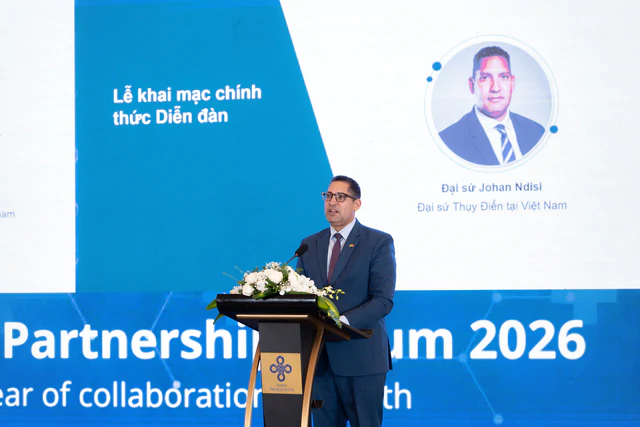
Swedish Ambassador to Vietnam Johan Ndisi speaks at the opening ceremony of the Sweden-Vietnam Partnership Forum 2026, held as part of Sweden-Vietnam Health Week 2026. Photo courtesy of the Embassy of Sweden
As Vietnam continues to modernize its healthcare system and expand access to quality healthcare for its population of more than 100 million, the Health Week provided a platform for promoting cooperation in areas such as digital health, precision medicine, sustainable healthcare, hospital modernization and healthcare workforce development.
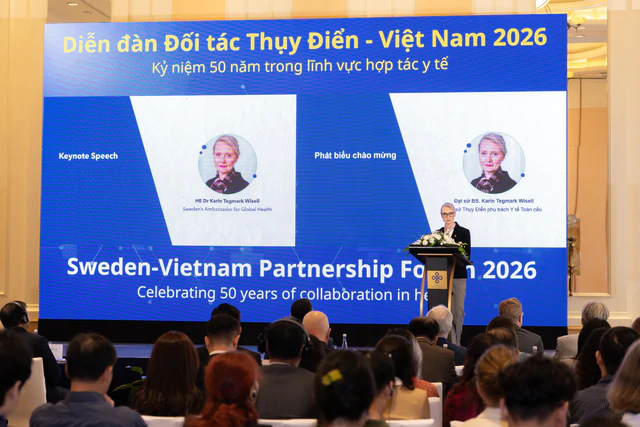
Sweden’s Ambassador for Global Health Karin Tegmark Wisell speaks at the Sweden-Vietnam Partnership Forum 2026, held as part of the Sweden-Vietnam Health Week 2026. Photo courtesy of the Embassy of Sweden
Sharing his views with the Embassy of Sweden during the Health Week, Carlo Negri, international director at Sweco Architects, said healthcare would no longer be delivered solely in hospitals.
Healthcare services would be expanded through primary care networks, community healthcare facilities, home-based care and remote consultations.
This would allow hospitals to focus on complex cases or those requiring intensive treatment, supported by data, remote monitoring technology, and AI.
According to him, hospitals of the future need to be environmentally friendly and people-centered, while effectively integrating in-person care with digital healthcare.
This is an area where Sweden and Vietnam can learn from each other, he said.
Despite their different contexts, both countries face common challenges: a growing demand for healthcare, an aging population, and the need to develop a more sustainable healthcare system, he added.
Meanwhile, Julia Bergevi, COO and co-founder of EviBody, an evidence-based, AI-supported health app, said she was inspired by the expertise and dedication of Vietnamese healthcare professionals and their commitment to better health for everyone.
“I believe digital health and AI can make support more personal, accessible and continuous between healthcare appointments,” she said.
“Someone whose health check identifies a risk could receive clear explanations, practical support to build healthier habits, and guidance on when to contact a healthcare professional.
“AI can help tailor that support to individual needs.”
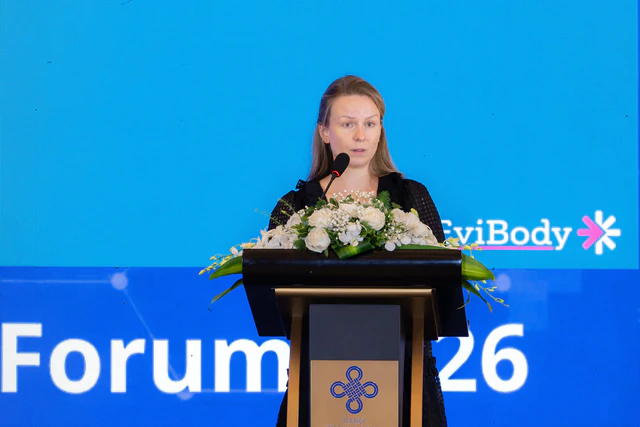
Julia Bergevi, COO and co-founder of health app EviBody, speaks at the Sweden-Vietnam Partnership Forum 2026, held as part of Sweden-Vietnam Health Week 2026. Photo courtesy of the Embassy of Sweden
According to Sweden’s Ambassador for Global Health Karin Tegmark Wisell, the 50-year history of health cooperation between Vietnam and Sweden has yielded numerous achievements.
She specifically highlighted progress in education and training, noting that nearly 50 Vietnamese doctors and nurses have completed their doctoral programs at the Karolinska Institutet in Sweden.
Through collaborative initiatives, Sweden has also been assisting in training 40,000 Vietnamese healthcare workers to improve their skills.
Conversely, Ambassador Tegmark Wisell noted that with a population of around 100 million, Vietnam is “extremely good at doing things at scale,” an area from which Sweden could learn from.
For instance, Vietnam’s approach to developing large-scale hospitals, capable of serving a vast number of people and ensuring broad access to healthcare services, offers valuable lessons.
During the Sweden-Vietnam Health Week 2026, Johan Ndisi, Sweden’s Ambassador to Vietnam, insisted that the true legacy of health cooperation between the two countries is not merely reflected in the hospitals or medical facilities that have been built, but in the generations of healthcare professionals, researchers, and patients who have benefited from this partnership.






Max: 1500 characters
There are no comments yet. Be the first to comment.