


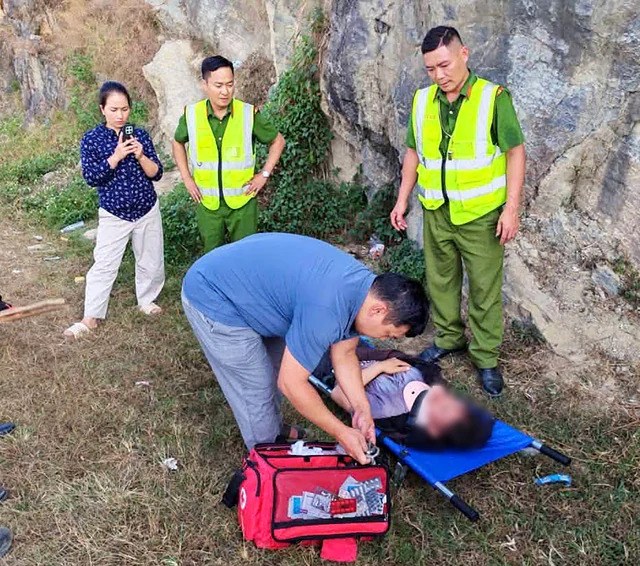
Rescue personnel provide first aid to a male tourist after he fell down a cliff about 300 meters deep while visiting Vietnam’s northernmost point in Lung Cu Commune, Tuyen Quang Province, October 24, 2026. Photo: Lung Cu - Vietnam’s Northernmost Point
The two tourist accidents occurred in Vietnam last week, raising concerns about how travelers can better protect themselves while exploring the country’s natural attractions.
In the first incident, the male tourist fell into a deep ravine at Vietnam’s northernmost point in Lung Cu Commune in Tuyen Quang Province on Saturday afternoon.
In the second, the Malaysian tourist fell into a hole while hiking in Da Lat, a popular tourist site in the Central Highlands province of Lam Dong on Sunday morning.
A moment of carelessness can have serious consequences
The male tourist who fell into the ravine was a tour guide familiar with the mountainous terrain, yet he was still involved in the accident.
According to the Lung Cu Commune People’s Committee, the man was standing on a concrete guardrail to take photographs when he fell.
The guardrail was sturdy and some 50 centimeters wide, but a ravine about 300 meters deep lay below.
When he was found, the man was still conscious.
He reportedly could not understand how he had fallen and only realized what had happened when he regained consciousness at the bottom of the cliff.
The following morning, the Malaysian woman fell into a hole some 10 meters deep in a pine forest while hiking with a group of friends.
People at the scene tried to pull her out but were unable to do so.
Rescue teams eventually freed the woman nearly two hours later before taking her to hospital for emergency treatment.
The two incidents illustrate how quickly a trip intended for relaxation and rejuvenation can become a traumatic experience when safety precautions are overlooked.
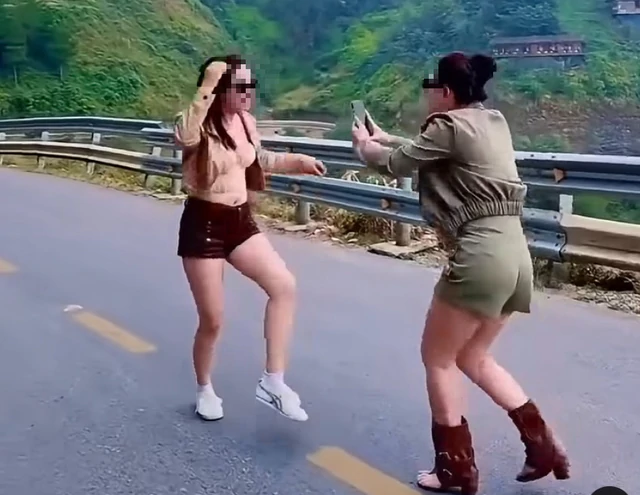
A still image taken from a clip shows two young girls dancing in the middle of a road while filming a video.
Respect safety warnings and stay away from dangerous areas
Bui Thanh Tu, chief marketing officer of travel company BestPrice, told Tuoi Tre (Youth) online newspaper that safety was always a top priority for tourists traveling on organized tours.
Travel companies and tour guides are responsible for taking visitors to authorized attractions and ensuring their safety throughout the trip.
An accident involving even one tourist can affect the morale of the entire group, disrupt the tour, cause difficulties for the travel company and damage the destination’s tourism image, he said.
“Tour guides must keep a close eye on their groups and explain what visitors should and should not do at attractions,” Tu said.
Tourists are regularly reminded to prioritize their personal safety.
Tour operators would never deliberately take visitors to dangerous locations, such as areas beyond safety barriers or near cliff edges, he stressed.
For independent travelers, however, responsibility for safety rests largely with the individuals themselves.
With social media becoming increasingly influential, many young travelers are seeking unusual photographs and videos to attract attention, generate engagement or follow online trends.
Some have been seen standing close to cliff edges, crossing safety barriers or sitting in the middle of roads to capture distinctive images.
The problem often lies in overconfidence and an underestimation of the risks involved, Tu said.
Seeing someone else take a photograph in a dangerous location without incident can lead others to believe they can do the same.
They may overlook hazards such as slippery surfaces, changing weather conditions and their own lack of experience in handling emergencies.
“A memorable trip is not about taking the most daring photograph, but about enjoying the experience and returning home safely,” he said.
Young travelers should obey warning signs, avoid crossing barriers and never enter hazardous areas without authorization.
Those seeking striking photographs can instead choose suitable viewpoints or use equipment that allows them to take pictures from a safe distance, he added.
Tourists reminded to exercise caution
Nguyen Thuat, who runs a motorbike rental business in Tuyen Quang Province, said his company reminded customers of important safety precautions when they rented motorbikes to explore the province, particularly in border areas.
The business regularly monitors updates about local tourist attractions to keep customers informed of potential hazards and restrictions.
Authorities have fenced off many locations deemed unsafe and installed warning signs to prevent visitors from entering dangerous areas.
Tourists are advised not to cross these barriers simply to take photographs, Thuat said.
Visitors to border areas must also comply with specific regulations.
These include restrictions on operating drones and other unmanned aerial vehicles without authorization, as well as prohibitions on approaching border patrol roads and barbed-wire fences without permission.


Max: 1500 characters
There are no comments yet. Be the first to comment.