


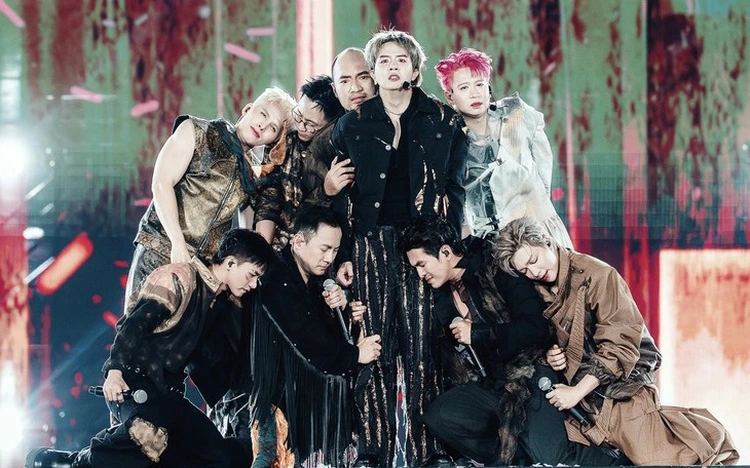
The ‘Anh Trai Vuot Ngan Chong Gai’ (Call Me by Fire) concert series, based on a reality television music competition featuring established male entertainers, has attracted tens of thousands of attendees each night. Photo: Producer
Vietnamese consumers are allocating an increasing share of their budgets to entertainment, reflecting a broader shift in cultural consumption habits.
Nguyen Thi Thanh Thuy, deputy director of the Ho Chi Minh City Department of Culture and Sports, once observed, “A nation is not strong only because of its ability to produce steel, electricity or technology.”
“In the 21st century, strength is also measured by the ability to create films, music, games, and stories that its own people are willing to pay for."
Today, cultural industries are no longer solely a sector serving spiritual and cultural needs.
They are increasingly becoming one of the new drivers of the creative economy, helping enhance national soft power while generating growing economic value, according to National Assembly deputy Bui Hoai Son.
Rise of spending on entertainment
In an interview with Tuoi Tre (Youth), music producer Huy Tuan recalled that organizers in Vietnam once approached concert production with caution because they feared low attendance.
In 2022, a My Tam concert that drew 30,000 people to My Dinh National Stadium in Hanoi surprised many industry insiders. My Tam is a pop icon in Vietnam.
Over the past two years, however, the concert market has shown encouraging signs, laying the groundwork for what could become a new industry.
“Vietnam has a new audience that is very different from previous generations. They are young, willing to spend, and highly responsive to trends,” Huy Tuan said.
Programs such as 'Anh Trai Vuot Ngan Chong Gai' (Call Me by Fire), 'Anh Trai Say Hi,' and live concerts by My Tam and singer-songwriter Ha Anh Tuan have repeatedly set attendance records.
Even solo concerts by younger artists such as Grey D and Phung Khanh Linh have sold out quickly, prompting organizers to add second nights beyond their original plans.
The popularity of concerts over the past two years shows that tens of thousands of attendees are willing to spend anywhere from several hundred thousand Vietnamese dong to tens of millions of dong on tickets alone, not to mention travel, accommodation, merchandise, and related expenses.
According to the Vietnam Music Industry Overview 2025-26 report recently published by RMIT University Vietnam, more than 50 percent of listeners are willing to spend VND50,000-200,000 (US$1.9-7.6) on paid music subscriptions.
Fans are also willing to spend VND200,000-500,000 ($7.6-20) on artist-branded products.
Merchandise spending is even higher, with 33.2 percent spending VND500,000-1 million ($20-38) and 22.9 percent spending more than VND1 million.
Cinema is also becoming a routine entertainment expense for Vietnamese consumers.
At a strategic partners conference in March, CGV Vietnam, the country’s largest cinema chain, said total box-office revenue reached VND5.593 trillion ($215 million) in 2025, up 24 percent from the previous year.
Compared with the pre-pandemic period in 2019, the figure was more than 35 percent higher.
The record revenue was driven by more than 70 million movie tickets sold.
Movie ticket prices in Vietnam vary depending on theater segment, audience group, screening time, and viewing format, averaging roughly VND60,000-120,000 ($2.3-4.6).
Multiplied by 70 million tickets, the figures provide a sense of the scale of consumer spending on cinema.
Vietnam has surpassed Thailand to become Southeast Asia’s second-largest film market after Indonesia, which generated more than $300 million in box-office revenue.
Globally, Vietnam ranks roughly between 20th and 25th in market size.
The box-office performance of films such as 'Mua Do,' 'Tu Chien Tren Khong,' and 'Dia Dao,' which draw on Vietnamese historical and military themes, along with a growing list of local blockbusters surpassing the VND100 billion revenue mark, suggests that audiences are not only seeking entertainment but are also willing to pay for high-quality domestic productions.
That demand has encouraged local filmmakers to become increasingly active, with 25-26 Vietnamese films released since January 2026.
At the same time, the subscription economy is expanding rapidly.
Many younger consumers are choosing to pay for smoother user experiences instead of relying on free services.
Spotify, Netflix, YouTube Premium, Apple Music, and domestic streaming platforms such as VieON, FPT Play, and Galaxy Play are becoming recurring household expenses in many urban families.
Most recently, HBO Max officially entered the Vietnamese market, underscoring the country’s attractiveness to international streaming providers.
If movies and concerts represent the visible side of the entertainment economy, gaming is the much larger force beneath the surface.
According to Statista and Newzoo, Vietnam’s gaming market generates roughly $700 million annually, making it one of the largest in Southeast Asia.
DataReportal and Statista estimate that Vietnam has more than 50 million gamers, placing it among the region’s largest gaming communities.
From students to office workers, millions of Vietnamese consumers spend money on digital items, battle passes, skin, and in-game services.
This is among the clearest examples of how digital entertainment has become an integral part of the economy.
Entertainment no longer a discretionary expense
Cultural spending once ranked behind essential household needs. Today, that dynamic has changed.
The growth of cultural industries is closely linked to urbanization, digital transformation, and the rise of a new generation of consumers.
Pham Huy Quang, acting rector of Ho Chi Minh City University of Theater and Cinema, said entertainment activities are increasingly becoming part of everyday lifestyles rather than simply a way to pass time after work.

‘Mua Do,’ a film based on the 1972 Battle of Quang Tri, one of the bloodiest campaigns during Vietnam’s wartime, set a Vietnamese box-office record with revenue exceeding VND700 billion ($26.9 million), according to Box Office Vietnam. Photo: The producer
Generation Z, those born roughly between 1997 and 2012, and millennials, born between 1981 and 1996, are leading this new spending trend.
A concert is no longer merely about watching a singer perform. It is also an opportunity to connect with fan communities, create social media content, and participate in a symbolic cultural event.
Similarly, owning a Spotify or Netflix subscription is not simply about listening to music or watching films. It is increasingly associated with a digital lifestyle that has become a standard among younger middle-class consumers.
From an economic perspective, these seemingly small entertainment expenses are helping form a market worth billions of dollars.
Industry stakeholders increasingly recognize that film, music, television, digital content, software, and gaming are becoming critical components of Vietnam’s cultural industry ecosystem.
A movie ticket, a Spotify subscription, or a concert ticket may appear to be a personal expense.
At the scale of millions of consumers, however, they become a source of revenue for businesses, jobs for workers, and value added for the broader economy.
As Vietnamese consumers become increasingly willing to spend on films, music, games and digital products, the question is no longer simply how much people spend on entertainment.
It is a sign that an entertainment economy is taking shape, one in which culture is not only consumed but also serves as a new engine of national growth.
Demand for domestic content continues to grow
Recent years have seen a notable shift in audience behavior, with consumers increasingly willing to support products made in Vietnam.
In cinema, Vietnamese films have become the industry’s main growth driver.
According to Jeong Ji Young, CEO of CGV Vietnam, local films accounted for just 25 percent of total box-office revenue in 2016 but rose to 62 percent in 2025.
In music, the contrast is equally striking.
Three years ago, BlackPink’s two ‘Born Pink’ concerts in Hanoi attracted more than 67,000 attendees and generated $13.66 million in revenue, according to Touring Data.
Just one year later, however, the domestic concert market surged with 'Anh Trai Vuot Ngan Chong Gai,' 'Anh Trai Say Hi,' and a growing series of live music events drawing increasingly larger audiences.
Attendance has risen from roughly 25,000-35,000 people per night in the early stages to around 50,000 today.
Attracting between 20,000 and 50,000 attendees per concert is no longer considered beyond the reach of Vietnam’s domestic entertainment market.








Max: 1500 characters
There are no comments yet. Be the first to comment.