


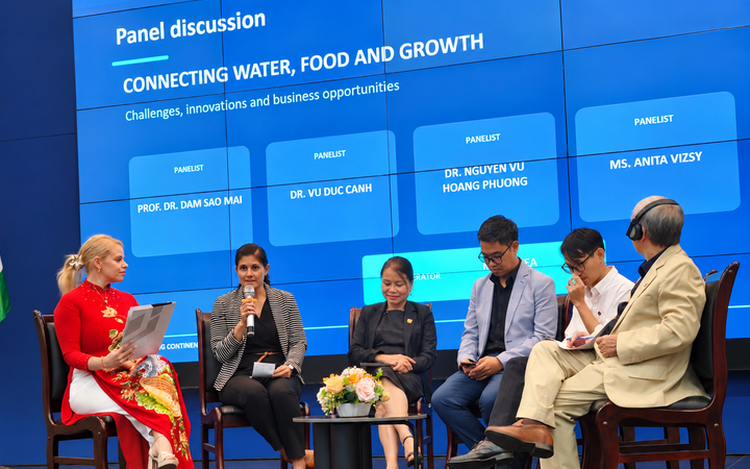
Water experts from Vietnam and Europe discuss at a workshop in Ho Chi Minh City, September 14, 2026. Photo: Trong Nhan / Tuoi Tre
Water is an area in which Hungary has extensive technological expertise and significant potential for expanded cooperation with Vietnam, Gabor Lehocz, Consul General of Hungary in Ho Chi Minh City, told the Connecting Continents 2026 workshop held at Hung Vuong University in Ho Chi Minh City on Monday.
The workshop, co-organized by the university, the Hungarian Water Partnership (HWP) and the Consulate General of Hungary in Ho Chi Minh City, centered around water, food and sustainable solutions.
Hungarian companies offer solutions covering drinking-water, wastewater and groundwater treatment, the removal of specific pollutants, decentralized water treatment and water-system management, he said.
He shared that the Hungarian side desires to work with Vietnamese partners to identify specific water-related challenges, test technologies under real-world conditions, and then assess their potential for technology transfer and wider deployment.
Businesses, universities, researchers and water-sector organizations could all participate in the process.
Recent cooperation programs between the HWP and several Vietnamese universities have been developed along similar lines, combining technology with research and training.
Students, lecturers and researchers can participate in pilot projects, exchange technical expertise, undertake internships and gain direct exposure to Hungarian technologies.
Hungary also sees Vietnam as a potential gateway for developing relationships with other Southeast Asian markets if cooperation models established in Vietnam prove successful.
Robert Forintos, co-chairman of the HWP, said the HWP currently connects more than 40 members and strategic partners across the water sector.
In Vietnam, the HWP sees high demand for technologies addressing arsenic removal, decentralized water treatment, wastewater reuse, flood management and drainage, saline-water treatment and securing water supplies amid climate change.
One technology showcased at the workshop was AsMET, an adsorbent material designed to remove arsenic in both its trivalent and pentavalent forms.
The material can be regenerated for continued use and integrated into the PurAID system, which provides a complete solution to remove iron, manganese, ammonia, arsenic, boron and iodine and infections from drinking water in five steps.
A PurAID unit can treat up to 10,000 liters of water per day and can operate on either grid electricity or solar power, making it suitable for areas without fully developed centralized water-supply systems.
Multiple units can also be connected into clusters and monitored through a centralized system.
According to the HWP, AsMET and PurAID were tested in Hanoi in 2024 at a capacity of around 10 cubic meters per day over six months.
The system achieved an arsenic removal rate of more than 95 percent.
Previously, a company within the HWP network also participated in a water-treatment plant in Quang Tri Province, north-central Vietnam, with a capacity of 10,000 cubic meters per day, using river water as its source.
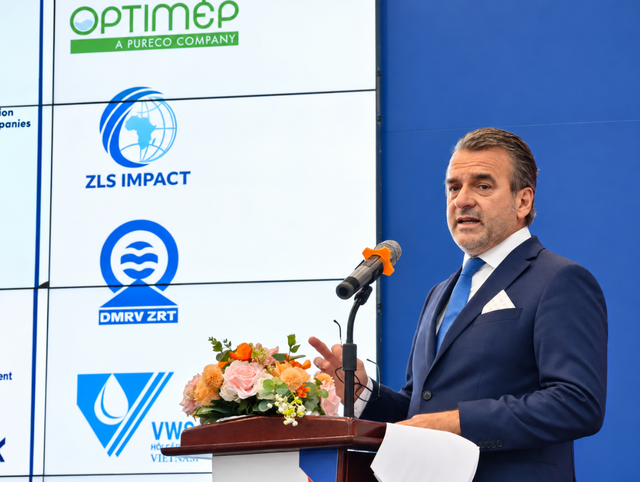
Robert Forintos, co-chairman of the HWP. Photo: Trong Nhan / Tuoi Tre
Urban water demand could reach 22 million cubic meters a day
Vietnam currently has more than 1,000 water-supply plants and stations, with a combined capacity of some 13.2 million cubic meters per day, said Prof. Dr. Tran Duc Ha from East Asia University of Technology.
Urban water demand alone is forecast to rise to 20-22 million cubic meters per day by 2030 from around 12 million cubic meters per day in 2025.
Ha said the pressure on Vietnam’s water sector is not simply a matter of increasing treatment capacity.
Source-water quality is creating demand for technologies capable of addressing a broad range of contaminants, including arsenic, manganese, ammonia, salinity, microorganisms and organic compounds, as well as emerging contaminants such as antibiotics, persistent organic pollutants (POPs) and PFAS.
This means water-treatment plants will need greater capacity for advanced treatment while strengthening quality control from water sources through to distribution networks.
In addition, more water utilities are beginning to adopt SCADA, GIS, smart meters and sensors.
Technologies including the Internet of Things (IoT), artificial intelligence, digital twins, remote sensing and early-warning systems are also expected to see wider application in the coming years.
Vietnam also needs to develop solutions for saline-water treatment and wastewater reuse, reduce water losses and adopt water-supply models tailored to the needs and conditions of individual regions in order to meet rapidly growing demand through 2030, Ha said.








Max: 1500 characters
There are no comments yet. Be the first to comment.