


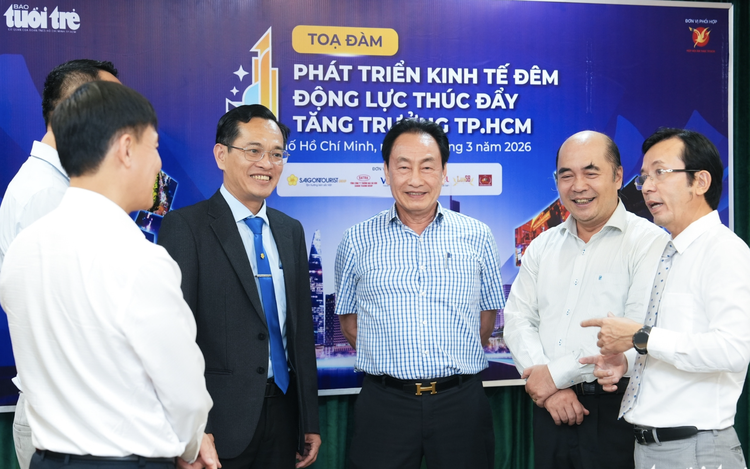
Experts discuss before a thematic seminar titled 'Nighttime Economy: Driving Growth in Ho Chi Minh City' in Ho Chi Minh City, March 25, 2026. Photo: Huu Hanh / Tuoi Tre
These issues were at the center of a thematic seminar titled 'Nighttime Economy: Driving Growth in Ho Chi Minh City,' jointly organized by Tuoi Tre (Youth) newspaper and the Ho Chi Minh City Food Association in the southern metropolis on Wednesday.
The event was held to support the implementation of Decision No. 1129, issued by the government, which aims to develop the nighttime economy, unlock new growth opportunities, and improve incomes and living standards.
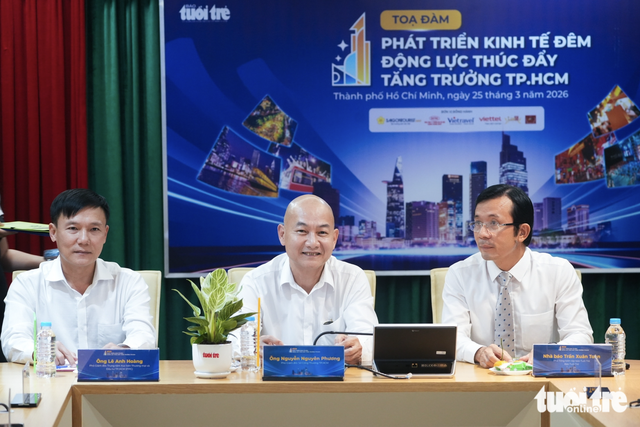
Nguyen Nguyen Phuong (C), deputy director of the Ho Chi Minh City Department of Industry and Trade, Le Anh Hoang (L), deputy director of the Ho Chi Minh City Investment and Trade Promotion Center, and Tran Xuan Toan, deputy editor-in-chief of Tuoi Tre (Youth) newspaper. Photo: Huu Hanh / Tuoi Tre
Untapped potential, persistent bottlenecks
Speaking at the seminar, Deputy Editor-in-Chief of Tuoi Tre (Youth) newspaper Tran Xuan Toan noted that the city’s growth is anchored in three pillars, including consumption, exports, and investment.
The nighttime economy could provide a major boost to consumption while generating spillover benefits for tourism, services, and capital inflows, he said.
With its expanded urban space and a growing influx of visitors, Ho Chi Minh City has ample room to develop nighttime activities.
However, the evening economy should not be narrowly defined by food, entertainment, and nightlife.
Instead, it must encompass tourism promotion, diversified services, and retail stimulation.
Nguyen Nguyen Phuong, deputy director of the municipal Department of Industry and Trade, said that the strategy for developing the night economy has been consistently guided from the central to local levels.
However, when it comes to practical implementation, the primary bottleneck lies in the organization and execution stage.
Currently, no agency has been clearly designated to take overall responsibility for coordinating nighttime economic activities across the city.
Although initial roles have been assigned, the operational mechanism remains unclear and ineffective, resulting in a lack of the coordinated implementation of proposals and initiatives from businesses and local authorities.
Numerous plans and programs have been drafted, yet relatively few have translated into successful models.
The problem lies not in a shortage of ideas or private-sector resources, but in institutional bottlenecks, particularly regulatory and legal constraints.
One major issue is the absence of a clear legal distinction between daytime and nighttime economic activities.
Sectors central to the nighttime economy such as food services, entertainment, and alcohol-related businesses are still governed by regulations designed for daytime operations, limiting their flexibility and growth.
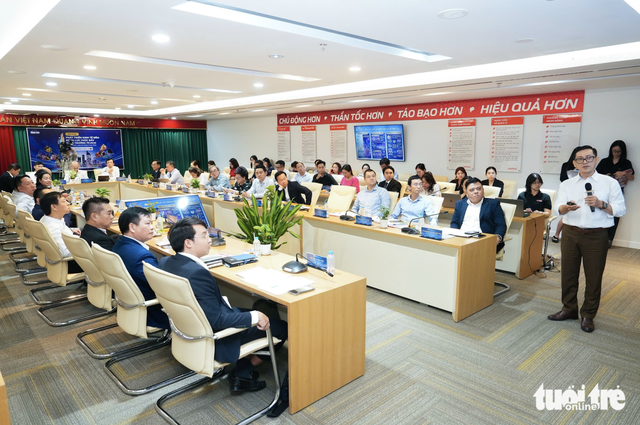
Assoc. Prof. Dr. Dinh Tien Minh shares a comprehensive perspective on the development of Ho Chi Minh City’s nighttime economy. Photo: Huu Hanh / Tuoi Tre
Building holistic, distinctive nighttime economy
“Developing the nighttime economy is not just a commercial challenge, it is a question of organizing modern urban life,” said Associate Professor Dr. Dinh Tien Minh from the School of Business under the University of Economics Ho Chi Minh City.
He argued that the nighttime economy must be understood through three interconnected dimensions: economic, cultural, and social.
Reducing it to extended business hours reflects a narrow and ultimately ineffective approach.
“If the nighttime economy is seen merely as staying open later to sell more, the approach is far too narrow,” he stressed.
Instead, cities should treat the evening economy as a comprehensive urban experience ecosystem that includes spatial planning, experience design, public safety, nighttime transportation, environmental management, cultural programming, and urban branding.
If properly developed, the nighttime economy can lengthen tourist stays, increase nighttime spending, attract investment in service industries, create jobs, and improve returns on existing urban infrastructure.
Ho Chi Minh City holds clear advantages.
As Vietnam’s largest economic, commercial, and tourism hub, it boasts vibrant urban life, strong purchasing power, and high demand for entertainment.
It also benefits from rich cultural, artistic, and culinary resources, alongside a dual customer base of both residents and tourists.
Despite this dynamism, the city’s nighttime economy remains fragmented.
While offerings may appear diverse, they are often repetitive and lack distinct identity.
Planning remains inconsistent, activities are scattered and small-scale, and there is insufficient integration between different functions and zones.
Challenges also include public safety concerns, noise pollution, waste management, and risks such as counterfeit goods.
Meanwhile, risk control mechanisms are still underdeveloped.
Besides, the absence of a dedicated coordinating body and weak inter-agency collaboration have made it difficult to achieve breakthroughs.
In addition, perceptions of the nighttime economy remain inconsistent, often skewed toward control rather than innovation, creating policy barriers that stifle creativity.
Perhaps most critically, while Ho Chi Minh City is undeniably lively at night, it lacks a clear and recognizable identity.
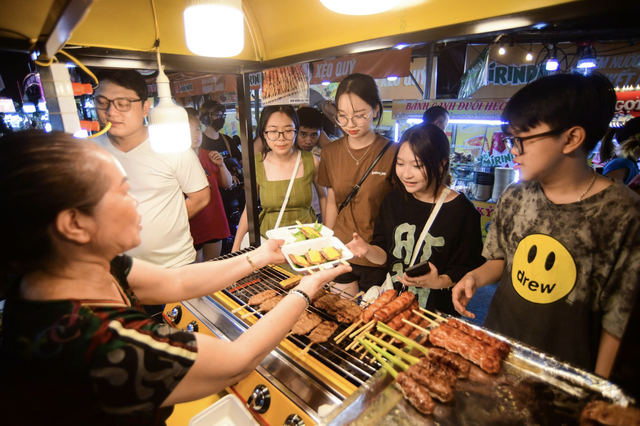
The nighttime economy needs to offer a variety of products, experiences, and spending levels to cater to different segments of international visitors. Photo: Quang Dinh / Tuoi Tre
Learning from global models
International experience suggested that successful nighttime economies rely on dedicated management bodies, thematic planning, and strong links to local culture.
Product diversification is equally important.
Beyond dining and entertainment, the city should invest in nighttime cultural performances, guided night tours, themed pedestrian streets, open public spaces, and integrated infrastructure systems.
Another main factor is foundational infrastructure, including transport, lighting, security, and accessibility.
Above all, experts stressed, the nighttime economy must be rooted in local cultural identity to create unique values and competitive advantages.
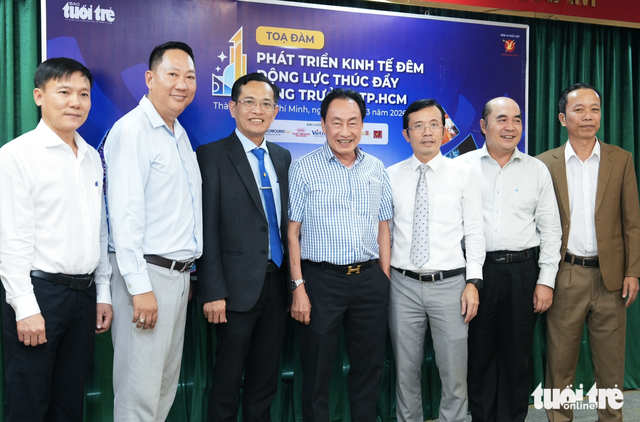
Representatives at the seminar. Photo: Huu Hanh / Tuoi Tre
Nighttime Economy: Driving growth in Ho Chi Minh City
To identify bottlenecks and unlock resources for the nighttime economy, Tuoi Tre (Youth) newspaper and the Ho Chi Minh City Food Association co-hosted a thematic seminar titled 'Nighttime Economy: Driving Growth in Ho Chi Minh City' on Wednesday in Ho Chi Minh City.
The event was held as the city is drafting a special urban law and a resolution on specific policy mechanisms, creating opportunities for the city to proactively plan, attract investment, and develop its evening economy.
The seminar brought together government officials, policymakers, leading economists, the Ho Chi Minh City Food Association, and representatives of major companies such as Saigontourist Group, Vietravel, Satra, and Viettel.
Discussions focused on spatial planning, diversifying culturally distinctive arts and entertainment products, and gathering direct feedback from businesses on policies for developing the nighttime economy.
The event was expected to showcase successful international models and propose effective pilot roadmaps, helping position the night economy as a new growth engine for the city.









Max: 1500 characters
There are no comments yet. Be the first to comment.