


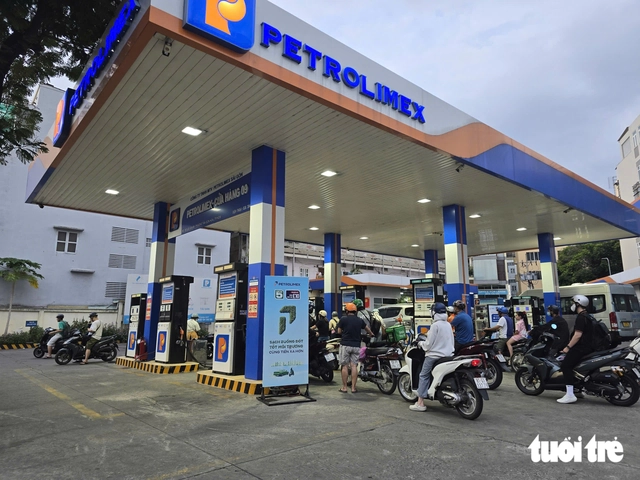
Granting fuel traders the authority to adjust retail prices could mak fuel prices in Vietnam more responsive to market movements, but it may also expose consumers to greater price volatility. Photo: Cong Trieu / Tuoi Tre
Experts said the proposed change would affect not only fuel businesses but also consumers, while requiring stricter state oversight of the petroleum market.
Consumers could benefit from competition under fuel pricing reform
One expected benefit is that domestic fuel prices would track global market movements more closely.
Under the proposal, businesses would be able to adjust retail prices more flexibly instead of waiting for the government's fixed price adjustment schedule.
Experts said this could narrow the gap between domestic and international fuel prices and reduce the risk of fuel stations suspending sales or withholding supplies because regulated prices no longer cover operating costs.
A fuel distributor in Ho Chi Minh City told Tuoi Tre (Youth) online news paper that allowing businesses to set retail prices would introduce greater competition in both pricing and service quality.
The distributor said retail fuel prices would become more varied instead of remaining largely uniform across gas stations.
Consumers would be able to choose stations offering lower prices, while businesses that reduce operating costs would have greater room to cut retail prices to attract customers.
A representative of a fuel retailer in Dong Nai Province told Tuoi Tre that giving businesses pricing authority would also encourage improvements in customer service.
The representative said retailers would have to improve both service quality and product standards to retain customers.
He added that reducing intermediary stages in the fuel distribution chain could lower retail prices and benefit consumers.
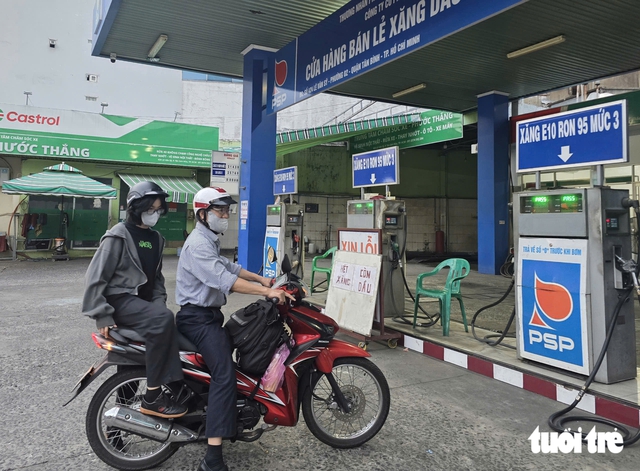
An expert has proposed setting regulated profit margins for fuel businesses in Vietnam instead of fully liberalizing prices for the essential commodity. Photo: Cong Trieu / Tuoi Tre
Expert backs profit margin mechanism instead of full price liberalization
The draft decree also proposes consumer protection measures for remote and mountainous areas.
Under the proposal, retail fuel prices in those areas would not be allowed to exceed the highest price announced by the lead fuel trader operating in the locality.
The measure is intended to ensure equitable access to fuel and support social welfare in disadvantaged areas.
Pham Viet Thuan, director of the Ho Chi Minh City Institute of Resources Economics and Environment, offered a different view.
Thuan said profit remains the primary objective of businesses.
He said Vietnam could not relax state management of essential commodities such as gasoline because of its socialist-oriented system.
Thuan said businesses should not be given unrestricted authority to set fuel prices.
He said businesses should not be given full authority to set fuel prices because doing so could fuel inflation and run counter to the country's development goals.
Instead, Thuan proposed that the government regulate allowable business costs and profit margins rather than allowing full price liberalization.
Thuan proposed a reasonable profit margin of about 14 percent per year on total investment or a fixed percentage for each liter of fuel sold.
He said the mechanism would allow businesses to maintain operations without creating excessive profits at consumers' expense.
"The calculation is based on the average bank interest rate of around 8.6 percent plus an appropriate margin. If profits reach 17 percent, they could be considered excessive," Thuan said.
Another expert told Tuoi Tre that granting businesses greater pricing authority would not mean reducing state oversight.
The expert said consumers would benefit only if regulators effectively prevented businesses from colluding to manipulate prices or maintain high retail price levels.
Businesses would be required to declare fuel prices and notify regulators after each adjustment.
The government would continue publishing standard business cost components used in the pricing formula to facilitate supervision and ensure market transparency, the expert said.
The Ministry of Industry and Trade is seeking public comments on a draft decree that would replace Decree 83 and other regulations governing petroleum trading.
The draft proposes a market-oriented pricing mechanism that would give businesses greater flexibility in setting retail prices while strengthening their accountability and regulatory supervision.
Under the proposal, the government would no longer announce a benchmark fuel price on a fixed weekly schedule.
Instead, fuel wholesalers and distributors would determine and announce retail prices within their distribution networks based on a pricing formula specified in the decree.
Businesses would be required to declare new prices and notify regulators after each adjustment.
The government would continue announcing only one pricing component, the standard business cost, to serve as the basis for supervision and help prevent unreasonable price increases.








Max: 1500 characters
There are no comments yet. Be the first to comment.