


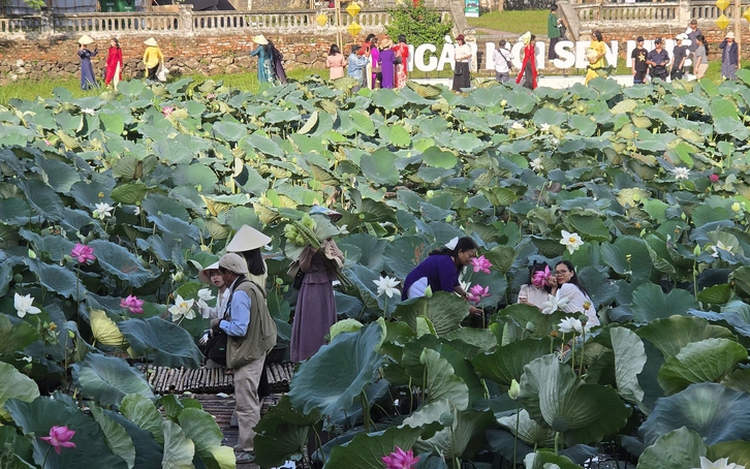
Visitors admire lotus flowers during Hue Lotus Festival 2026 in Hue City, central Vietnam. Photo: Thai Loc / Tuoi Tre
This year’s lotus crop has been especially abundant, drawing crowds eager to admire the blossoms, photograph the scenery, and sample the famed lotus seeds long associated with Hue’s royal heritage.
“A single pot of lotus seeds from Tinh Tam Lake fills an entire room with fragrance," said Ho Thi Hoang Anh, a royal cuisine artisan.
“It is a flavor that seems to make memories even more beautiful as time passes."
A lotus lake that captivates visitors
Arriving at Tinh Tam Lake shortly after sunrise, visitors are greeted by a tranquil landscape of broad lotus leaves and white blossoms stretching across the water.
The scent of lotus drifts through the cool morning air as elderly residents exercise along the paths, while groups of young people and women in traditional 'ao dai' gather to take photographs among the flowers.
Others spend hours relaxing beneath bamboo shelters on Bong Lai Islet, sipping tea while overlooking the lake carpeted with lotus blossoms.
Duong Dan, a lotus grower at Tinh Tam Lake, said this year’s lotus has flourished beyond expectations, producing unusually large flowers and leaves.
According to Le Cong Son, deputy director of the Hue Monuments Conservation Center, last year's major flooding was the key reason behind the exceptional bloom.
The floodwaters flushed out years of accumulated pollution and deposited a rich layer of sediment across the lakebed, creating what Son described as 'new ground' that lotus plants naturally thrive in.
“The royal white lotus is highly sensitive to poor water quality. Even slight pollution can keep it from surviving," Son said.
“But this year, after the water was naturally cleansed, the flowers all came into bloom at once."
A genuine lotus trail has emerged across Hue, stretching from the moat below the Hue Flag Tower to the lakes within the Imperial City and the Citadel, where lotus blossoms are drawing visitors from one site to the next.
Enduring aroma of a legendary lotus seed
The uniqueness of Tinh Tam lotus cannot be told without recalling stories from a bygone era, many of which have been preserved in the memories of cultural researcher Tran Dinh Son.
When Son was a young boy, Tinh Tam lotus seeds were considered one of Hue’s most prized seasonal delicacies, reserved almost exclusively for the aristocracy of the former imperial capital.
He still remembers his great-grandmother, the wife of a high-ranking Nguyen Dynasty court official, waiting each lotus season for lotus vendors to pass by before calling them over.
Wearing her reading glasses, she would carefully inspect each reddish-brown lotus seed before making her selection.
Instead buying them by the kilogram, as consumers often do today, she would purchase only 50 or 100 seeds, just enough for ancestral offerings or to serve distinguished guests.
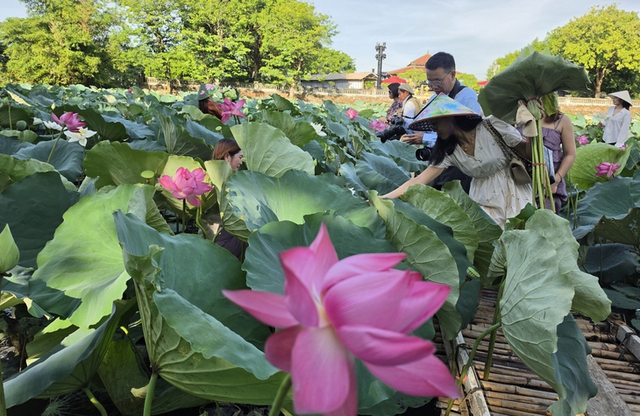
Visitors admire lotus flowers at Tinh Tam Lake in Hue City, central Vietnam. Photo: Thai Loc / Tuoi Tre
Tinh Tam lotus seeds are small and nearly round, about the size of a longan seed, unlike those grown elsewhere, whose seeds typically have pointed ends.
Most are distinguished by their characteristic reddish-brown color, known locally as ‘canh gian.’
When cooked, the seeds become naturally soft and creamy, with a delicate fragrance.
Hue connoisseurs could often identify their origin by taste, asking whether the lotus had come from Tinh Tam Lake, the lakes within the Imperial Citadel, the royal tomb lakes, or village ponds nearby.
The exceptional quality of Tinh Tam lotus once brought prestige to the communities that cultivated it.
Historical accounts say that several villages in Hue produced the finest lotus, which supplied the imperial court directly, with their harvest presented to the senior royal women at Dien Tho Palace.
Royal cuisine artisan Ho Thi Hoang Anh, Tran Dinh Son’s wife, said the exceptional quality of Tinh Tam lotus is best reflected in the preparation of traditional royal-style candied lotus seeds.
She said the confection required remarkable precision.
After steaming, each lotus seed was carefully carved by hand so that, as it absorbed sugar, it opened into four delicate petals.
The finished sweet was coated with a dry layer of crystallized sugar while remaining soft, fragrant, and tender inside.
Lotus grown elsewhere often produces larger seeds but lacks the same fragrance, she said, prompting cooks to add ingredients to soften them during cooking.
Hue lotus, particularly the variety grown at Tinh Tam Lake, stands apart for its naturally tender texture and refined aroma.
Preserving centuries-old heritage
According to cultural researcher Doan Van Quynh, Hue’s harsh climate is one reason for the distinctive quality of its lotus.
Long periods of intense heat followed by heavy seasonal rains encourage the plants to concentrate nutrients and essential oils rather than producing excessive foliage, resulting in richer flavor and fragrance.
Several theories trace the origins of Hue’s lotus to varieties brought from the Mekong Delta or northern Vietnam during the Nguyen Lords’ rule.
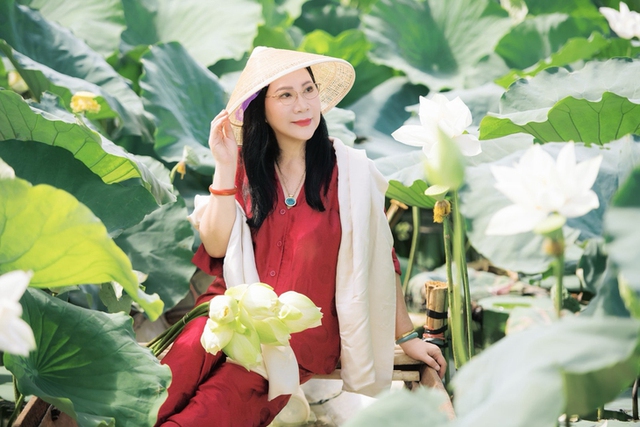
Royal cuisine artisan Ho Thi Hoang Anh visits Tinh Tam Lake during Hue’s lotus season. Photo: Supplied
Regardless of its origins, the plant was gradually selected and cultivated into the royal lotus variety closely associated with the imperial court.
This year’s Hue Lotus Festival 2026, themed ‘Ngu Lien Thuc Thuy,’ (Royal Lotus Awaken the Water), has become the centerpiece of the city’s lotus season.
Held at Tinh Tam Lake, the festival features the Thuc Thuy Show, combining lighting, music, and royal-inspired cuisine on the historic lake.
Visitors can also participate in traditional lotus tea making, lotus-leaf hat crafting, and paper lotus workshops.
The return of the royal white lotus follows years of efforts by Le Cong Son and Nguyen Thi Hue, director of Hue Viet Organic Company, who searched temples and the tomb complex of Emperor Gia Long, the Nguyen Dynasty’s first emperor, to recover surviving heritage lotus varieties.
Cultural and historical researcher Doan Van Quynh believes restoring lotus to Tinh Tam Lake alone is not enough.
The former royal garden, ranked by Emperor Thieu Tri, the third emperor of the Nguyen Dynasty, among the capital’s most celebrated scenic sites, deserves a comprehensive study to restore its historic plant ecosystem, he said.
Such an effort should follow traditional principles that shaped royal garden design, including the concepts of yin and yang, the Five Elements, the I Ching, and traditional views of humanity’s relationship with nature and the universe.
Quynh said vegetation on the lake’s islands and the Kim Oanh embankment should also be replanted.
He proposed planting longan, Alexandrian laurel, and dracontomelon trees on the eastern side of the lake; weeping willows and red-flowering paperbark trees on the western side; palmyra palms to the south; and Alexandrian laurel, cluster fig, and soapberry trees to the north.
He also called for dredging parts of the lake to expand lotus cultivation, while creating separate sections for water lilies and water chestnuts to help improve water quality.
Other open-water areas should be left undisturbed to provide habitat for fish and other aquatic life.








Max: 1500 characters
There are no comments yet. Be the first to comment.