


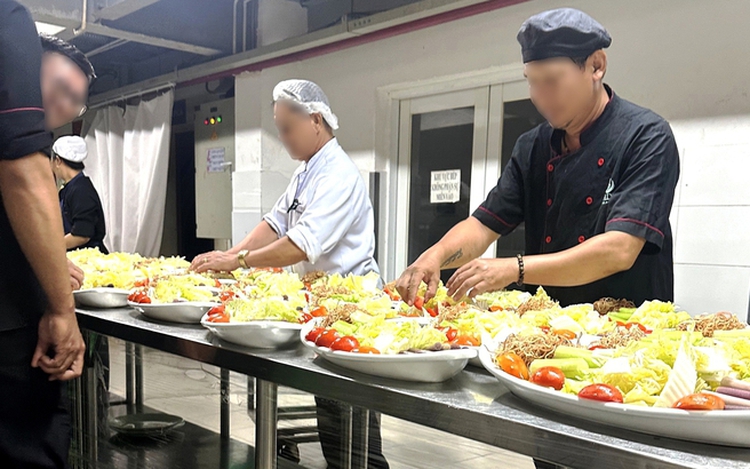
Staff members prepare food without wearing gloves at a conference and wedding banquet center in Ho Chi Minh City. Photo: Thao Thuong / Tuoi Tre
From roadside eateries to luxury restaurants and banquet halls, food safety risks remain widespread as some operators prioritize profits over oversight.
Recent incidents have exposed systemic weaknesses, raising doubts about the effectiveness of current licensing and inspection regimes.
The risks have been highlighted by several serious cases, including the discovery of 130 metric tons of pork contaminated with African swine fever at a warehouse linked to Ha Long Canned Food JSC and a network that allegedly distributed hundreds of metric tons of tainted noodles in Ho Chi Minh City over several years.
In December 2024, two people died and 15 others were hospitalized in Hanoi after attending a banquet at a conference center, underscoring the potentially fatal consequences of food safety failures.
Gap between safety rules and practice
Food safety violations are not limited to informal eateries. Even diners in upscale restaurants may be unaware that serious hygiene breaches occur behind the scenes.
Nguyen Huu Huong, head of the tourism and hospitality department at FPT Polytechnic College in Ho Chi Minh City, said his experience across both budget and five-star establishments shows a persistent gap between written procedures and actual practice.
Although restaurants and catering services are required to obtain food safety certificates, compliance in daily operations often falls short.
Staffing and training remain among the weakest links.
Large banquet venues frequently rely on temporary workers with little or no formal instruction in food hygiene, a shortcut often tolerated amid labor shortages. Even high-end hotels may scale back training to cut costs.
Profit pressure is a key driver.
Properly handling large-scale events requires high-capacity dishwashing systems and strict sanitation processes, but meeting such standards demands investment and effort that some operators are unwilling to make.
Ingredient control challenges beyond licensing
Former food safety inspectors in Ho Chi Minh City say cases such as the ‘Ha Long canned food’ scandal show how difficult it is to control ingredient quality, particularly for small and medium-sized operators.
Financial pressure can disrupt supplier consistency, increasing the risk that substandard or contaminated ingredients enter restaurant kitchens.
Experts warn that even a single lapse at the procurement stage can compromise an entire operation as risks multiply through sourcing, processing, storage, and service.
Lawyer Le Thi Kim Ngan of the Hanoi Bar Association said food safety is not only about protecting consumers’ health but also Vietnam’s image as a safe destination.
Yet food safety certificates do not always reflect actual hygiene standards, making stricter post-licensing supervision and inspections essential.
Repeated violations across multiple stages, she noted, point to systemic weaknesses, poor management, and a business mindset that fails to put customer safety first.
Stronger enforcement needed
Lawyer Tran Minh Hung of the Ho Chi Minh City Bar Association said Vietnamese law clearly defines responsibility in food safety incidents, particularly those involving food poisoning, with liability extending from frontline workers to business owners.

A patient receives emergency treatment at Bach Mai Hospital in Hanoi after suffering food poisoning at a banquet held at a local conference center. Photo: Bach Mai Hospital
Recent cases involving contaminated pork products and food poisoning at both casual and high-end eateries underscore the need to trace responsibility back to operators rather than shifting blame to temporary or frontline staff.
Even when seasonal workers are hired, owners remain fully accountable for staff training, supervision, and food safety procedures, Hung said.
Food safety certificates or business licenses do not exempt establishments from liability. Failure to control staff or comply with mandatory processes can result in administrative penalties or criminal prosecution, depending on the severity of the outcome.
Consumers, however, still face major hurdles in seeking compensation due to complex supply chains, delayed evidence collection, and high legal costs.
Hung noted that existing penalties are often too light to deter violations compared with the profits gained from cutting corners.
To strengthen deterrence, he called for stricter post-licensing inspections, tougher sanctions targeting business owners, and greater transparency through public disclosure of violators.
Consistent detection, punishment, and disclosure of violations, he said, would increase compliance pressure and offer better protection for consumers.








Max: 1500 characters
There are no comments yet. Be the first to comment.