


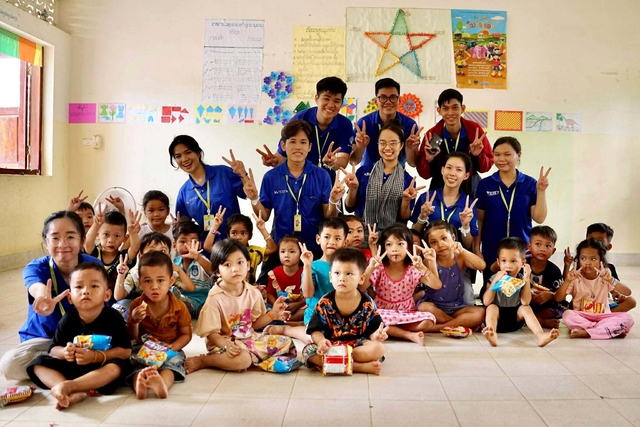
Coppy Philavanh (back row, right) poses with fellow students from Ho Chi Minh City during a summer volunteer campaign in Laos. Photo: Do Khai
Among them is Coppy Philavanh, a 24-year-old medical student from Pakse in southern Laos, who greets classmates and patients alike in a white lab coat and fluent Vietnamese tinged with a southern accent.
He arrived in Ho Chi Minh City at 18 under a Vietnam–Laos medical training cooperation program, drawn by Vietnam's strong emphasis on hands-on clinical education.
Medical studies are demanding anywhere, but studying medicine in a foreign language nearly pushed him to quit.
Specialized terminology felt overwhelming at first, he said, but patient instruction from lecturers and help from Vietnamese classmates gradually eased the transition.
Today, Philavanh confidently checks blood pressure and speaks gently with patients during volunteer medical trips, crediting Vietnamese doctors' dedication for reaffirming his choice.
"When it gets exhausting, I remember why I started," he said.
"Seeing how Vietnamese doctors care for people made me believe I chose the right path."
Language as a bridge
If Philavanh came to Vietnam for medicine, Zheng Xin Xin, a 20-year-old student from Chaozhou in China's Guangdong Province, came for the language.
A Vietnamese-language major at Guangxi University for Nationalities, he is currently on exchange at the University of Social Sciences and Humanities in Ho Chi Minh City.
His daily routine is strict: mornings in class, afternoons self-studying in cafés, evenings walking around the dormitory while practicing listening and speaking.
He avoids part-time work to focus entirely on Vietnamese, a language he describes as "rich and beautiful," and hopes to become a professional Chinese–Vietnamese interpreter.
Formal linguistics courses have tested his limits, he said, particularly literary Vietnamese with its layered meanings.
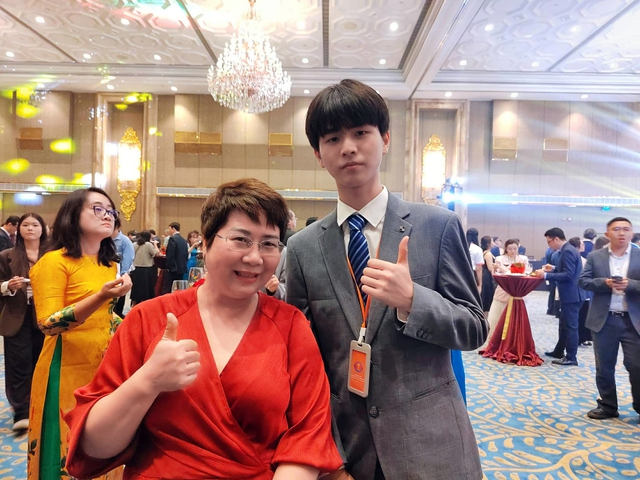
Zheng Xin Xin (R) is pictured with Vietnamese literary translator Nguyen Le Chi in Ho Chi Minh City, Vietnam. Photo: Supplied
But immersion beyond textbooks has helped, from conversations with street vendors to chats with motorbike taxi drivers.
"Language lives in everyday life," he said.
"To be good at Vietnamese, you have to live like a Vietnamese person."
A welcoming country
Another student, Salsabilla Meyrianti, 22, from Riau in Indonesia, arrived in Vietnam through an exchange program at the University of Economics and Finance in Ho Chi Minh City to study import-export management.
She had expected an emerging economy; instead, she said, she was most struck by everyday warmth.
Despite wearing a hijab, she said she felt immediately welcomed.
"People smiled and said hello naturally," she recalled, easing her initial anxiety.
She quickly developed a taste for Vietnamese food, from ‘bun bo Hue’ (Hue-style spicy beef noodles) to vegetable-heavy home-style meals, which she said felt lighter than the oil-rich cuisine she grew up with.
Wearing the hijab in Vietnam, she said, has been a personal commitment to her faith and identity, one she feels is respected.
"People may look with curiosity, but it's friendly, not judgmental," she said.
Vietnam's appeal to international students is reflected in numbers.
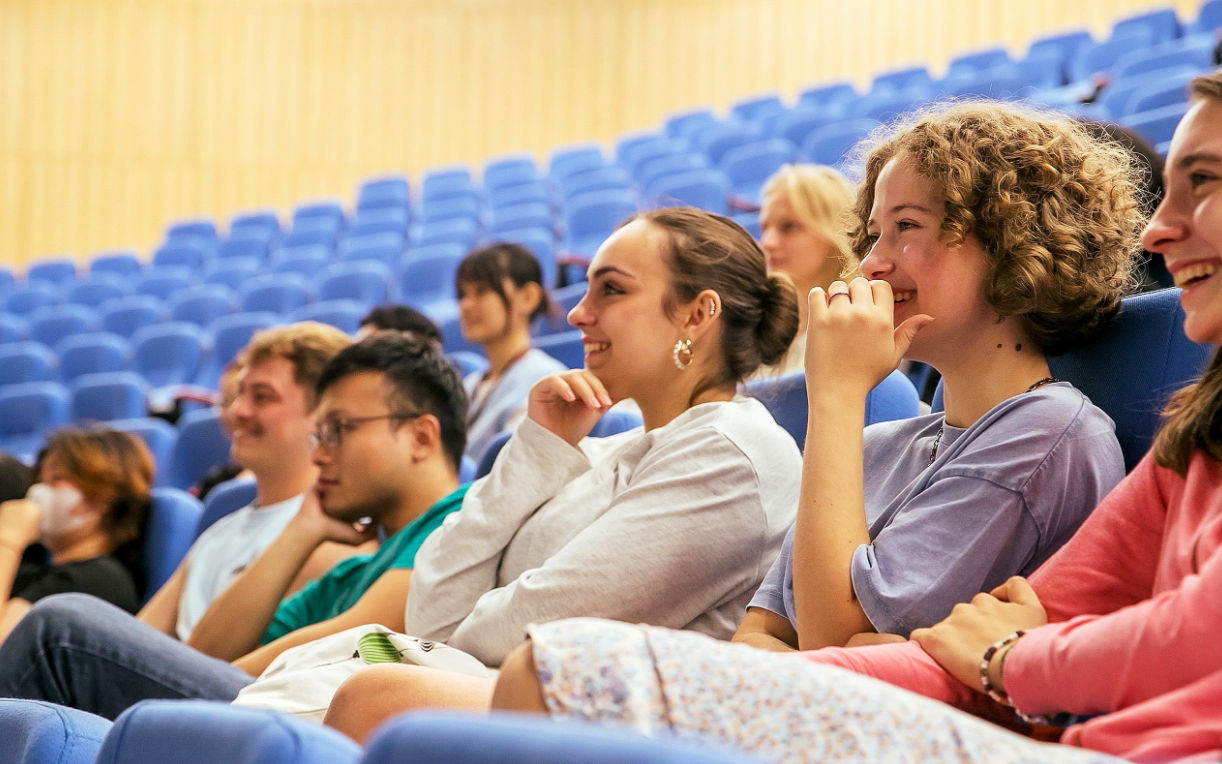
According to Khamtan Somvong, education and cultural counsellor at the Lao Embassy in Vietnam, 10,725 Lao students are currently studying in the country, most under bilateral government scholarships.
Vietnam admits about 1,120 Lao students annually to short- and long-term programs, with 200 to 300 enrolling in full degree courses each year.
Before arriving, Lao students receive cultural orientation to help them adapt, while the embassy works with Vietnam's education authorities to support housing and administrative needs, Somvong said.
For many international students, it is not only structured programs but small, everyday gestures that leave lasting impressions: a shopkeeper allowing delayed payment when a wallet is forgotten, or a stranger calling out to remind someone to put down a motorbike stand.
Such moments, students say, turn Vietnam from a place of study into a place that feels like home.








Max: 1500 characters
There are no comments yet. Be the first to comment.