


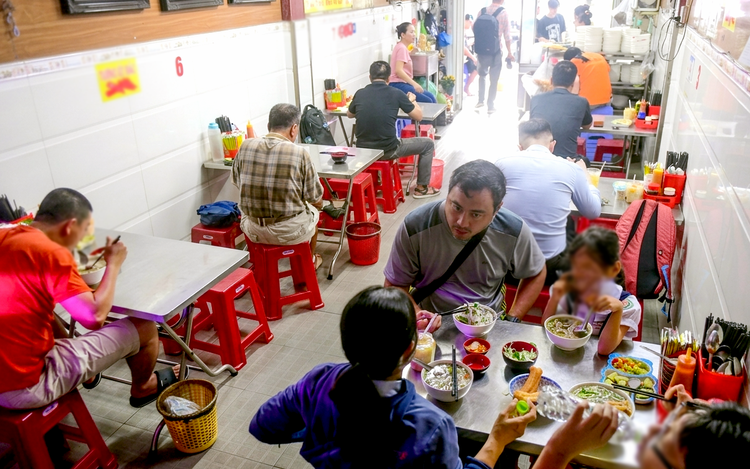
Though fuel prices have fallen, many restaurants and eateries in Ho Chi Minh City that had previously raised menu prices following fuel price hikes have yet to lower the rates. Photo: Quang Dinh / Tuoi Tre
Many customers argued that sellers were quick to raise prices when gasoline and diesel prices surged, but they are now reluctant to lower the rates after fuel became significantly cheaper.
Nguyen Van Nhat, a resident of Binh Thanh Ward in Ho Chi Minh City, said that he has closely followed recent fuel price movements.
Gasoline and oil prices have dropped, while the prices of many goods and services have remained elevated, he said.
“When fuel prices were rising, businesses blamed transportation costs and immediately increased prices," he lamented.
“Now that fuel prices have fallen sharply, hardly anyone is lowering their prices.
"Some have even raised them further."
Earlier this year, many eateries increased menu prices by VND5,000-VND7,000 (US$0.19-0.26) per serving as fuel rates climbed.
Accordingly, a rice meal costs at least VND35,000 ($1.33), while bowls of rice noodles sell for VND45,000-VND55,000 ($1.71-$2.09) each.
Customers accepted those increases at the time because they understood businesses were facing higher operating costs, Nhat said.
However, such businesses have failed to return the favor.
“They asked customers to share the burden when fuel prices rose, but now very few businesses are willing to share the benefits when fuel prices fall. That isn’t fair to customers,” he said.
Tran Thi Hau, another Ho Chi Minh City resident, said she recently suggested that the owner of a local rice restaurant reduce prices but she was turned down.
She recalled that when fuel prices peaked in late March, with diesel approaching VND40,000 ($1.52) per liter and gasoline around VND34,000 ($1.3), the restaurant quickly added VND3,000 ($0.11) to each meal.
Combined with an earlier increase, prices rose by VND6,000 ($0.22) within a month.
“Prices seem to go up very easily but almost never come down,” she said.
“Fuel prices have fallen dramatically, with diesel nearly halving, yet businesses simply find new reasons to keep prices high.”
Similarly, restaurants and beer joints across Ho Chi Minh City had previously added VND20,000-VND30,000 ($0.76-1.14) to dishes, citing soaring fuel costs, but they have made no mention of reducing prices after fuel costs declined.
Supermarkets tell a similar story.
While fresh produce, meat, and seafood are frequently discounted through seasonal or promotional campaigns, prices for processed foods and household staples, including cooking oil, fish sauce, fresh milk, dried noodles, and vermicelli, have remained largely unchanged.
Some brands have even begun proposing further price increases.
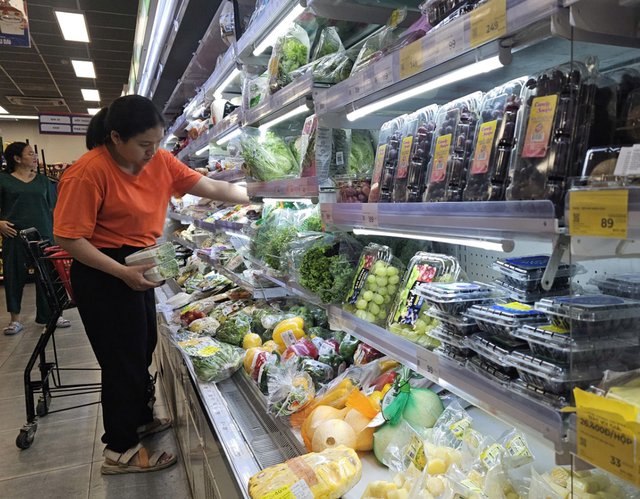
Residents shop at a supermarket in Ho Chi Minh City. Photo: Nguyen Tri / Tuoi Tre
Businesses say fuel is only part of the equation
Hung, owner of an eatery in Saigon Ward, said his business recently lowered prices by about 7-8 percent following the decline in fuel costs, although that reduction was smaller than the roughly 15-percent increase implemented when the fuel rates were at their peak.
He attributed the limited adjustment to persistently high transportation charges imposed by third-party logistics providers.
“Fuel accounts for around 35-40 percent of road transport costs, so transportation is a crucial link in the supply chain,” he said.
“If logistics providers don’t reduce their charges, it becomes difficult for restaurants and eateries to lower prices significantly.”
Another restaurant owner in Binh Thanh Ward acknowledged that some businesses are simply reluctant to give up higher profit margins.
However, he added that pricing decisions are influenced by many factors beyond fuel, including rent, labor costs, and raw material prices.
Nguyen Thanh Lam from supermarket chain Farmers Market told Tuoi Tre (Youth) Online on Sunday that the company had begun reviewing retail prices after fuel costs declined.
Yet several processed food suppliers have requested additional price hikes, pointing to continued pressure from international shipping rates, exchange rate fluctuations, and rising import costs.
Lam said Farmers Market would continue negotiating with suppliers and prioritize products from companies offering more competitive and stable pricing.
“If suppliers lower their prices, we will immediately pass those reductions on to consumers,” he said.
Vo Tran Ngoc, sales director at Saigon Co.op, said some businesses had taken advantage of the earlier fuel price surge to raise prices unnecessarily.
The retailer had worked with suppliers to keep prices stable, particularly for essential food items, he said.
Saigon Co.op has maintained relatively stable prices while continuing to offer promotions.
Long-haul bus fares also slow to decline
Long-haul bus fares have also shown little sign of falling despite the substantial drop in fuel prices.
In March and early April 2026, many long-haul bus operators serving routes between the Central Highlands region and Ho Chi Minh City increased ticket prices by 20-25 percent.
However, those fares have remained largely unchanged since then.








Max: 1500 characters
There are no comments yet. Be the first to comment.