


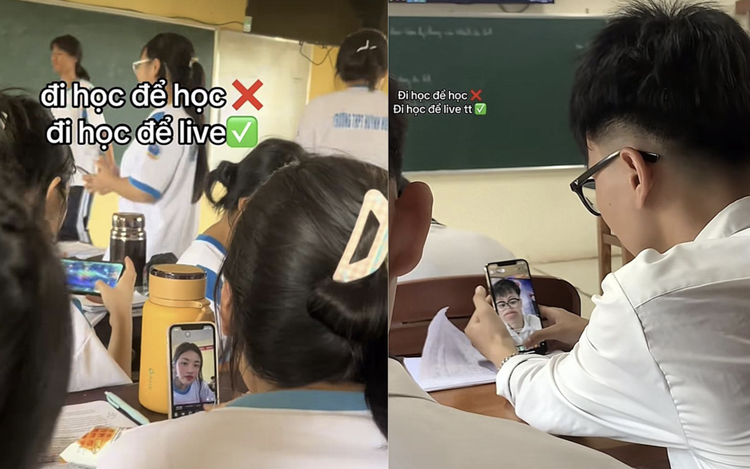
Students live-stream on social media during class hours, a practice that has become more visible in recent years in Vietnam.
Some clips even show the examination rooms, teachers walking between rows of desks, drawing thousands of views, and in some cases, tens of thousands of views.
A range of disruptive behaviors
Clicking on the V.I.K. live stream on Tiktok, the screen shows some students in a classroom, the camera angled down toward a desk.
On a blank sheet of paper, handwritten messages appear one by one, 'An loves My,' 'Khoi loves Truc.'
The pen moves as the viewers’ request, quickly filling the page, accompanied by quiet laughter and whispered prompts urging the writer to go faster.
On another channel, T.A., a live stream is also underway inside a classroom.
Three or four faces take turns trying out filters, rabbit ears, exaggerated facial features, and sparkling effects.
A viewer asks in the comments, “What subject? Which period?” A hushed reply comes back: “Math, third period.” The phone rests on the desk as the teacher lectures in the distance, while the live-stream conversation continues.
Live-streaming has increasingly become a kind of real-time campus diary, unfolding at the pace of social media.
Content is produced quickly, spontaneously, and shared with strangers with few apparent barriers.
But on closer examination, many see signs that the classroom’s educational space is gradually being reshaped in a negative way.
Lectures are suddenly turned into content for viewers outside the room. Casual remarks can be clipped out of context, and private moments may be exposed without warning.
Trong Tan, a student at the University of Science under the Vietnam National University-Ho Chi Minh city, recalls being especially enthusiastic about live-streaming during his freshman year, often going live with friends in the middle of class.
At the time, he said it felt harmless, just a few minutes of entertainment that did not bother anyone.
“We live-streamed just for fun, unwrapping secret boxes, using filters, and laughing the whole time,” Tan said with a smile.
“Sometimes I was so caught up in the live-stream that I looked up at the board and had no idea what the teacher was talking about, but I could catch up later by reviewing the lesson.”
When fun crosses the line in the classroom
Pham Diep Phuong Uyen, a lecturer currently teaching at Louisiana State University in the U.S., likens classroom live-streaming to turning an entire lesson into an open public observation, where outsiders who are not part of the class can watch and pass judgment.
“Not live-streaming during class helps protect lectures, personal information and, importantly, student safety,” Uyen said.
“Once people know they are being watched, neither teachers nor students can act naturally.
"The quality of the lesson suffers, and privacy is almost entirely lost.”
Taking a firmer stance, Ngo Tuan Phuong, a lecturer at the Ho Chi Minh City University of Law, said teachers live-streaming, especially footage of students during exams, violates professional teaching standards and infringes on privacy rights.
Examination spaces, he said, require seriousness and confidentiality, and turning them into social media content cannot be dismissed as accidental.
According to Phuong, students’ live-streaming during class reflects a clash between online culture, driven by visibility and interaction, and school discipline, which prioritizes focus and respect.
“A classroom is not a public space,” he said.
“Recording can only take place with clear consent and for legitimate educational purposes.”
Tieu Minh Son, a lecturer in soft skills at the Student Capacity Development Center of Van Lang University in Ho Chi Minh City, said live-streaming during lessons directly undermines teaching and learning quality.
When a class is split between absorbing knowledge and interacting with an online audience, both teachers and students lose focus, turning the classroom into an improvised stage where content is diluted or distorted.
Son added that using instructional time for personal activities such as live-streaming is inconsistent with professional ethics.
“This is no longer a personal matter,” he said.
“It involves responsibility to the institution, to learners, and to the role of educators themselves.”
How the world regulates classroom live-streaming
In many countries, live-streaming is considered an activity that directly impacts personal data and privacy, prompting schools to regulate it under data protection laws and internal rules governing the use of recording devices.
The U.S. Department of Education explains that photos and videos of students can be considered part of an educational record under the Family Educational Rights and Privacy Act, a federal law governing access to and disclosure of student education records, if they are directly related to a student and maintained by an educational institution. In such cases, sharing is subject to strict student privacy protections.
As a result, many U.S. universities advise instructors that, without legally valid consent, recordings should be planned in ways that prevent student identification, excluding names, faces, voices, or other identifying information, or be shared only within approved, limited settings.
In the United Kingdom, the Information Commissioner’s Office, the country’s data protection regulator, stresses that schools have the authority to restrict photography and filming if it disrupts educational activities.
The regulator also advises parents and students against posting images of others on social media when it may be inappropriate or infringe on privacy.
France has taken a more restrictive approach by targeting devices themselves. A 2018 law bans mobile phones and electronic communication devices in preschools, primary schools, and lower secondary schools, aiming to protect learning environments and student well-being.
In Australia, regulation varies by state. In Victoria, schools are required to ensure that the collection and use of student images, audio, and video comply with education laws and departmental policies, grounded in clear purposes, privacy protection, and informed consent.
New South Wales, meanwhile, emphasizes digital safety and contextual appropriateness even in video-based learning, warning against unnecessary exposure of personal information and digital risks.
Calls for stricter rules
According to soft skills lecturer Son, live-streaming in classrooms should not be framed merely as a question of whether it should or should not happen, but placed within a clear governance framework set by educational institutions.
Schools, he said, need to issue explicit regulations on the use of recording devices and live-streaming during class, clearly defining permitted behavior and violations to avoid inconsistent interpretations or ad hoc responses after incidents occur.
In the long term, sanctions may be necessary. More importantly, Son argued, institutions must build proper digital awareness among both lecturers and students.
Universities and schools can offer short courses, workshops, or training programs on digital citizenship, digital ethics, and online conduct as part of essential professional competencies in the modern era.
“If learners and educators are equipped with the right knowledge and clear guidelines,” Son said, “digital technology can support learning rather than reshape classroom spaces that require focus, respect, and safety for everyone.”








Max: 1500 characters
There are no comments yet. Be the first to comment.