


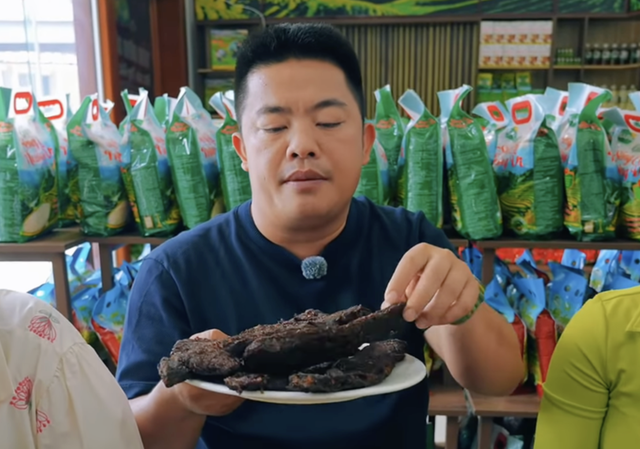
Hai Sapa TV promotes smoked buffalo meat in a video. Photo: Screenshot from video
They may think of the mountainous region, kitchen smoke, traditional seasoning methods and flavors tied to the locality.
They are not simply paying for a few hundred grams of meat. They are buying the story of where the product comes from.
The case involves Vu Hoang Hai, better known as Hai Sapa TV, a popular Vietnamese YouTuber and TikToker promoting food and local specialties in northwestern Vietnam.
Investigators said dried buffalo meat he sold made from frozen buffalo meat imported from India was promoted online as a "Northwestern Vietnam specialty," a product popular with foreign tourists.
Consumers are the first to suffer
The provincial Investigation Police Agency of Lao Cai Province, northen Vietnam, has prosecuted Hai on charges of defrauding customers.
The case remains under investigation, and his criminal liability will depend on the conclusions of the relevant authorities.
But the case raises a broader question: How much is the word "specialty" really worth?
In everyday use, a specialty generally refers to a food or product that a particular region boasts.
Its value lies beyond its ingredients.
A specialty product may cost a higher price because it is associated with a place of origin, traditional processing expertise and a reputation built by a community over many years.
Vietnam's intellectual property law also recognizes the connection between a product and its geographical origin through geographical indications.
Article 79 of the Law on Intellectual Property stipulates that a product protected under a geographical indication must originate from the corresponding area and have a reputation, quality or characteristics primarily determined by geographical conditions there.
Simply putting the word "specialty" or a place name on packaging does not make a product a protected geographical indication.
But the underlying principle is important.
Geographical origin is not merely decorative when it affects how consumers identify and value a product.
The words "Northwestern Vietnam" labeled on a food product can create expectations about its ingredients, place of production, processing methods and cultural story.
Buyers may be willing to pay more because of those values.
If a product is associated with a place simply because the name is appealing and helps sell the product, that goes beyond choosing an attractive label.
Consumers are the first to suffer. They have the right to know what they are buying, where it comes from and what its quality is.
Genuine producers also pay the price
Article 10 of Vietnam's 2023 Law on the Protection of Consumer Rights prohibits businesses and individuals from deceiving or misleading consumers by providing false, incomplete or inaccurate information about products, goods or services.
Clause 4 of Article 24 of the E-Commerce Law, which took effect on July 1, 2026, also prohibits livestream sellers from providing false or misleading information about the uses, origin, quality, price and other relevant details of goods and services.
Those working to produce genuine local specialties may suffer more quietly.
A family in a mountainous area or a processing facility may spend years selecting ingredients, preserving recipes, ensuring food safety and maintaining the reputation of a local product.
When a product has no corresponding connection to a locality but is sold using that locality's reputation, genuine producers must compete against an advantage that their rivals did not spend years building.
That reputation is accumulated through the work of generations, as well as through local culture, customs and market trust. It is almost a shared intangible asset of the community.
But in digital commerce, that asset can be exploited quickly through a single sentence in a livestream, a line of text on packaging or a video telling a story.
This is also what makes social media commerce different from selling an ordinary product. The story surrounding a product can sometimes be more powerful than the product itself.
Someone who has spent years creating content about mountainous areas and their cuisine can build trust among viewers.
When that person sells a product presented as a "Northwestern Vietnam specialty," buyers are not simply receiving information about the product.
They are also receiving an implicit endorsement based on the seller's personal reputation, accumulated through hundreds of videos and years of audience engagement.
At that point, the seller's reputation becomes part of the value of the transaction.
The responsibility of a well-known seller therefore cannot simply be reduced to "I had a product and the customer agreed to buy it."
Consumer consent only has real meaning when it is based on truthful information.
"A willing buyer and a willing seller" cannot be used as a shield for a transaction in which one side knows the facts while the other makes a decision based on a different story.
Nor can the entire burden be placed on consumers with the familiar advice that they should simply "be careful."
Buyers should certainly exercise caution, but a healthy market cannot operate on the principle that anyone who is too trusting must bear the consequences.
Sellers know where their products are made, what ingredients are used and how they are produced.
Buyers, for the most part, can only rely on product labels, advertising and information provided by sellers.
This is precisely the information asymmetry that consumer protection laws seek to narrow.
What is needed after cases like this is greater transparency and easier verification of product origins.
For products sold on the basis of their regional identity, local traditions and cultural heritage, there should be clear traceability and clear accountability.
E-commerce platforms also cannot continue to act simply as a "marketplace" standing outside what sellers tell millions of consumers.
The new E-Commerce Law has begun to impose responsibilities on platforms, including verifying livestream sellers, storing livestream data and taking measures to control violations.
A locality may take decades to turn a food into a specialty. On social media, however, it can take only a few minutes of storytelling for a product to acquire a history, culture and reputation that may not actually belong to it.
If such stories can easily be turned into revenue, the victims are not only customers who buy the wrong product.
Genuine producers also lose market share.
Real specialties gradually lose their distinctiveness.
More dangerously, consumers' trust in legitimate local products is also eroded.
Protecting local specialties is therefore not simply about protecting a name.
It is about protecting consumers' right to know the truth, protecting genuine producers and protecting the value that an entire community has built.
A specialty may need a story to travel far. But first, that story has to be true.








Max: 1500 characters
There are no comments yet. Be the first to comment.