


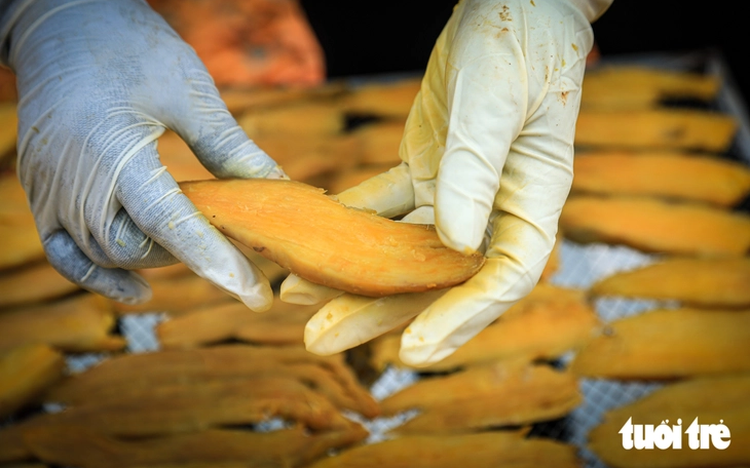
The elongated, amber-colored slices have a naturally rich sweetness, earning khoai deo the nickname 'Quang Binh ginseng.' Photo: Thanh Nguyen / Tuoi Tre
Today, the delicacy has become a popular local product, with producers combining generations-old techniques with modern drying equipment to meet growing demand.
Behind the chewy, sweet slices is a labor-intensive process shaped by generations of experience.
The elongated, amber-colored slices have a naturally rich sweetness, earning the specialty the nickname 'Quang Binh ginseng.'
Ninh Chau Commune is now part of Quang Tri Province and includes areas that were formerly in Quang Binh Province.
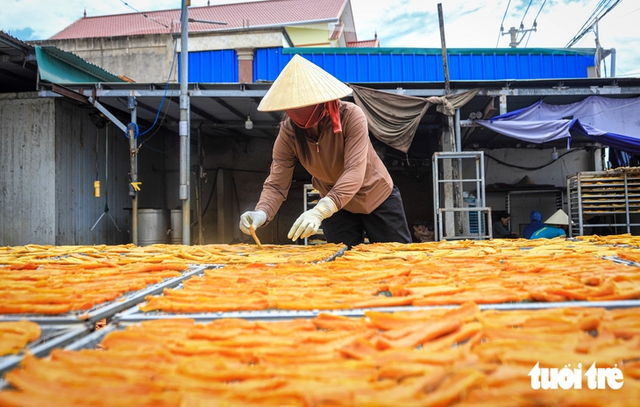
Around 500 households in Ninh Chau Commune, Quang Tri Province are involved in growing and processing 'khoai deo'. Photo: Thanh Nguyen / Tuoi Tre
According to local residents, khoai deo emerged during difficult times when food was scarce. To preserve sweet potatoes after harvest and ensure a food supply throughout the year, locals developed various processing methods.
Some chopped raw sweet potatoes into small pieces and dried them to make sweet potato chips, which could be cooked with rice or black beans.
Another method was to boil the potatoes, slice them and dry them in the sun. As the slices dried, their sweetness became more concentrated, while their texture grew chewier and more flavorful. This is how khoai deo came to be.
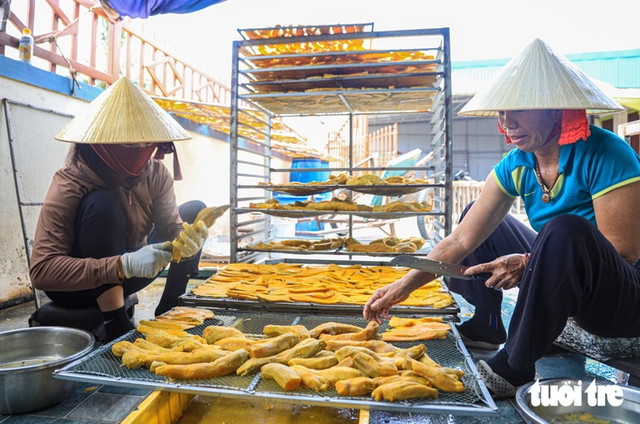
After peeling the sweet potatoes, residents slice them before laying them out to dry in the sun. Photo: Thanh Nguyen / Tuoi Tre
The earliest versions were simply boiled and sun-dried, making them relatively hard. Yet for generations of local residents, these tough dried slices became a familiar snack during cold, rainy winters.
Adults carried them to the fields, students tucked a few slices into their school bags, and many people enjoyed them as a humble snack to chew on during their free time.
Because the slices were hard and chewy, they had to be eaten slowly, allowing the sweet, nutty flavor to gradually spread across the palate. This simple way of enjoying khoai deo became part of the region's food culture.
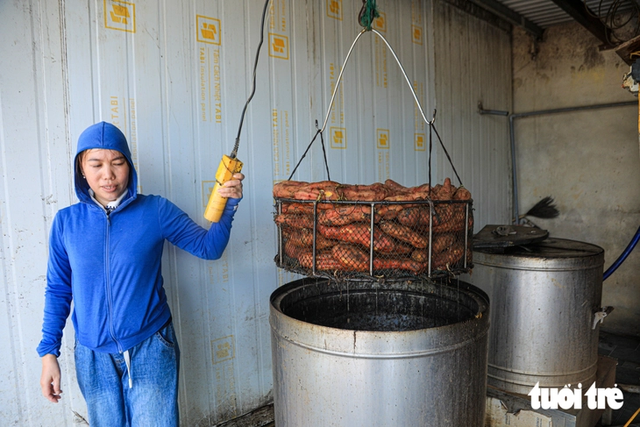
Many households use electric steamers to increase 'khoai deo' production capacity. Photo: Thanh Nguyen / Tuoi Tre
Over the years, khoai deo evolved from a preserved staple into a local specialty. Some visitors describe the experience as irresistible: the slices may be difficult to bite through at first, but the longer they are chewed, the more enjoyable they become.
Today, producers have refined the process to create softer and chewier slices while retaining the sweet potato's natural flavor.
Secrets behind the specialty
Ho Thi Bon, a longtime khoai deo producer in Ninh Chau Commune, said her family once relied mainly on sweet potatoes grown in the sandy soil.
Sweet potatoes grown in the sandy soil have a mild sweetness, moderate chewiness, and distinctive aroma.
However, the area under cultivation has declined as fewer households grow the crop.
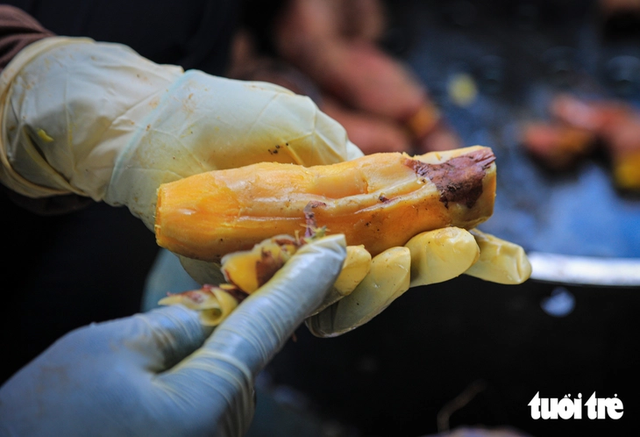
After steaming, sweet potatoes are carefully peeled before being sliced. Photo: Thanh Nguyen / Tuoi Tre
Meanwhile, consumers increasingly prefer softer and chewier slices, prompting her family to source honey sweet potatoes from Da Lat.
"Many distributors and customers ask whether we add sugar or other additives because the sweet potatoes are so soft and sweet. In fact, the sweetness comes entirely from the potatoes' natural sugars and the careful processing method," Bon said.
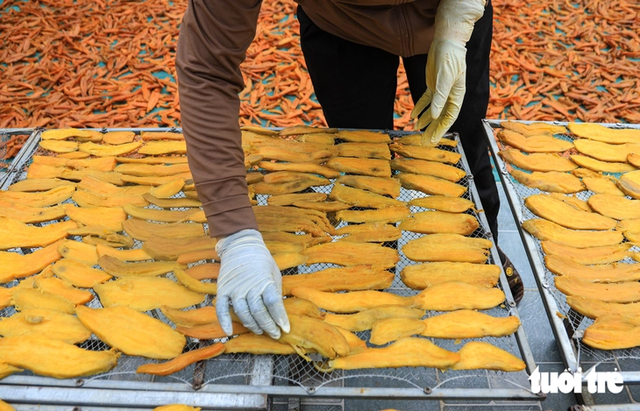
Workers carefully inspect the slices during the drying process to ensure 'khoai deo' meets quality standards. Photo: Thanh Nguyen / Tuoi Tre
According to Bon, producing high-quality khoai deo begins with careful selection of the raw sweet potatoes, with damaged, worm-eaten or spoiled ones removed.
After arriving at the production site, the sweet potatoes are not processed immediately. Instead, they are covered with thick blankets and left outside for about 24 hours before being stored indoors for around half a month.
This process helps reduce moisture and convert starches into various types of sugar, making the potatoes softer and sweeter when steamed.
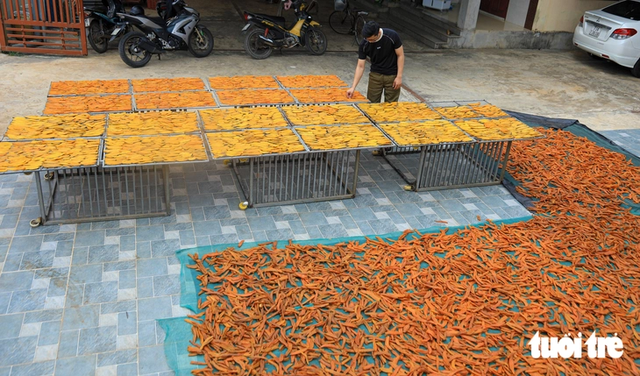
Drying racks covered with golden sweet potato slices fill household yards during the 'khoai deo'-making season. Photo: Thanh Nguyen / Tuoi Tre
Once steamed, the potatoes are peeled, sliced and laid out in the sun. This is the most crucial stage in determining the quality of the finished product.
If the slices are exposed continuously to intense sunlight, they can become excessively dry and hard, so producers must carefully control the drying time.
Bon said a batch typically goes through around nine rounds of drying in the sun to achieve the desired color, chewiness, and sweetness.
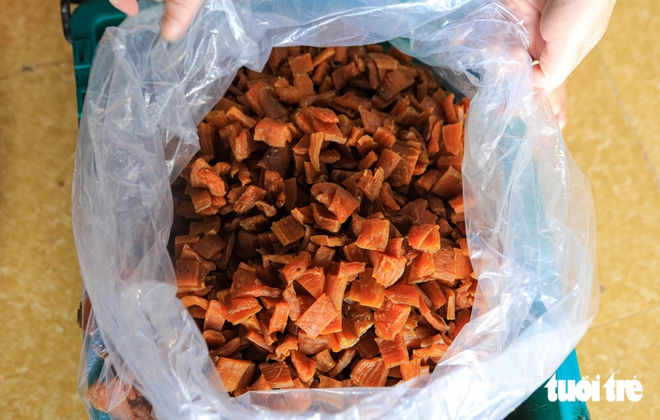
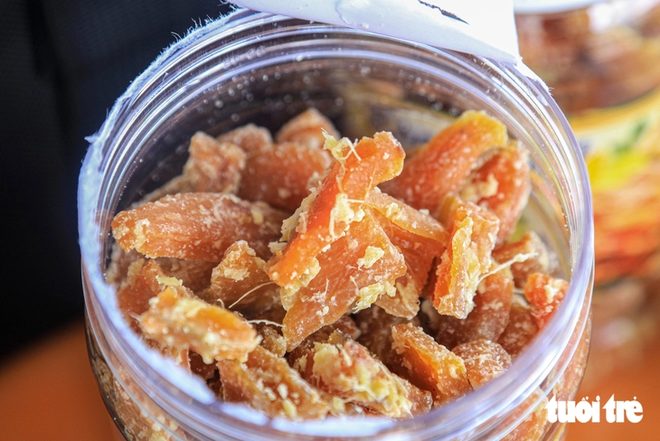
Ho Thi Bon's family in Ninh Chau Commune, Quang Tri Province has added ginger-infused 'khoai deo,' which has recently become popular among consumers. Photo: Thanh Nguyen / Tuoi Tre
In addition to traditional sun-drying, her family has invested in drying equipment to maintain production during unfavorable weather and ensure year-round supplies.
At Bon's household, around 10 workers begin work at 2:00 am and continue until about noon to prepare the sweet potatoes and put them out to dry.
The family processes about one metric ton of raw sweet potatoes each day and ships around 200-300 kilograms of finished khoai deo.
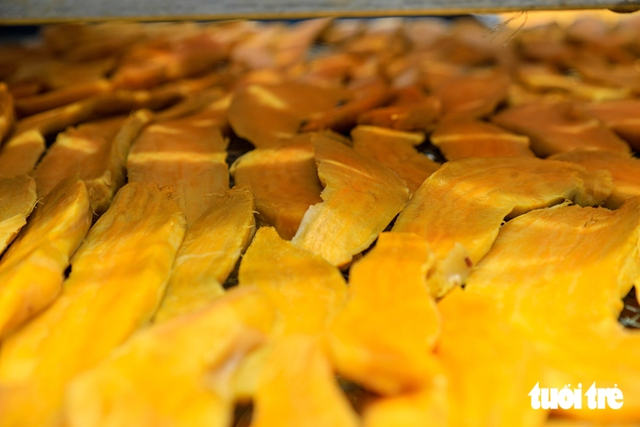
Golden 'khoai deo' slices are laid out on drying racks. Photo: Thanh Nguyen / Tuoi Tre
The specialty currently sells for around VND150,000-200,000 (US$5.7-7.6) per kilogram. Ginger-infused khoai deo has also become popular among consumers.
According to the Ninh Chau Commune Farmers' Association, around 500 households in the area are involved in growing and processing khoai deo.
Local producers collectively supply hundreds of metric tons of finished products to the market each year.
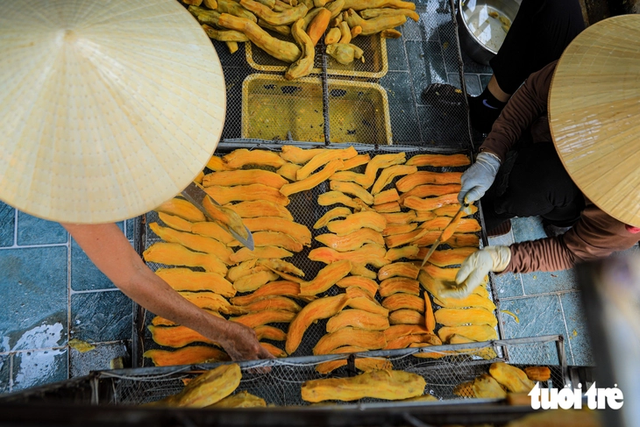
Residents make 'khoai deo' from 2:00 am to noon. Photo: Thanh Nguyen / Tuoi Tre
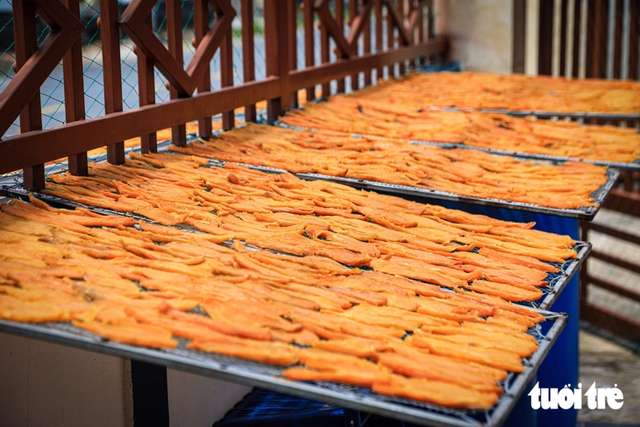
Residents make use of open spaces in yards and on rooftops to dry 'khoai deo'. Photo: Thanh Nguyen / Tuoi Tre








Max: 1500 characters
There are no comments yet. Be the first to comment.