


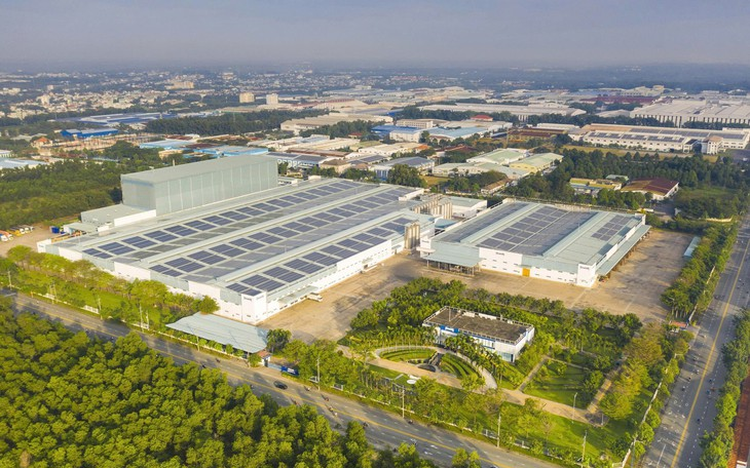
Rooftop solar panels at an industrial park in Ho Chi Minh City. Photo: Quang Dinh / Tuoi Tre
Businesses need to demonstrate measurable environmental and social benefits, establish reliable emissions data, and commit to a clear path toward reducing their carbon footprint, according to Dr. William L. Nolten, chairman and CEO of the Netherlands-based Golden Gate BCE Group.
Nolten told Tuoi Tre (Youth) online newspaper that the main barriers to green finance are not simply a company’s size or lack of collateral, but also its ability to demonstrate its current position, show how it plans to reduce emissions, and prove that a project can deliver both financial and environmental results.
Nolten has years of experience in strategic cooperation involving green agriculture, sustainable development, logistics, and ESG data standards in Vietnam.
Businesses do not need to be ‘green’ from the start
The world has substantial sources of green finance, yet Vietnamese businesses still face difficulties accessing them.
For SMEs, the biggest barriers are often thought to be a lack of collateral or their small scale.
However, the biggest obstacles are not company size or a lack of collateral.
“What international investors are looking for are projects that can demonstrate financial performance alongside environmental and social benefits," he stressed.
"International investors do not require a business to become ‘green’ immediately.
"What matters is that the business has the willingness and commitment to follow an emissions-reduction roadmap."
Based on his years of consulting work in Vietnam, Nolten said many Vietnamese SMEs still do not know where to begin their emissions-reduction efforts.
They invest in individual technologies but lack an integrated solution covering the entire value chain.
“Export markets are increasingly demanding higher standards for traceability, emissions reduction, quality, and transparency in ESG data," Nolten said.
"If businesses cannot demonstrate these factors, it is very difficult for them to access international capital, even if their products are of good quality."
One positive development among Vietnamese businesses is that some have begun conducting ESG assessments directly to attract green finance, hiring experts or consulting firms, regardless of whether their partners require them to do so.
However, shareholders, management, employees, and other stakeholders must understand the results themselves.
Otherwise, an ESG report can easily become a box-ticking exercise.
A more effective approach is to build the system from within, with the participation of stakeholders, starting with actual company data and gradually expanding its scope.
The first step in any sustainability system, whether it is intended to facilitate access to green finance or measure the environmental footprint of a company or product, is to establish a baseline in accordance with international standards.

Dr. William L. Nolten, chairman and CEO of Golden Gate BCE Group. Photo: Supplied
Focus investments where they matter most
For Vietnamese SMEs seeking to access green finance, Nolten said businesses should identify solutions that are easy to implement, low-cost and easy to measure — commonly known as 'low-hanging fruit' — to generate initial results.
For example, businesses can measure direct emissions from fuel used in factories and transportation, as well as indirect emissions from purchased electricity, heat or steam.
However, these figures must be kept separate from broader data such as industry averages, estimates or macroeconomic databases.
Once businesses understand how to calculate emissions based on their actual data, they can then expand the assessment to cover indirect greenhouse gas emissions across their value chains and operations.
The first priority is to establish a reliable and verifiable baseline for greenhouse gas emissions.
“Many businesses begin their green transition without baseline data. They may install rooftop solar panels or plant trees because they consider these green activities, but they do not know where the emissions hotspots in their operations are," he said.
"As a result, businesses may spend a significant portion of their funds on activities that have little impact on their overall emissions."


Max: 1500 characters
There are no comments yet. Be the first to comment.