


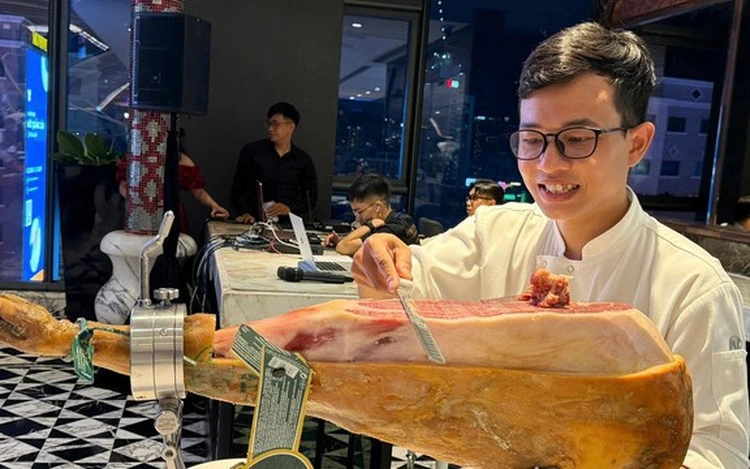
A diner poses beside a Spanish-style cured ham leg at a restaurant in Ho Chi Minh City, where Spanish cuisine is gaining popularity among local customers. Photo: N. Binh / Tuoi Tre
This growing access to global cuisines shows how foreign restaurant chains are embedding themselves in Vietnam’s consumer market, reshaping dining habits while generating new economic activity nationwide.
In June 2025, Pin Wei, a Singapore-style ‘banh cuon’ (steamed rice roll) brand, opened its first outlet opposite Ben Thanh Market in Ho Chi Minh City.
By 2026, the brand plans to open two additional locations in Thao Dien and at Landmark 81, the tallest skyscraper in the city.
Eddy Tan, owner of Pin Wei, said the company initially considered expanding across Southeast Asia but it chose Vietnam thanks to its strong post-pandemic recovery, a value-added tax rate of eight percent, and rising consumer spending power.
He said Vietnam’s fast-growing economy and long-term outlook were key factors behind the decision.
Tan added that early business momentum and strong potential in central locations allow the brand to serve both international tourists and local diners seeking diverse culinary experiences.
He also pointed to the clustering of international restaurants in these areas as a sign of strong market activity, while praising Ho Chi Minh City’s open business environment and safety conditions.
Asian chains tap tourism, local demand
The Benaras Indian restaurant chain, led by owner Nidhi Arora, has expanded to 10 outlets across Vietnam as of 2026, after opening its first restaurant in Ho Chi Minh City in 2018.
The chain operates in tourist-heavy areas, including Ho Chi Minh City and Phu Quoc Special Zone in An Giang Province, where international visitor traffic remains strong.
Arora said the growing number of Indian visitors to Vietnam has been a key driver of expansion, noting that Indian travelers typically prefer familiar cuisine even when abroad.
Meanwhile, Oh Sang Sik, director of Hanmaeum BBQ in Vietnam, said the South Korean barbecue chain did not initially target tourists but it has seen strong acceptance among Vietnamese customers.
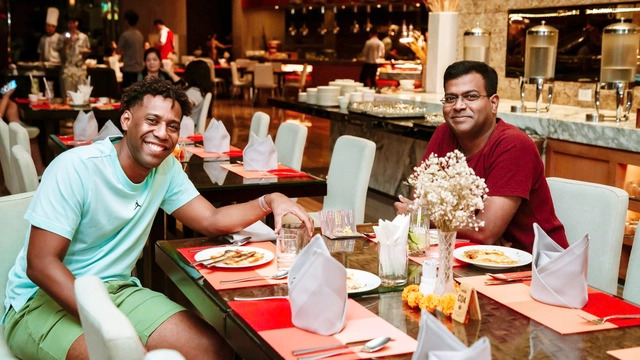
Tourists enjoy Indian cuisine at a Benaras restaurant in Vietnam. Photo: Benaras
The chain’s first outlet in Vietnam, located in Phu My Hung Urban Area, Ho Chi Minh City, opened in 2024 and recorded an initial customer split of roughly 50 percent Vietnamese and 50 percent South Koreans, while Vietnamese diners now account for about 80 percent.
Since then, Hanmaeum BBQ has expanded to seven restaurants nationwide, including five in the city, focusing on high-traffic weekend areas and neighborhoods with large young working populations.
Spanish cuisine gains ground in Vietnam
Beyond Asian cuisines, European dining concepts are also gaining traction in Vietnam, with Spanish restaurants and bars expanding from modern tapas venues to Mediterranean-style dining spaces.
This allows diners in Ho Chi Minh City to experience Spanish cuisine without traveling to Europe.
Nestor Santos Franco, economic and commercial counsellor at the Embassy of Spain in Vietnam, said the number of Spanish restaurants under the Restaurants from Spain program, promoted by Spain’s trade and investment agency, has steadily increased.
The number rose from six certified restaurants in 2022 to seven in 2023 and reached 11 in Vietnam.
He said Spanish ingredients, wines, and food products are becoming more visible in the market, alongside a growing number of culinary events and increased participation by Spanish chefs.
This reflects rising recognition of Spanish cuisine among both consumers and industry professionals in Vietnam.
Local sourcing becomes key for foreign restaurants
As international restaurant brands expand, many are increasingly integrating into Vietnam’s local supply chains and workforce.
Companies say most operations now rely heavily on local employees and domestic sourcing.
Hanmaeum BBQ still imports specialty ingredients to preserve authentic flavors but it sources about 90-95 percent of its inputs locally, including vegetables from Da Lat.
Pork is sourced domestically, while only beef is imported, along with select seasonings and curing techniques from South Korea.
Pin Wei values Vietnam’s seafood supply, including shrimp, crab, and scallops, noting that the quality of Vietnamese seafood sometimes enhances the flavor of Singapore-style dishes and that crab soup has been introduced locally as a menu item.
Counsellor Franco said both Spanish and Vietnamese cuisines emphasize fresh ingredients, local produce, and regional culinary traditions.
He noted that pork, seafood, and rice are central to both food cultures, though used differently.
He also highlighted shared dining habits, noting that both cultures value communal eating, making Spanish cuisine feel familiar to Vietnamese diners.
Jobs, tourism, adaptation fuel growth
International restaurant chains are generating significant employment opportunities for local workers.
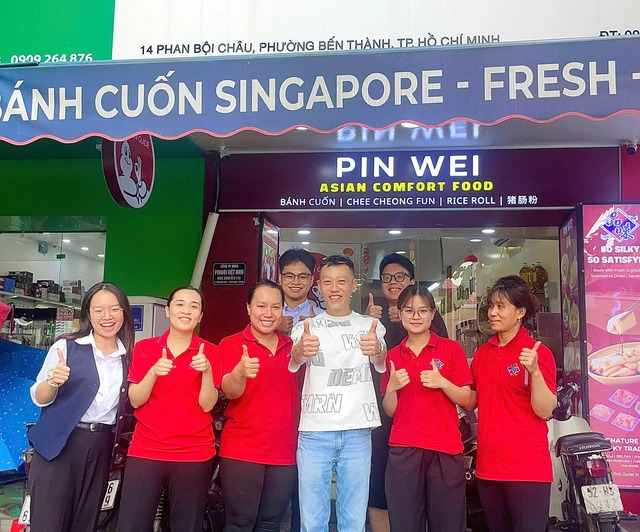
Eddy Tan and staff members at the Pin Wei restaurant near Ben Thanh Market in Ho Chi Minh City. Photo: Supplied
Tan of Pin Wei said the company prioritizes training young Vietnamese employees as part of its long-term development strategy.
He said young graduates are quick to learn, strong in language skills, and responsive to customer preferences.
Arora of Benaras said Indian tourists, particularly MICE groups and wedding travelers, have strong demand for familiar cuisine, making Indian restaurants an important part of tourism services.
Oh of Hanmaeum BBQ said the popularity of ‘South Korean spicy noodles’ in Vietnam reflects cultural adaptation between the two countries.
He noted that the version popular in Vietnam does not exist in South Korea in the same form but was developed locally, inspired by South Korean cuisine.
Arora added that Vietnamese customers often find Indian food unfamiliar due to its use of butter, cream, and spices.
In response, Benaras has positioned itself as offering healthier Indian cuisine, with reduced butter, cream, additives, and up to 80 percent less cooking oil.
Spanish cuisine, meanwhile, emphasizes high-quality ingredients and natural flavors rather than complex cooking techniques.
Olive oil, seafood, cured pork, rice, vegetables, and wines remain central to its culinary identity.








Max: 1500 characters
There are no comments yet. Be the first to comment.