


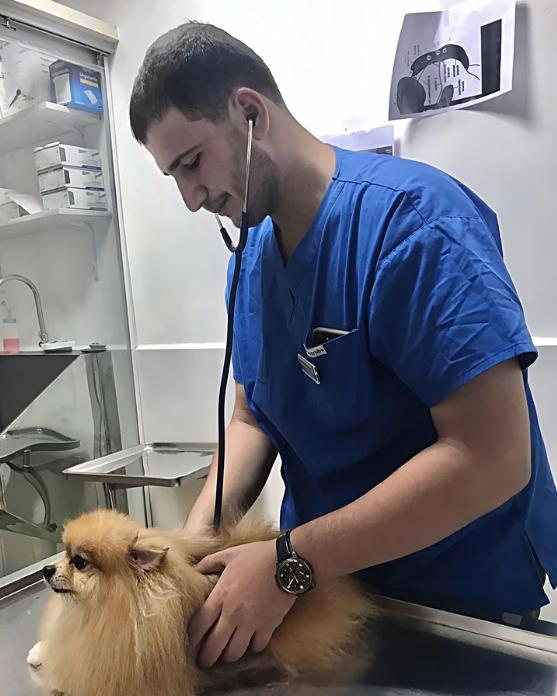
Nour Houbri, an international student coming from Palestine, says he is happy to live and pursue his dream career in Vietnam.
How Vietnam became home for a Palestinian student
In 2014, Nour Houbri, now 29, a Palestinian national, set foot in Vietnam for the first time.
He recalls feeling both happy and fortunate after receiving a scholarship from the Vietnamese government.
Arriving in a new country excited him, but it also came with anxiety as he left behind his familiar homeland.
Looking back on his early days studying Vietnamese at Hanoi University, Nour said the language posed a real challenge.
“Vietnamese is quite difficult, especially the pronunciation, which felt very unfamiliar. To learn it well, I had to invest a lot of time and effort,” he said.
He recorded his own voice to correct pronunciation, practiced difficult sound pairs, learned vocabulary by topic, stuck notes around his room, watched videos, listened to Vietnamese conversations daily, and tried to communicate even when his speech was not yet accurate.
“That’s how I built a basic foundation,” he said.
After completing his Vietnamese-language studies, Nour moved to Ho Chi Minh City to pursue a degree in veterinary medicine.
From that point on, his memories of Vietnam continued to grow richer.
He recalls accompanying lecturers on field trips from the city to livestock farms, where he immersed himself in local life.
There, Nour learned not only how to care for animals, but also patience and a sense of professionalism rooted in kindness.
In 2020, Nour graduated and decided to remain in Vietnam long term.
He said the dedication of his teachers and the sense of peace he felt living within a close-knit community were key reasons behind his decision.
“As a young international professional, I see Vietnam as a place full of opportunities for those with ability and commitment,” Nour said.
“The working environment here is professional and fair, and the veterinary sector is developing rapidly.
"Vietnam is open and supportive, giving foreigners like me the chance to contribute and prove ourselves.”
Beyond his professional work, Nour actively takes part in community activities, coordinating with local authorities to vaccinate pets, supporting animal rescue centers and joining free veterinary care programs.
“I hope to contribute, even in a small way, to the development of Vietnam’s veterinary sector and to improving animal welfare in the country,” he said.
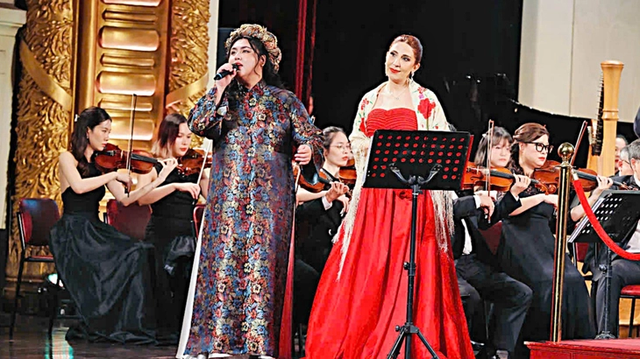
Sevinch, an Azerbaijani musical theater artist, performs at a concert in Vietnam.
For Sevinch Nguyen, 34, a musical theater artist, singer, and cultural representative of Azerbaijan in Vietnam, the idea of 'home' is not necessarily a fixed point on a map.
Born in Russia to a Vietnamese mother and an Azerbaijani father, Sevinch grew up accustomed to moving between countries from an early age.
She first came to Vietnam in 2007 and has remained ever since, gradually coming to regard the country as her home.
She studied in the Russian-English bilingual program at the University of Social Sciences and Humanities in Ho Chi Minh City starting in 2010.
Looking back, she describes her student years as “pressured but deeply worthwhile,” especially when grappling with abstract philosophy courses.
“Philosophy was full of difficult concepts. Even though I had some Vietnamese, there were moments when it felt more like solving math problems than studying social sciences,” she said with a laugh.
Outside the classroom, Nguyen independently worked on improving her language skills, regularly visiting the American Center to practice English.
At the time, the center offered free access for students from disadvantaged backgrounds, with an open library and weekly study exchanges.
“You don’t have to study at an expensive center to improve,” she said. “I made use of libraries and clubs to learn.”
Thanks to that foundation, she now speaks English, Russian, and Vietnamese fluently.
In 2016, Nguyen received a scholarship funded by the U.S. Consulate General in Ho Chi Minh City to study musical theater in Thailand and Indonesia, marking a turning point toward a career in the arts.
After completing her studies abroad, Nguyen chose to return to Vietnam.
In 2025, she performed musical theater alongside a symphony orchestra at her former university as part of an arts outreach project for students.
She says life in Vietnam brings a rare sense of relief. A simple breakfast of banh mi and coffee costing only a few dollars is enough to fuel a long day. Markets are filled with fresh produce, close to nature, and everyday life.
“When I have free time, I like to travel and explore different regions,” she said. “Costs are reasonable, and people are incredibly friendly and always willing to help visitors.”
One of her most profound memories in Vietnam dates back to the COVID-19 pandemic, when her family relocated to Phan Thiet.
“I spent many years in Moscow, where life was fast-paced, and everything revolved around money and performance targets,” she said.
“Living in Phan Thiet during the pandemic, I realized that everything was already ‘enough.’
"I felt safe, relaxed, able to slow down and breathe.
"I became grateful for what I had and cherished every moment with my family.
“That was when I truly understood that ‘home’ is a place that brings a sense of fullness and peace.
“And for me, in its own way, Vietnam has become that home.”
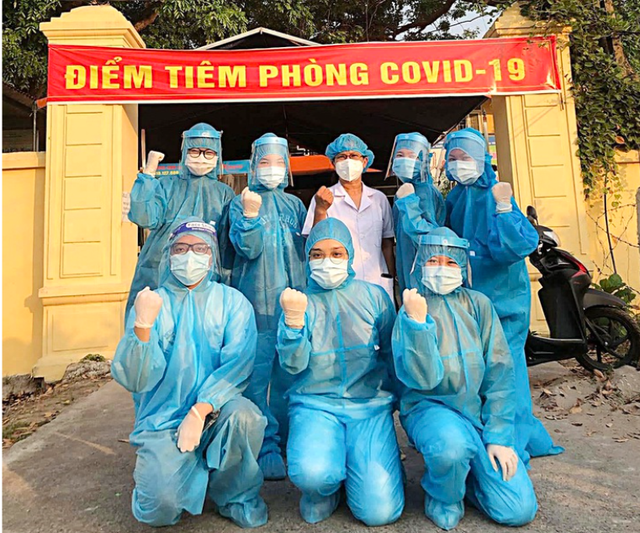
Paulina (center, front row) takes part in volunteer activities during the COVID-19 pandemic.
Volunteer during COVID-19 pandemic
“I initially decided to come to Vietnam out of curiosity and excitement rather than as part of a long-term plan,” said Paulina Szulic, 23, a Finnish national who has just graduated with a degree in logistics and supply chain management from the University of Economics Ho Chi Minh City.
What struck her most upon arrival, she said, was the hospitality.
“As soon as I landed, even though I couldn’t speak Vietnamese, people were eager to help me, give directions, and talk to the taxi driver on my behalf," Szulic recalled.
“That kindness truly moved me.”
Szulic said one of the most impressive aspects of studying in Vietnam was that her tuition fees and study materials were fully covered.
“The program was taught in English, so I adapted quite quickly,” she said.
“The knowledge was very practical, covering supply chains, import-export operations, and even IoT (Internet of Things) applications in logistics.
"It helped me better understand the industry in Vietnam and Southeast Asia.”
She also studied Vietnamese to communicate more easily with lecturers and classmates.
"As I grew more attached to Vietnam, I realized I wanted to stay here long term,” she said.
Szulic described forming close friendships that supported her both academically and socially.
“They invited me to join volunteer activities and taught me how to live with kindness. I truly cherish those bonds,” she said.
Recalling the outbreak of the COVID-19 pandemic, Szulic said it was a time filled with fear and uncertainty.
Her family in Finland was worried, and many of her friends chose to return home, but she decided to stay.
She joined volunteer efforts during the pandemic, helping residents in lockdown areas.
“Those days were exhausting, but for me they were the most meaningful time I’ve spent in this beautiful country,” she said.
After several years in Vietnam, Szulic said she has come to deeply appreciate the country’s sense of solidarity.
“People here truly care for one another,” she said.
“I want to be part of that circle and contribute, in whatever small way I can, to spreading those positive values.”
According to Vietnam’s Ministry of Education and Training, the number of international students in the country is on the rise.
As of the end of 2024, about 22,000 international students were enrolled in educational institutions nationwide.
Popular fields of study include medicine, pharmacy, economics, business, culture, and languages.
Of these, around 4,000 students study under bilateral or multilateral agreements, while the majority are self-funded or enrolled through cooperative and joint training programs between institutions.








Max: 1500 characters
There are no comments yet. Be the first to comment.