


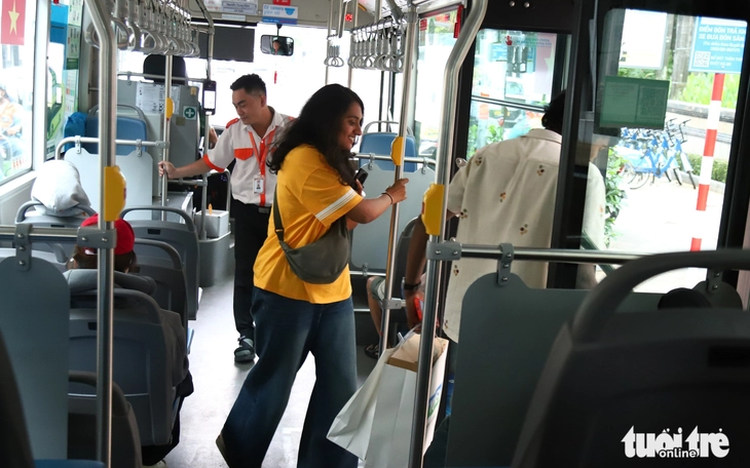
Passengers enjoy a comfortable and convenient experience using Ho Chi Minh City's bus services. Photo: Ngoc Lan
After the city introduced its free bus policy early this month, ridership has reached record levels, with both residents and international visitors increasingly choosing buses for daily travel.
However, some foreign passengers have experienced confusion when boarding, particularly during the trip validation process, and in some cases were unable to complete the procedure.
A representative of the Ho Chi Minh City Public Transport Management Center told Tuoi Tre (Youth) online newspaper that the validation process for foreign passengers is straightforward.
When boarding a bus, passengers only need to tap an EMV chip-enabled bank card, such as Visa or Mastercard, or use contactless payment methods like Apple Pay, Google Wallet, or Samsung Pay on the card reader installed on the bus.
The validation process does not involve any fare collection. Instead, it allows transport authorities to collect passenger data to better assess travel demand, identify routes experiencing increased ridership, adjust service frequency, allocate buses more efficiently, and continue improving service quality.
Under current regulations, bus attendants are responsible for guiding passengers through the validation process by asking them to tap their bank card on the card reader.
During the current phase of the free ride program, foreign passengers are not required to present Vietnamese identification or any substitute identification documents.
If technical issues occur or passengers are unable to complete the card validation, bus attendants are instructed to accommodate them so they can continue using the service under the city's free bus policy.
The Public Transport Management Center acknowledged that many bus attendants still face challenges communicating in English.
It said it would work with relevant agencies to improve the foreign language skills of frontline staff. The center also plans to provide more visual guidance materials to help both passengers and staff overcome language barriers.
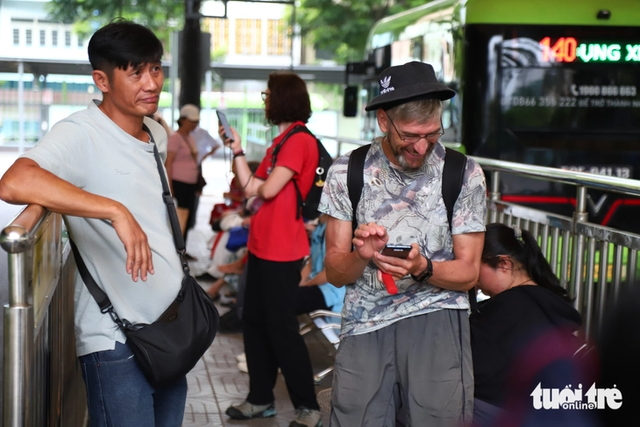
Ho Chi Minh City continues promoting a friendly, modern, and civilized public transport system. Photo: Ngoc Lan
To make the policy more accessible to the international community, the center has distributed English-language information through media outlets targeting foreign audiences.
The materials emphasize that the free ride policy is "open to all passengers, regardless of residency or nationality."
The center has also integrated an English-language interface into the MultiGo application and other digital platforms, allowing foreign passengers to look up routes, view eligible bus services, and access trip validation instructions.
Vietnamese-English information boards have also been installed at bus stations, terminals, and major transit hubs.
In the coming period, the center plans to expand multilingual support by introducing additional onboard and station announcements, increasing the number of visual instruction boards, and gradually developing a bus user guide for international tourists.
It will also coordinate with the tourism sector, airports, the metro system, and digital platforms to promote information about the city's free bus services to visitors arriving in Ho Chi Minh City.
The integrated communication, infrastructure, and passenger guidance measures are expected to help foreign travelers use the city's bus network more easily while reinforcing Ho Chi Minh City's image as a friendly, modern, and civilized public transport system.








Max: 1500 characters
There are no comments yet. Be the first to comment.