


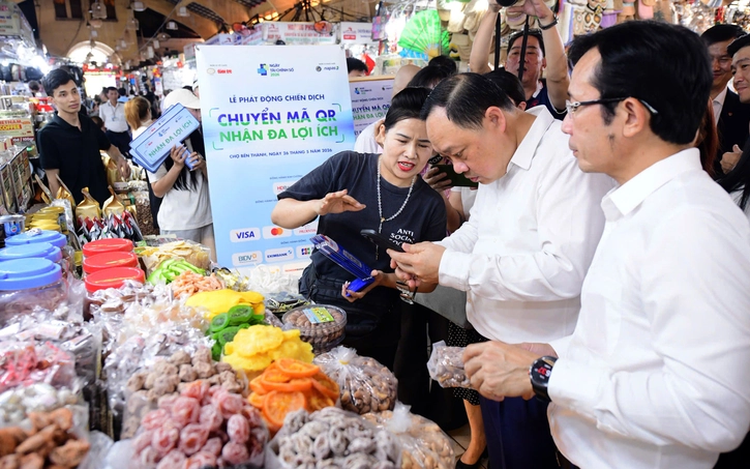
Representatives of management agencies, banks, and Tuoi Tre (Youth) newspaper experience digital payment services at Ben Thanh Market in Ho Chi Minh City. Photo: Quang Dinh / Tuoi Tre
At a press conference held in Ho Chi Minh City on Tuesday to announce Digital Finance Day 2026 under the theme 'Smart Payments Promote Digital Finance,' representatives from the State Bank of Vietnam (SBV), financial institutions, and businesses highlighted the rapid growth of cross-border digital payments and cashless transactions.
The event was organized by Tuoi Tre (Youth) newspaper in coordination with the SBV’s Payment Systems Department, the Ho Chi Minh City Department of Industry and Trade, and the National Payment Corporation of Vietnam (NAPAS), under the direction of the SBV and the Ho Chi Minh City administration.
Pham Anh Tuan, director of the SBV’s Payment Systems Department, said bilateral payment services between Vietnam and China were launched in early April, while inbound payment services for Chinese visitors began later that month.
He said shopping transactions by Chinese tourists have increased dramatically, rising from just a few hundred million Vietnamese dong per day to several billion dong daily. (VND100 million = US$3,797)
Similar growth has also been recorded among South Korean visitors.
“With the recent results, cross-border payment transaction value could far exceed expectations as more people participate in bilateral payment systems,” Tuan said.
He added that banks’ active participation and the expansion of payment options for Chinese visitors beyond Alipay to include WeChat Pay would help attract large numbers of Chinese tourists to spend in Vietnam using these e-wallets.
Alongside the China initiative, Vietnam is also preparing to launch bilateral payment services with Malaysia, with completion targeted for 2027.
Nguyen Thanh Tung, deputy general director of NAPAS, said the company completed payment connectivity with Thailand, Laos, and Cambodia in 2024.
In early 2026, NAPAS expanded services to China and South Korea and plans to add Singapore and Taiwan later this year, bringing the total number of connected international markets to seven.
More than 20 Vietnamese banks and payment intermediaries are now participating in cross-border payment systems, allowing Vietnamese users to make purchases, dine out, and use services abroad by scanning QR payment codes directly through domestic banking apps.
“The system automatically converts transactions into local currencies, helping users avoid carrying large amounts of foreign cash when traveling overseas,” Tung said.
Booming digital payment market
During the event, representatives from Tuoi Tre, the Ho Chi Minh City Department of Industry and Trade, the SBV, and commercial banks visited Ben Thanh Market to experience QR Pay digital payment solutions.
At Ngoc Hoa tea, coffee, candy, and jam stall, participants tested QR Pay transactions instead of standard bank transfer QR codes.
After scanning the codes, banking apps immediately displayed the payment amounts, allowing customers to confirm transactions before receiving electronic invoices.
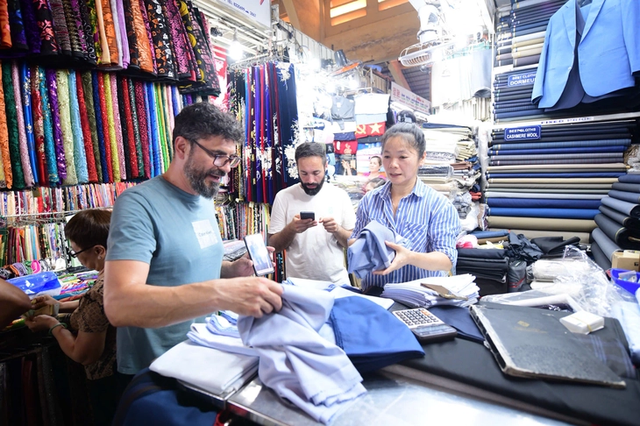
International visitors go shopping at Ben Thanh Market in Ho Chi Minh City, May 26, 2026. Photo: Quang Dinh / Tuoi Tre
Tran Thi Hong, owner of a beverage stall at Ben Thanh Market, said around 70 percent of customers now choose cashless payments, with the figure reaching 80-90 percent among younger shoppers.
“QR Pay makes it easier to track revenue and simplify tax declarations,” Hong said.
Kelvin Utomo, head of products and solutions for Visa Vietnam, Laos, and Cambodia, said Vietnam is entering a strong phase of digital commerce development, supported by consumers’ growing confidence and readiness to adopt digital payments.
“Three years ago, contactless payments accounted for only around 50 percent of Visa transactions in Vietnam during Cashless Day," Utomo said.
“By the time Digital Finance Day was launched, the figure had risen to around 80 percent, with 30 percent coming from global e-wallet features,”
He added that the Vietnamese government and payment ecosystem partners are promoting solutions to help small businesses and household enterprises access modern payment methods more easily.
“We believe the network accepting digital payments should continue expanding. Businesses should not see this as a cost but as a necessary condition for growth as consumer behavior changes rapidly,” Utomo said.
Ho Chi Minh City attracts rising spending from visitors
Nguyen Nguyen Phuong, deputy director of the Ho Chi Minh City Department of Industry and Trade, said the city is focusing on developing modern commercial infrastructure, promoting e-commerce, and stimulating consumption to support double-digit GRDP growth targets.
Ho Chi Minh City is also strengthening programs that combine tourism with shopping in an effort to attract more international visitors.
However, Phuong noted that challenges remain in bringing digital payments into traditional markets and small grocery stores, despite numerous attempts.
“To promote digital payments in traditional retail areas, it is important to better understand the actual needs of small traders and develop more suitable solutions,” he said.
Vu Thanh Truc, brand management and marketing campaign director at Prudential Vietnam, said digital transformation is focused not only on technology but also on redesigning customer experiences to improve transparency and convenience.
Meanwhile, Nguyen Phuong Huyen, director of the retail banking division at Sacombank, said QR Global payment services have already been deployed with Thailand, Cambodia, and Laos, and recently expanded to China and South Korea, where transaction volumes have shown impressive growth.
She said the model not only supports Vietnamese travelers abroad but also opens opportunities to develop a broader ASEAN digital payment market and attract more foreign currency spending from international visitors to Vietnam.








Max: 1500 characters
There are no comments yet. Be the first to comment.