


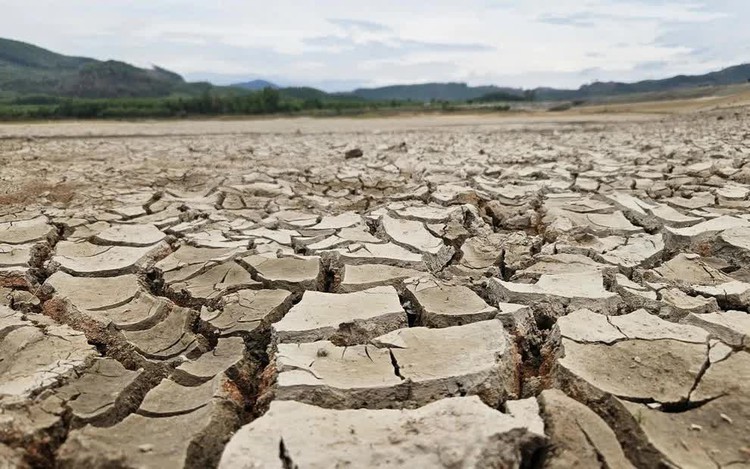
Hoc Cay reservoir in Khanh Cuong Commune, Quang Ngai Province, central Vietnam, is cracked, with its dry bed exposed amid prolonged hot weather. Photo: Tran Mai / Tuoi Tre
According to the Quang Ngai water management authorities, the 127 irrigation reservoirs in the province's eastern communes currently hold an average of just over 31 percent of their designed capacity.
Declining water supplies amid a lingering dry spell have forced many localities to carefully regulate and use every remaining cubic meter of water to maintain agricultural production and minimize losses for farmers.
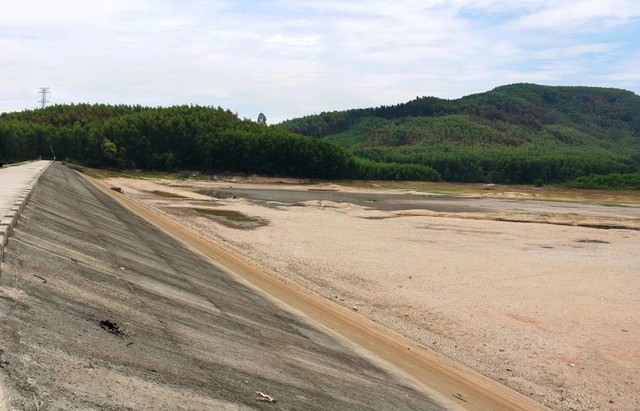
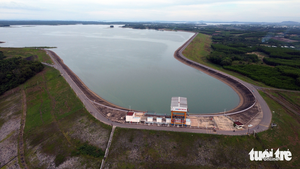
An irrigation reservoir in Quang Ngai, central Vietnam. Photo: Tran Mai / Tuoi Tre
At An Hoi reservoir, one of 14 such facilities tasked with supplying irrigation water for summer-autumn crops in Dong Son Commune, the lakebed has dried out, with cracks appearing in many areas.
In Mo Duc Commune, Hoc Sam reservoir is now at only around 3.8 percent of its capacity.
The reservoir is supposed to irrigate more than 93 hectares of summer-autumn rice, but dwindling supplies are making it increasingly difficult for local authorities to sustain agricultural production.
Meanwhile, Liet Son reservoir in Duc Pho Ward, the second-largest irrigation reservoir in eastern Quang Ngai, is also rapidly running dry.
On July 24, it held around 26 percent of its capacity, but that figure has since fallen to only around 10 percent.
The area has experienced thunderstorms in the late afternoons and evenings in recent days, but the rainfall has provided little additional water, failing to offset water used for agricultural production and lost to evaporation amid the hot weather.
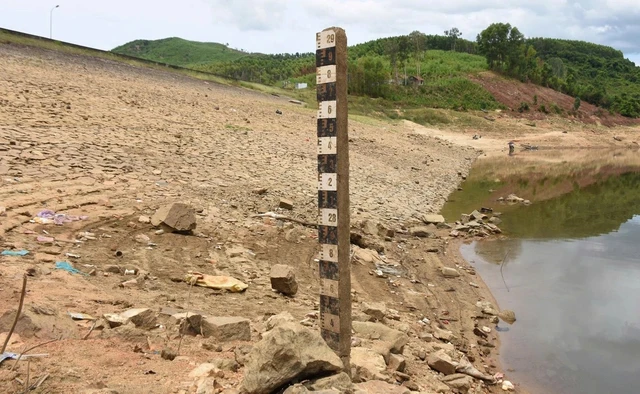
The water-level marker at Liet Son reservoir in Duc Pho Ward, Quang Ngai Province, central Vietnam, stands exposed as the reservoir's capacity has fallen to only 10 percent. Photo: Tran Mai / Tuoi Tre
In Khanh Cuong Commune, Hoc Cay reservoir has also dried up completely.
The reservoir is supposed to supply irrigation water for around 25 hectares of rice and other crops during the summer-autumn growing season.
However, water supplies at the reservoir have been insufficient for several consecutive years.
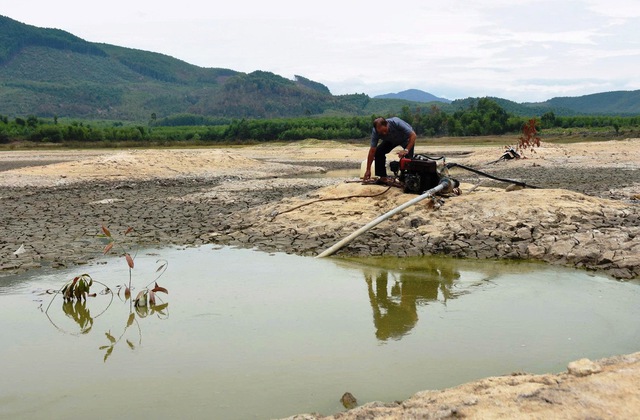
A farmer uses a pump to draw water from small pools at the bottom of a reservoir in Quang Ngai Province, central Vietnam. Photo: Tran Mai / Tuoi Tre
Although farmland lies right next to the reservoir, local farmers are still unable to cultivate all of their available land.
Compared with the winter-spring crop, the area planted with rice during the summer-autumn crop is only around two-thirds as large, with the remaining farmland left uncultivated due to a lack of irrigation water.
More concerningly, many rice fields in the area are now entering the heading stage, a critical period that determines crop yields.
As water supplies become increasingly scarce, local authorities have been forced to pump out and make use of the small amount of water remaining in reservoirs in an effort to maintain irrigation for rice crops.








Max: 1500 characters
There are no comments yet. Be the first to comment.