


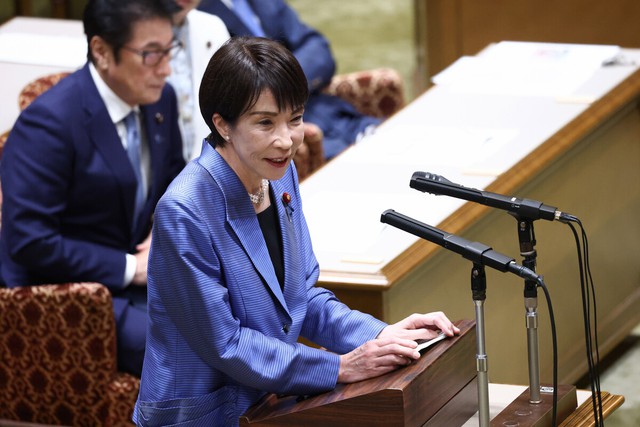
Japan's Prime Minister Sanae Takaichi speaks at a party leaders' debate in the Diet building, November 26, 2025. Photo: Jiji Press
While the measure has gained support from lawmakers, including opposition party members, concerns remain that the government could strengthen its surveillance and tighten control over information.
The focus will be how to balance the development of a counterintelligence system in light of the severe security environment surrounding Japan and the protection of constitutional rights, such as confidentiality of communication and freedom of speech.
In a parliamentary debate with party leaders on November 26, Takaichi pledged to draw up related legislation "swiftly."
On Thursday, Chief Cabinet Secretary Minoru Kihara told a press conference, "It's extremely significant to prevent unjust interference from foreign countries."
Takaichi's Liberal Democratic Party and its ally, the Japan Innovation Party (Nippon Ishin no Kai), stipulated in their coalition agreement that such legislation be enacted promptly.
To begin with, the government and the ruling parties will consider enacting a law requiring individuals acting on behalf of foreign interests to report their financial sources and activities. The aim is to make the activities of foreign forces more visible.
In 1985, the LDP submitted a bill to the Diet, Japan's parliament, to prevent espionage following the Miyanaga case, in which a former Ground Self-Defense Force major general leaked defense secrets to a spy from the former Soviet Union.
However, the lawmaker-sponsored bill was criticized for its strict provisions covering a wide range of targets and punishments, which included the death penalty. It was scrapped due to concerns that it could be used to punish speech and press activities.
The difference between now and then is that opposition forces are also calling for legislation against espionage.
The Democratic Party for the People and Sanseito have each submitted legislation to the Diet to strengthen intelligence activities. The departure of Komeito, cautious about antispy legislation, from the ruling coalition has also helped boost momentum for enactment of such a measure.
On the other hand, the main opposition Constitutional Democratic Party of Japan warns against hasty moves, saying that there is a risk of serious human rights violations.
It is already possible to punish leaks of important national security information under the laws on the protection of specially designated secrets and the protection and utilization of critical economic security information.
To gain a broad-based understanding from the public, it is necessary for the government to take human rights into consideration and clearly distinguish the new legislation from existing laws.
"It's natural that sufficient consideration should be given to the rights of the people, and we will provide careful explanations," Kihara said of the matter.









Max: 1500 characters
There are no comments yet. Be the first to comment.