


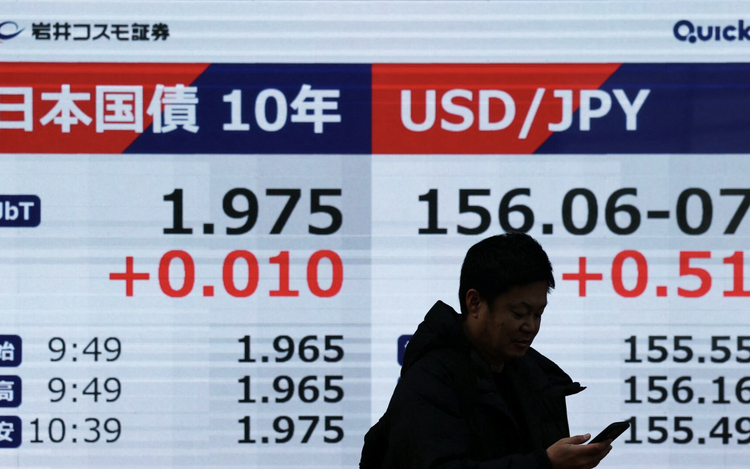
A man uses his smartphone in front of a screen displaying Japan's 10-year government bonds level and exchange rate between Japanese yen and U.S. dollar outside a brokerage in Tokyo, Japan December 19, 2025. Photo: Reuters
"They absolutely do not reflect fundamentals," Katayama told a news conference on the yen's declines after Bank of Japan Governor Kazuo Ueda's news conference last week.
"I don't believe they would have gone that far unless there were speculative moves. The government will take appropriate action against excessive moves," based on Japan's agreement with the U.S. in September on exchange-rate policy, she said.
The remarks mostly echo those she made in an interview with Bloomberg on Monday.
The yen rose to around 156 per U.S. dollar on Katayama's remarks on Tuesday, though it wasn't too far from the 11-month low of 157.78 touched on Friday.
In a joint statement issued in September, Japan and the U.S. reaffirmed their commitment to "market-determined" currency rates, while agreeing that foreign exchange interventions should be reserved for combating excess volatility.
Japanese policymakers have cited the statement as giving them the right to intervene when yen moves deviate from economic fundamentals and make excessively big swings.
Tokyo last stepped into the foreign exchange market in July 2024, buying yen after the currency hit a 38-year low of 161.96 per dollar.
"If the dollar climbs past the post-BOJ press conference highs into 158 yen and beyond, the government would conduct intervention at some point for sure," Hiroyuki Machida, director of Japan FX and commodities sales at ANZ, said.
A weak yen has become a source of headache for Japanese policymakers as it pushes up import prices and broader inflation, thereby increasing households' cost of living.
Tuesday's remarks contrasted with those Katayama made on Monday, when she said Japan will take appropriate action but did not define recent yen moves as out of line with fundamentals.
The BOJ raised interest rates to 0.75% on Friday, taking them to levels unseen in 30 years in another landmark step in ending decades of huge monetary support.
While the move helped narrow the interest rate gap with the U.S., the yen fell as markets interpreted comments from Ueda's post-meeting press conference as signaling the BOJ was in no rush to raise rates further.
ANZ's Machida said the yen's recent weakness reflects both the government's reflationary fiscal policies and the BOJ's still-easy monetary policy.
With Prime Minister Sanae Takaichi's administration preparing an expansionary budget for the next fiscal year, the market needs to see further monetary tightening for a correction in the yen's weakness, he said.








Max: 1500 characters
There are no comments yet. Be the first to comment.