


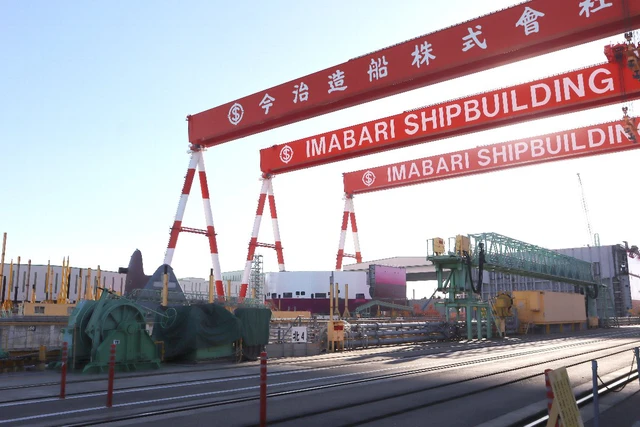
Imabari Shipbuilding's Marugame division shipyard in Marugame, Kagawa Prefecture, photographed in November 2025. Photo: Jiji Press
Last year, the transport ministry drew up a road map for revitalizing Japan's shipbuilding sector, setting a target of doubling shipbuilding volume by 2035 from the 2024 level.
The plan calls for one trillion yen in combined public- and private-sector investment.
In addition to capital spending, the road map aims to strengthen the industry as a whole by improving productivity through the use of robots and artificial intelligence technology, while also developing human resources.
Japan's shipbuilding industry accounted for nearly 40 pct of the global market in the 1990s, but its share has steadily declined.
As China and South Korea gained ground with large-scale shipyards, Japan's competitiveness weakened, and its global market share fell below 10 pct in 2024.
Currently, shipbuilding orders from domestic shipowners stand at about 12 million gross tons on a completion year basis, while domestic shipbuilding capacity is only about 10 million gross tons.
Japan depends on overseas sources for critical goods such as energy and food, and maritime shipping handles almost all of its trade. The shipbuilding industry is therefore essential to the country's economic security.
"We can't survive fierce competition with other countries unless we work together in an all-Japan effort," said Yukito Higaki, chairman of the Shipbuilders' Association of Japan and president of Imabari Shipbuilding Co.
Low-carbon vessels
The transport ministry has allocated 120 billion yen in the fiscal 2025 supplementary budget to establish a fund aimed at revitalizing the shipbuilding industry.
The fund will be used to subsidize upgrades to production facilities, investments in automation, and research and development projects.
The ministry is calling for total investments of about one trillion yen, including private-sector contributions.
Public and private investment will be financed in part through the issuance of green transformation, or GX, economic transition bonds, designed to support decarbonization efforts.
Investment targets include key vessel categories such as bulk carriers, tankers and container ships, as well as automobile carriers, a segment in which Japan has a competitive advantage.
Liquefied carbon dioxide carriers, which are expected to emerge as a new market, are also among the targets.
Within these key categories, next-generation ships with effectively zero greenhouse gas emissions are seen as a particularly promising market.
Development of world-leading vessels is already underway.
Nippon Yusen K.K. and other companies aim to complete the world's first ammonia-fueled medium gas carrier for international shipping in November.
"The market for next-generation ships is not yet large, but if Japan can build outstanding vessels, that could help change perceptions of the country's capabilities in other major ship categories as well," said Shinichiro Otsubo, a specially appointed researcher at the Japan Transport and Tourism Research Institute.
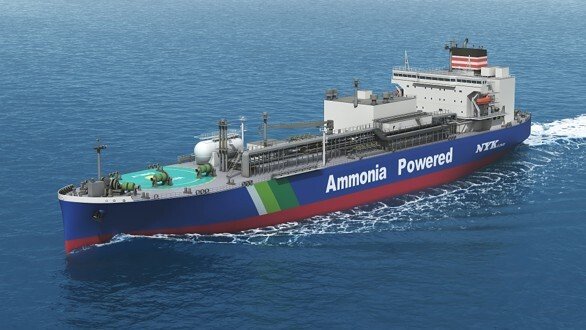
Computer-generated rendering of the completed ammonia-fueled medium gas carrier. Photo: Courtesy of Nippon Yusen
Steel costs, workforce upgrade
At the same time, Otsubo identified rising steel prices and labor shortages as major challenges facing the industry.
Shipbuilding costs in Japan are about 20 pct higher than in China, driven primarily by steel prices, which account for roughly 30 pct of the total costs.
To address these pressures, related industries, including shipbuilders and steelmakers, have established a high-level council on shipbuilding, shipping, marine equipment and steel to develop a cooperative framework.
The group held its first meeting in March.
Although the overall decline in the shipbuilding workforce has been halted by an increase in foreign workers, the number of Japanese workers in the industry continues to fall.
The revitalization road map proposes a range of measures, including developing highly skilled personnel through cooperation with communities near shipyards and educational institutions, improving employment conditions and introducing humanoid robots.
Shipowners, who place orders for vessels, also believe that strengthening Japan's shipbuilding industry will help enhance the competitiveness of the country's maritime shipping sector.
"As an island nation, Japan can't afford to lose the people who build ships and their components or the people who operate ships," said Hitoshi Nagasawa, president of the Japanese Shipowners' Association and chairman of Nippon Yusen.
"One of the core elements in strengthening the entire maritime industry is reinforcing the shipbuilding sector."









Max: 1500 characters
There are no comments yet. Be the first to comment.