


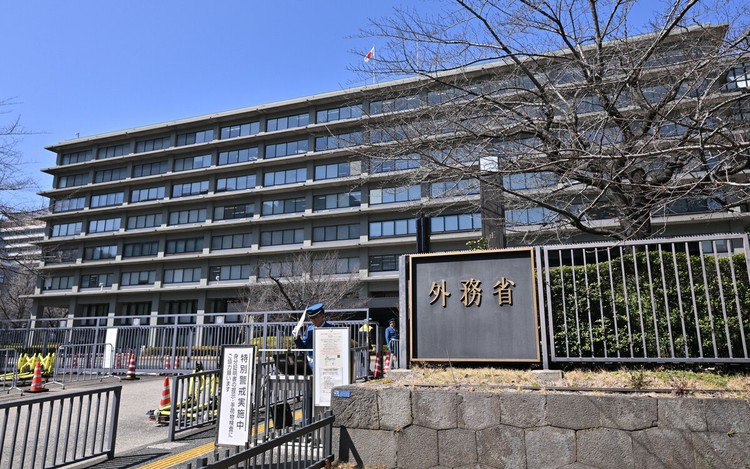
The Foreign Ministry building in Chiyoda Ward, Tokyo, pictured on March 12
The ministry plans to adopt the computer-based testing format for the new test for those seeking the Specified Skilled Worker residence status. It has included related funding in its fiscal 2027 initial budget request, government officials said.
Foreign workers are required to prove their Japanese proficiency in order to obtain the Specified Skilled Worker status.
For those seeking Type 1 of the residency status, the Japanese government currently offers two Japanese-language tests: the Japanese-Language Proficiency Test (JLPT) and the Japan Foundation Test for Basic Japanese (JFT-Basic). Both are operated by bodies including the Japan Foundation.
The JLPT, conducted in July and December in principle, adopts a paper-based bubble sheet method, while the JFT-Basic, held monthly in principle, uses the computer-based testing format.
The number of JLPT applicants has been increasing since 2023, following the subsiding of the COVID-19 pandemic.
The number of domestic applicants for the exam scheduled for December is expected to reach a record high of about 510,000, with all available slots filled. Applications for the December test were closed in September.
The number of foreigners intending to take the JLPT in order to obtain residence status other than Specified Skilled Worker is also believed to have risen.
Following revisions to ministerial ordinances under the immigration control and refugee recognition law, foreign workers who newly enter Japan under Type 2 residency status for specified skilled workers from April 2027 will be required to demonstrate Japanese proficiency equivalent to the B1 level or above under the Common European Framework of Reference for Languages, a widely used international standard for describing language ability.
As the JFT-Basic does not offer a test level to assess such proficiency, demand for the JLPT is expected to rise further.
Under such circumstances, the ministry concluded that a new test is necessary to measure Japanese proficiency at the B1 level or above. The leading proposal is to add the new test level to the JFT-Basic. The ministry will also consider introducing a computer-based testing version of the JLPT.
The Regulatory Reform Implementation Plan approved by the cabinet in July called on the ministry to take measures to expand testing opportunities for applicants with the B1 level or above.



Max: 1500 characters
There are no comments yet. Be the first to comment.