


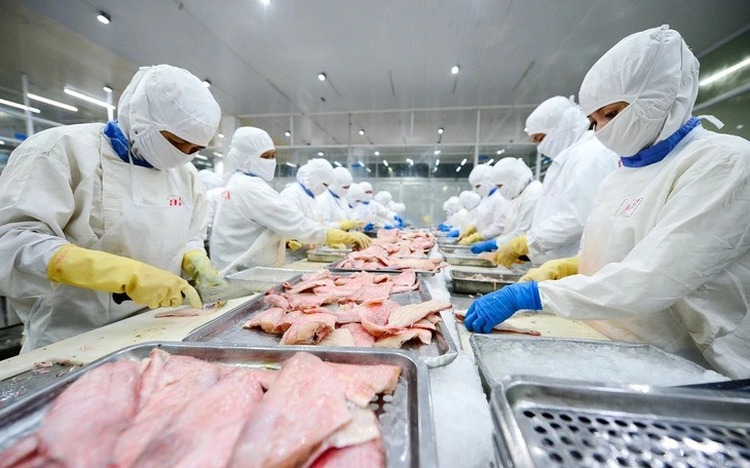
Workers process Vietnamese tra fish (pangasius) for export at a factory in Vietnam. Photo: T.L. / Tuoi Tre
In the first nine months of 2025, total export earnings of Vietnamese pangasius products to Japan reached US$34 million, up 14 percent from the same period last year.
Frozen pangasius fillets remain the leading export item, accounting for nearly $30 million out of the total, up 11 percent from a year earlier.
In addition, the export value of value-added processed pangasius rose 47 percent, reflecting strong consumer demand for these items in Japan.
Exports of other fresh, frozen, whole, and cut pangasius products also increased 39 percent, indicating a broader product mix in Vietnam’s tra fish exports to the Japanese market.
In September alone, the export value of pangasius products to Japan rose 12 percent, reflecting stronger import demand as natural fish sources such as Alaska pollock and cod face reduced supply due to catch quotas.
Currently, Vietnam ranks third in Japan’s white fish market, behind the U.S. and Russia.
Within Japan’s white fish consumption structure, pangasius fillets are second only to Alaska pollock fillets and meat, becoming an increasingly popular alternative in the processed food industry, restaurant chains, and supermarkets across the country.
Recently, Vietnamese tra fish has been added to the menu of Kura Sushi, a Japanese restaurant chain with more than 100 outlets nationwide.
Kazumasa Suzuki, director of Toyo Reizo Co., Ltd., a marine products general trading company in Japan, noted that demand for Vietnamese tra fish in Japan is expected to grow further as consumers look for safe, high-quality, and reasonably priced seafood.
VASEP credits part of this growth to the Comprehensive and Progressive Agreement for Trans-Pacific Partnership, which provides tariff incentives that improve the price competitiveness of Vietnamese pangasius.
As Japan’s economy grows slowly, consumers are increasingly looking for products that combine stable supply with affordability.
However, competition is intensifying as Russia seeks to expand seafood exports to Asian markets, including Japan, to offset declining shipments to Europe.
In this context, VASEP recommends that Vietnamese firms diversify their processed product lines, invest in convenience items such as pre-cut, breaded, and pre-packaged pangasius fillets, and enhance traceability and quality certifications to build stronger trust and reputation in the Japanese market.









Max: 1500 characters
There are no comments yet. Be the first to comment.