


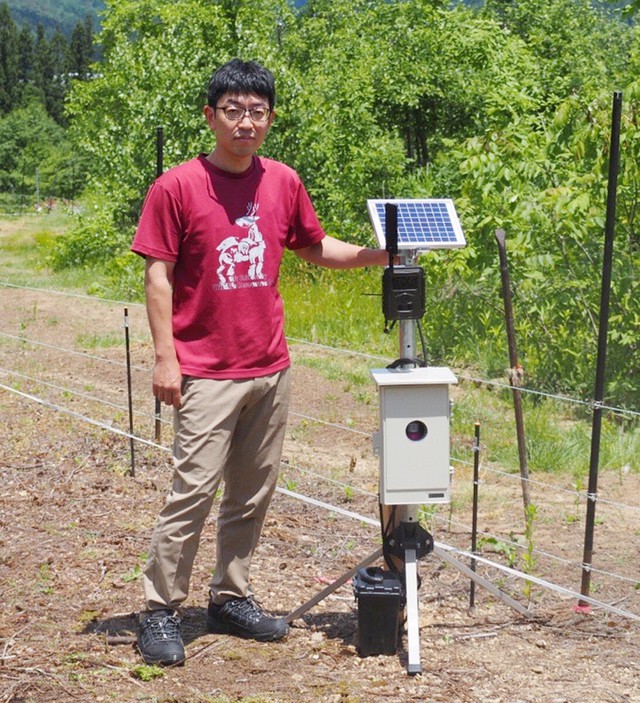
The AIBeS system, designed to automatically repel bears, and Junji Moribe, associate professor at Gifu University involved in a demonstration experiment using the system, pictured in the city of Hida, Gifu Prefecture, Japan, May 29, 2026. Photo: Jiji Press
The system, dubbed AIBeS, was developed by Hyke Inc., a company based in Asahikawa in the northernmost prefecture of Hokkaido, that specializes in AI-powered remote monitoring.
When the system detects an animal with thermal sensors or other detectors, its camera is activated and AI software analyzes the footage.
If the animal is identified as a bear, the system automatically discharges a commercially available bear spray.
The trial is underway in the city of Hida.
AIBeS can operate around the clock, and it can be used even in mountainous areas.
Widely used conventional measures to drive bears away include producing sounds that bears dislike and flashing lights. But given that some animals may have grown accustomed to those methods, the developer decided to use repellent.
The system can identify bears at a distance of up to about 15 meters, including at night when visual confirmation is difficult.
The spray reaches roughly 5 to 10 meters.
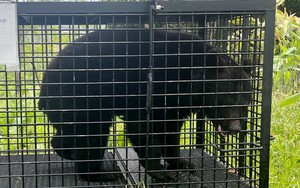
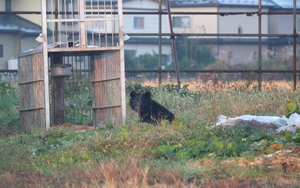
Powered by solar panels, the device needs no external power source. It can be installed in orchards and other sites that frequently attract bears.
Participants in the trial hope that repeated exposure to the system will condition bears to regard such locations as hazardous to them and avoid returning.
In the trial, two units are in operation. The city plans to increase the sites and gather detailed data on bears' reactions to the spray and changes in the frequency of their appearances.
Junji Moribe, associate professor at Gifu University's wildlife resource science laboratory, called the project "an important first step toward automation" in bear management.
But he cautioned, "It's only one of the various countermeasures, not a panacea."
The trial, conducted jointly by Hyke, Gifu University and the Hida city government, will run until the end of September.
Based on the results, Hyke aims to market the system to municipalities nationwide.
"Twenty-four-hour human monitoring is difficult, so it's better to rely on AI and machines," President Yuta Hayakawa said, in view of cases in which local governments struggle to respond quickly to bear sightings in remote areas and at night.









Max: 1500 characters
There are no comments yet. Be the first to comment.