


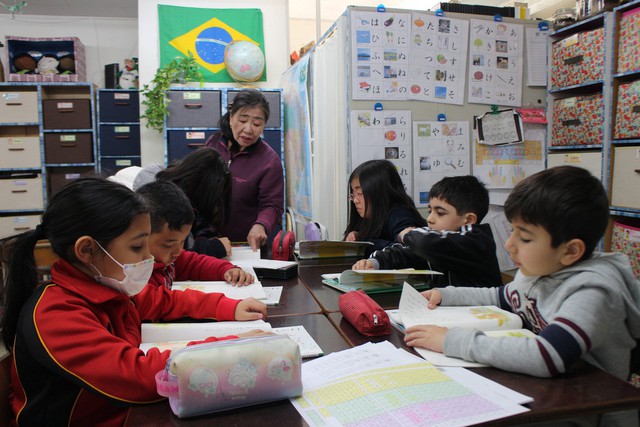
Children study in an elementary-level class at Escola Paulo Freire Seto, a school for Japanese Brazilian students, in Seto, Aichi Prefecture, central Japan, April 28, 2020. Photo: Jiji Press
In response to an increase in the number of foreign national children in Japan, the ministry aims to establish guidelines for effective instructions for such students, or so-called pre-classes, through the project
The number of public school students requiring Japanese-language instructions, including those who are unable to communicate adequately in daily Japanese conversation, reached a record high of 84,759 in fiscal 2025, which ended last March, doubling over nine years, according to a ministry survey.
Of those students, about 10 pct were not given sufficient instructions at their schools due mainly to a shortage of staff.
In urban areas with large numbers of foreign children, some local governments are already offering pre-classes. However, what instructions are given and how long they are offered vary.
Through the model project, the ministry aims to gather know-how about how such instructions should be provided.
Based on the findings, it will come up with guidelines for use by local governments and develop teaching materials.
The ministry will select multiple local governments for the project.
In municipalities with many children requiring instructions, students at several schools will be brought together at base schools or public facilities to receive instructions.
In rural areas, instructions may be given online.










Max: 1500 characters
There are no comments yet. Be the first to comment.