


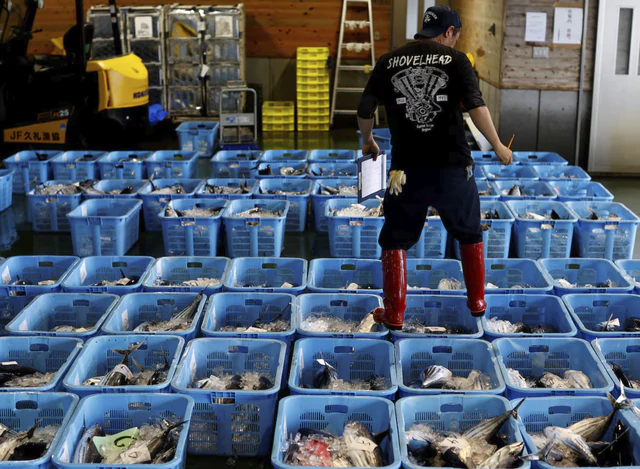
A member of the fish market staff checks the boxes of katsuo (shipjack tuna) before a wholesale auction at Kure Port, in Nakatosa Town, Kochi Prefecture, Japan, May 14, 2022. Photo: Reuters
The data will be among the factors the Bank of Japan will scrutinise at its next policy meeting on December 17 and 18, when many analysts expect the central bank to raise its policy rate to 1.5% from 1.25%.
"Wholesale inflation is likely to accelerate due to lingering uncertainty over the Middle East conflict, with a wide range of goods seen coming under upward price pressure," said Masato Koike, senior economist at Sompo Institute Plus.
"While the BOJ could opt to stand pat if markets remain volatile, our baseline projection is for the central bank to raise interest rates in December," he said.
The corporate goods price index, which measures the price companies charge each other for their goods and services, rose 7.1% in the year to October, BOJ data showed on Thursday, faster than a median market forecast for a 6.5% increase.
It accelerated to a 6.8% year-on-year increase in September, as firms timed price hikes at the October start of a new quarter and the latter half of Japan's fiscal year ending in March 2027, Sayaka Yamazaki, head of the BOJ's price statistics division, told a news briefing.
"A wide range of goods saw prices rise as firms continued to pass on rising labour and raw material costs," as well as higher oil and chemical goods prices from the Middle East conflict, she said.
Petroleum and coal goods prices rose 15.9% in the year to October, faster than an 11.5% gain in September. Prices of chemical goods were also up 15.5% in October after a 13.4% increase in September, the data showed.
Prices of transportation equipment, such as automobile parts, rose 3.2% in October, accelerating from a 2.9% gain in September, as brisk AI-related demand boosted prices of semiconductor chips.
The yen-based import price index rose 24.8% in October from a year earlier, the data showed, a sign that the currency's weakness continued to push up the cost of raw material imports.
With stubbornly high energy costs and rising import prices from a weak yen adding to inflationary pressures, the BOJ raised rates in September after delivering a hike in June - a shorter interval than the roughly twice-a-year hikes in 2024 and 2025.
At a subsequent meeting last month, the BOJ kept policy steady but declared victory in its 14-year battle to hit its price target and flagged upside price risks, reinforcing its hawkish bias.
Some BOJ policymakers called for speeding up the pace of interest rate hikes as underlying inflation reached the central bank's 2% target, a summary of opinions from its October meeting showed, bolstering the case for near-term tightening.


Max: 1500 characters
There are no comments yet. Be the first to comment.