


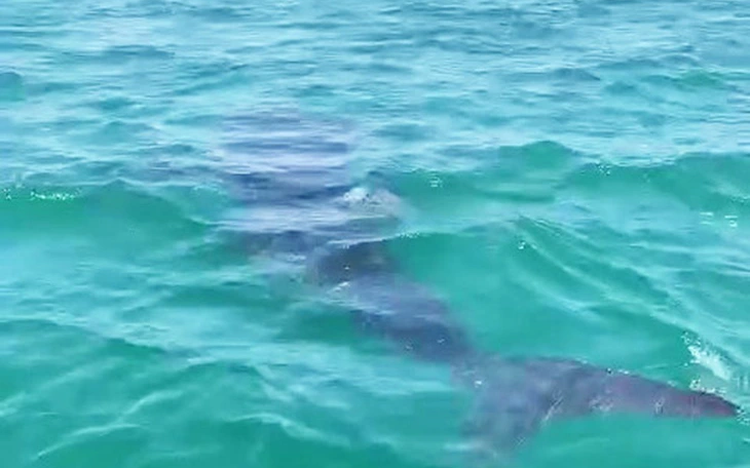
A screenshot from a video shows a large shark measuring nearly six meters in length swimming close to the shore of Duy Nghia Commune in Da Nang City, central Vietnam. Photo: Screenshot from Vinh Cuu Channel video
A video posted on Facebook on Wednesday captured the giant fish swimming near the coast of Duy Nghia Commune in Da Nang City on Tuesday morning.
Local fishermen believed the fish to be a whale shark.
The animal was estimated to be about six meters long and approximately 1.5 meters wide.
The owner of the Vinh Cuu Channel account, who recorded the footage while fishing offshore, said he encountered the large shark by chance as it swam calmly through the water.
He noted that the fish was nearly as large as his fishing boat.
If the shark was indeed a whale shark, it would be known for its docile nature and would not pose a threat to humans.
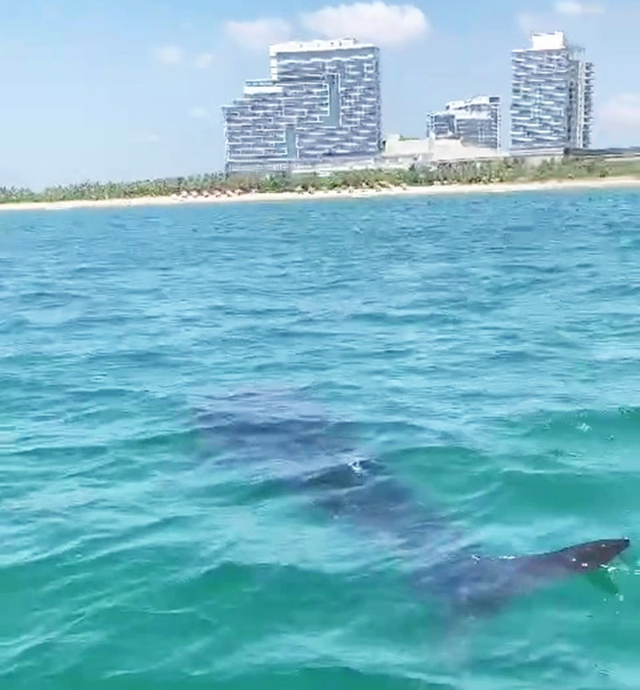
A screenshot from a video shows the giant fish swimming near a coastal resort in Da Nang, central Vietnam. Photo: Screenshot from Vinh Cuu Channel video
Pham Duoc, chairman of the Duy Nghia People’s Committee, told Tuoi Tre (Youth) newspaper that local fishermen treat the species with great respect and often associate it with 'ca Ong,' a revered sea deity in Vietnam’s coastal fishing culture.
According to Duoc, the fish likely followed schools of smaller fish, its primary food source, into nearshore waters before returning to the open sea.
“I asked local fishermen about it, and they said this is a very gentle species, not a dangerous one,” he said.
The commune leader added that this was not the first time large sharks believed to be whale sharks had been spotted near the Duy Nghia coastline, as they occasionally appear in the area.
Scientifically known as Rhincodon typus, the whale shark is a unique member of the subclass Elasmobranchii, which includes sharks and rays.
It holds several size records in the animal kingdom, most notably as the largest living non-mammalian vertebrate.
Whale sharks are commonly found in warm surface waters across tropical oceans.
Scientific studies estimate the species can live between 80 and 130 years.








Max: 1500 characters
There are no comments yet. Be the first to comment.