



A doctor removes a live leech from the nasal cavity of a 30-month-old boy at Quang Ngai Provincial Obstetrics and Pediatrics Hospital in Quang Ngai Province, central Vietnam. Photo: Ny Ny
Doctors at Quang Ngai Provincial Obstetrics and Pediatrics Hospital confirmed that the child’s condition is now stable after the leech was successfully removed through an endoscopic procedure.
The patient, identified as N.D.D., lives in Dang Thuy Tram Commune.
He was admitted to the hospital’s outpatient department on December 30, 2025 after experiencing continuous runny nose symptoms accompanied by intermittent nosebleeds.
His family members said the symptoms had persisted for about a week without improvement.
Prior to admission, the child had been taken to a local private clinic and treated for what was diagnosed as rhinitis, but his condition gradually worsened.
The family then decided to bring the child to the provincial-level hospital for further examination.
During medical history taking, doctors learned that about a week before symptoms began, the child had accompanied his parents to farmland in a mountainous area and had bathed in a natural stream.
After that, the boy frequently scratched his nose, experienced difficulty breathing while sleeping, and occasionally had nosebleeds.
The symptoms became more pronounced whenever he came into contact with water.
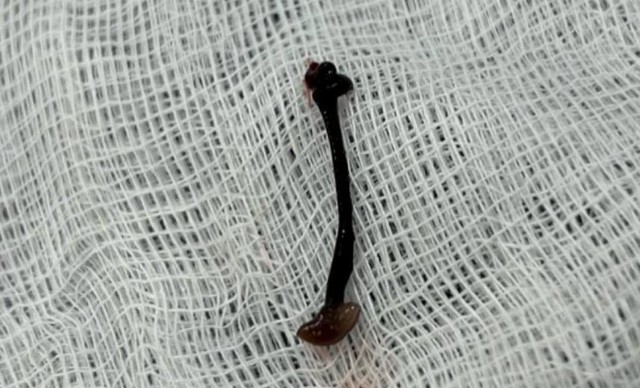
A live leech found parasitizing a 30-month-old boy’s nasal cavity causes prolonged nasal discharge, bleeding, and difficulty breathing. Photo: Ny Ny
A clinical examination combined with nasal endoscopy revealed a live leech lodged deep inside the child’s nasal cavity.
Doctors immediately performed an interventional endoscopic procedure and safely removed the leech, which measured approximately three centimeters in length.
Following the procedure, the child’s nosebleeds stopped and his breathing stabilized.
He is currently recovering well and no longer shows signs of respiratory distress.
Doctors at the hospital warned that leeches can enter the nose, throat, or respiratory tract when children bathe in streams or drink untreated water.
Once inside the body, leeches attach firmly to mucous membranes, feed on blood, and cause prolonged bleeding, symptoms that are easily mistaken for common nasal infections.
Doctors strongly advised parents to limit young children’s exposure to streams, ponds, and natural water sources, especially in mountainous or forested areas.
Children should never drink stream water directly, and water must be boiled before use.
Parents are urged to seek medical attention promptly if children show signs such as persistent nosebleeds, one-sided nasal congestion, foul-smelling nasal discharge, or unexplained breathing difficulties, as early endoscopic examination can prevent serious complications.








Max: 1500 characters
There are no comments yet. Be the first to comment.