


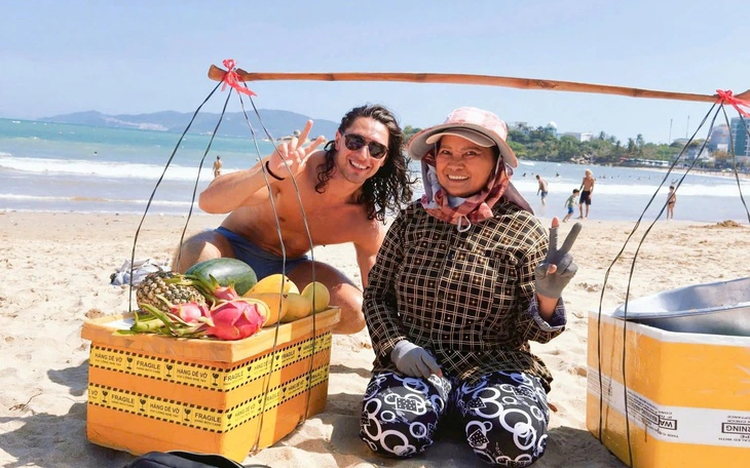
A foreign tourist (L) smiles while buying goods from Nguyen Thi Mai, a street vendor in Nha Trang, Khanh Hoa Province. Photo: Supplied
While positive interactions can create lasting memories and encourage visitors to return, negative practices targeting tourists can damage the country’s image and undermine sustainable tourism development.
This reality highlights the urgent need for comprehensive solutions to ensure that local people's activities become a cultural highlight rather than a negative mark in the eyes of international visitors.
Local people leave lasting impressions
In 2025, a British tourist named Louis met Mai, a fruit vendor on a beach in Nha Trang, Khanh Hoa Province, south-central Vietnam.
Instead of simply calling out to customers, she smiled and sang in English: “Mango, pineapple, banana, watermelon…” She even sang a line from a song by American singer and musician Lionel Richie.
Louis recorded a short video, which South African musician David Scott later remixed into an upbeat electronic track.
The clip quickly spread across TikTok, Instagram and YouTube Shorts.
More recently, a short video showing a conversation between a tourist and a tofu pudding vendor in Hoi An Ancient Town in central Vietnam went viral on social media.
In the video, the vendor fluently advised a Thai visitor in Thai, speaking naturally as if she were a native speaker.
When the tourist asked how many languages she could speak, she modestly replied, “Just a little,” while revealing that she could speak five languages: Chinese, Korean, Japanese, Thai and English.
In Ho Chi Minh City, 81-year-old Hai, a gray-haired woman who sells banh mi on Nguyen Trai Street, confidently speaks English and French to help foreign visitors find their way, tells stories and chats with foreigners.
Many foreigners said they were more impressed by her friendliness and communication skills than by the sandwiches she sells.
For many international tourists, Vietnam’s beauty lies not only in its landscapes but also in people like those featured in these stories.
Street vendors carrying baskets of goods, calling out to customers and offering genuine smiles have become vivid symbols of communities across the country.
Community-based tourism further highlights this appeal.
In many places, local residents not only welcome visitors but also open their homes, share family meals and teach tourists how to make traditional food, weave brocade and go fishing.
Such experiences create deep emotional connections, making visitors feel as though they are being welcomed as family members rather than treated simply as customers.
Local people's activities create the “soul” of a destination.
Tourism cannot rely solely on five-star hotels and luxury resorts.
The natural presence of local residents, their occupations, lifestyles and everyday interactions gives each destination its unique identity and helps Vietnam stand out from other destinations.
Negative practices damage Vietnam’s tourism image
Unfortunately, alongside these positive stories, there are also practices that make tourists wary.
At some popular tourist destinations, visitors face persistent touting, inflated prices charged to foreigners, counterfeit goods and unofficial guides who take tourists to stores in exchange for illegal commissions.
In some cases, tourists have even been robbed or extorted, sparking public outrage.
A recent crackdown in Ho Chi Minh City on a gang specializing in extorting tourists over shoe-shining services has also highlighted concerns over negative practices targeting visitors.
Such incidents not only cause tourists financial losses but can also leave lasting negative impressions that spread quickly on social media and international travel forums.
The consequences can be significant. The image of a friendly and safe destination can be damaged, while tourists who have had bad experiences may warn others or even list Vietnam among places they would not recommend visiting.
The tourism industry suffers a double loss: losing immediate revenue and suffering long-term damage to its reputation.
Honest local businesses and residents are also affected as tourists become more cautious and less willing to interact with local communities.
This is not a problem unique to Vietnam. Many developing countries with rapidly growing tourism industries have faced similar challenges.
Some have recognized the problems early and taken decisive measures to improve public awareness and community discipline.

Le Thi Nga, deputy head of Thai Hai Village, Thai Nguyen Province, northern Vietnam, wears traditional Tay ethnic attire. Photo: Nguyen Hien / Tuoi Tre
Proposed solutions
To promote the positive aspects of local involvement while limiting negative practices, coordinated measures are needed, ranging from public awareness and education to community action and government oversight.
Public awareness and community education should be strengthened.
Regular training and outreach programs should be organized for residents in tourist destinations to highlight the importance of the country’s image and the long-term benefits of sustainable tourism.
The message should emphasize that every resident is a “tourism ambassador” whose behavior directly affects the livelihoods of the wider community.
Successful stories of street vendors and community-based tourism operators who have earned tourists’ affection and encouraged repeat visits should be widely promoted as positive examples.
Local activities should also be organized and managed systematically. Rather than imposing blanket bans, local authorities should designate appropriate spaces for street vendors, enabling them to operate in an orderly, clean and civilized manner.
Licenses, uniforms or identification signs could be provided to reputable vendors.
For community-based tourism, clear codes of conduct should be established, alongside mechanisms for community members to monitor one another.
When local residents are well organized, they are more likely to take responsibility for their work.
Inspections should be strengthened to detect and address violations.
Authorities should conduct regular patrols in areas where tourist harassment and overcharging are common.
Violations should be dealt with firmly and publicly to serve as a deterrent.
At the same time, visitors should have quick channels for reporting problems through apps, hotlines or tourist assistance centers, allowing authorities to intervene promptly.
Technology and transparency should also be promoted. Apps could help tourists check reference prices, rate services and identify reputable vendors or local households.
Cashless payments should be encouraged to reduce risks. Online review platforms can also encourage local residents and businesses to maintain high service standards.
Basic foreign-language and soft skills training should be provided to local residents. Knowing how to greet visitors politely in foreign languages and introduce products respectfully can help create positive impressions.
Short courses on customer service and civilized behavior should be widely offered, especially in major tourist destinations.
A balanced system of benefits should be established. When residents see that honest and ethical business practices provide more stable and sustainable income than exploiting tourists for short-term gains, they will be more likely to adjust their behavior voluntarily.
Authorities can provide financial support, connect local products with markets, and create additional employment opportunities to reduce pressure on residents to maximize short-term earnings from tourists.
Travel companies and tour guides should also play a greater role.
Businesses should choose reputable local partners, explain codes of conduct to tourists and work with authorities to monitor activities in destinations.
Tour guides should provide proper guidance and never facilitate negative practices.
Local people are the soul of Vietnam’s tourism industry. Street vendors, boat rowers, genuine smiles, sincere invitations to visitors to come inside for a drink and family-style homestays all contribute to a distinctive appeal that is difficult to replicate elsewhere.
Preserving and promoting these positive qualities while decisively eliminating practices that damage the country’s image is a shared responsibility of communities, authorities and the tourism industry.








Max: 1500 characters
There are no comments yet. Be the first to comment.