


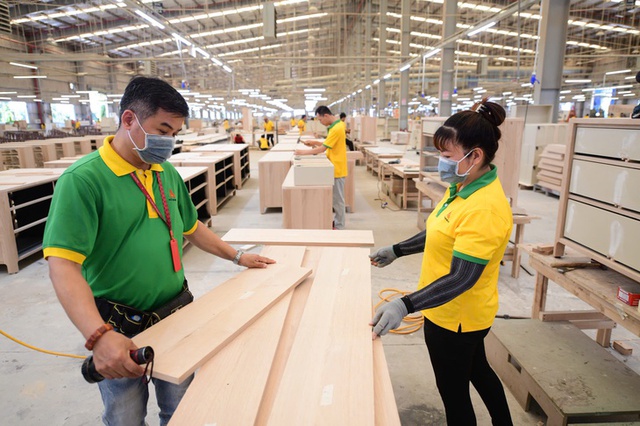
Workers process wooden furniture for export to the United States at a factory in Tay Ninh Province, southern Vietnam. Photo: Quang Dinh / Tuoi Tre
Editor's note: The following opinion piece was written by Do Thien Anh Tuan, a founding faculty member and lecturer in public policy at the Fulbright School of Public Policy and Management, Fulbright University Vietnam.
The piece was originally published in Vietnamese and has been translated into English and edited by Tuoi Tre News for clarity, consistency, and coherence.
As the long-standing industrial policy model based on low-cost labor, contract manufacturing, and broad-based foreign direct investment shows clear limits, the 'Make in Vietnam' strategy needs to be positioned as a deliberate strategic choice.
Its purpose is to strengthen the standing of Vietnamese manufacturing within global value chains.
Conceptually, 'Make in Vietnam' implies a shift away from 'Made in Vietnam,' which has largely relied on assembly work and foreign investment, toward a phase in which Vietnamese firms control design, technology, standards, and markets.
Yet this is precisely where the strategy reveals a structural weakness.
So far, 'Make in Vietnam' functions more as a guiding slogan than as an industrial standard with clear substance, defined criteria, and measurable benchmarks.
In terms of objectives, the strategy is aimed in the right direction: raising domestic value added, improving labor productivity, strengthening technological autonomy, and building a national brand.
But these goals remain largely at the level of policy statements.

Do Thien Anh Tuan, a founding faculty member and lecturer in public policy at the Fulbright School of Public Policy and Management, Fulbright University Vietnam.
Key questions remain unanswered, such as what 'control' actually means in practice, how much domestic value added is sufficient, and which criteria should be used to distinguish firms that genuinely create value from activities that amount to little more than relabeling.
Without clear answers to these questions, 'Make in Vietnam' is unlikely to guide investment decisions or drive innovation by Vietnamese companies in any meaningful way.
A comparison with Switzerland's 'Swiss Made' label highlights the difference.
'Swiss Made' is not a marketing slogan but a legally defined designation of origin.
It is backed by strict quantitative requirements on domestic value added, clear definitions of core technological stages, final assembly and inspection, and well-defined legal responsibilities.
As a result, 'Swiss Made' has become a national commitment to quality, allowing products that carry the label to command premium prices and strong trust in global markets.
Germany's 'Made in Germany' and the concept of 'German engineering,' as well as Japan's manufacturing philosophy of monozukuri and 'Japan quality,' follow a different path.
They do not rely on a formal national origin label in the Swiss sense, but instead build global credibility through rigorous technical standards, disciplined quality control, and strong legal accountability for products.
By contrast, India's 'Make in India' strategy, launched years ago, has focused on expanding production scale, attracting foreign investment, and promoting import substitution through incentives, rather than on creating strict origin or quality standards to support premium pricing.
That approach has delivered gains in scale and manufacturing capacity, but it has also limited India's ability to build a national brand anchored in quality and high value added.
The challenge for 'Make in Vietnam' is that it lacks clear criteria while also being unclear about which model it seeks to follow.
Vietnam does not yet have the industrial scale to compete on volume in the way India does.
At the same time, it has not fully developed the industrial ecosystem or legal framework needed to build a reputation for quality comparable to Germany or Japan, let alone a rigorously codified origin standard like Switzerland's.

Against this backdrop, for 'Make in Vietnam' to become effective, it needs to be redesigned around three core pillars.
The first is value added.
This requires clearly defining the share of value created domestically, differentiated by industry and technological complexity, instead of relying on assembly location alone.
The second is control of core stages, including design, foundational technologies, control software, and intellectual property.
The third is quality and standards.
Products should be required to meet technical, environmental, and safety standards aligned with target export markets, not merely domestic benchmarks.
On that basis, 'Make in Vietnam' should be linked to a transparent and credible certification mechanism, in place of allowing firms to apply the label at their own discretion.
Crucially, certification should be paired with conditional economic incentives, such as priority in public procurement, research and development support, preferential credit or trade promotion.
If it is restructured along these lines and grounded in clear standards, 'Make in Vietnam' could become a meaningful industrial policy tool.
It could help direct resources, upgrade firm capabilities, and gradually position Vietnam more firmly within global value chains.








Max: 1500 characters
There are no comments yet. Be the first to comment.