


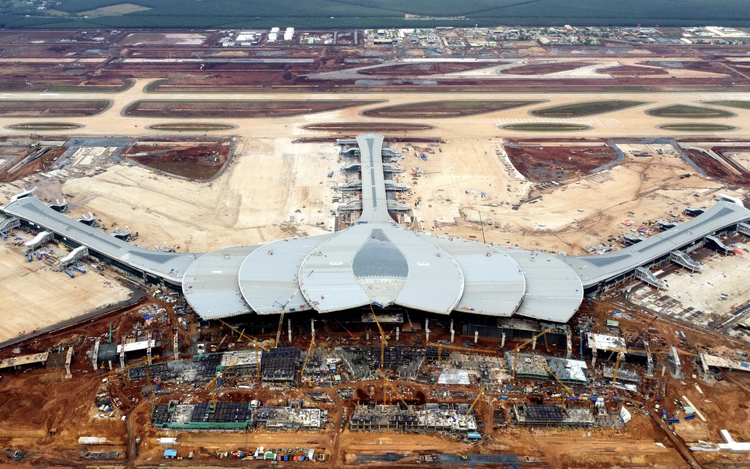
The lotus-shaped passenger terminal of Long Thanh International Airport in Dong Nai Province, southern Vietnam has largely taken shape and is in the final stage of completion, ready to welcome its first flight. Photo: A Loc / Tuoi Tre
The airport will temporarily shift from construction to operation to welcome its first technical test flights operated by Vietnam Airlines on Monday and Friday next week.
After four years and nine months since ground was broken on January 5, 2021, Vietnam’s largest airport has clearly taken shape.
Long Thanh International Airport is projected to require an investment of VND336.63 trillion (US$13 billion).
The project is being developed in three phases.
Phase 1 is scheduled for inauguration in December and commercial operations are set to begin in early 2026.
Once phase 1 becomes operational, the airport, with one runway and one terminal, will be able to serve 25 million passengers and handle 1.2 million metric tons of cargo annually.
When all three phases are finished, likely after 2035, the airport will be the largest in Vietnam with an annual capacity of 100 million passengers and five million metric tons of cargo.
Teams of workers drenched in sweat under the blazing sun at noon on Saturday, meticulously inspecting every detail of runway No.1, which stretches more than four kilometers.
Dozens of specialized vehicles mobilized from Tan Son Nhat International Airport in Ho Chi Minh City, Can Tho International Airport in Can Tho City and Cam Ranh International Airport in Khanh Hoa Province, south-central Vietnam, along with contractors’ equipment, moved slowly and steadily along the runway.
According to the Airports Corporation of Vietnam (ACV), the number of personnel has increased by some 1,000 workers compared to early November.
Construction now runs in shifts from early morning until late at night, covering the runway, taxiways, aprons, and the interior of the passenger terminal.
Nguyen Anh Dao, who leads a runway cleaning team, said work is divided into three shifts.
Some days their work begins at 7:00 am and ends at 11:00 pm.
“Each team handles a specific task such as sealing joints, painting markings, or vacuuming foreign objects from runway grooves,” she shared.
“It’s exhausting under the midday sun, but no one dares to cut corners. Even the smallest error is unacceptable in airport construction."
Along the runway edges, workers ate boxed lunches in haste, grabbed a few minutes of rest, then returned to their positions on Saturday, according to the observations of Tuoi Tre (Youth) newspaper reporters.
Much of the project’s key infrastructure has already been completed.
Calibration and inspection flights were conducted from late September to late October, allowing relevant units to assess the technical system’s synchronization, navigation capability, lighting, meteorology, and inter-agency coordination before moving into deeper trial operations.
Construction teams focus on not only volume and speed, but also on precision, detail, and compliance with operational standards.
Everything must be done correctly and in full synchronization.
Inspecting the runway at midday, Duong Quang Dien, director of the Long Thanh International Airport Project Management Unit, confirmed that runway No.1 and the taxiway system had completed construction, equipment installation and calibration flights, and are ready for operation.
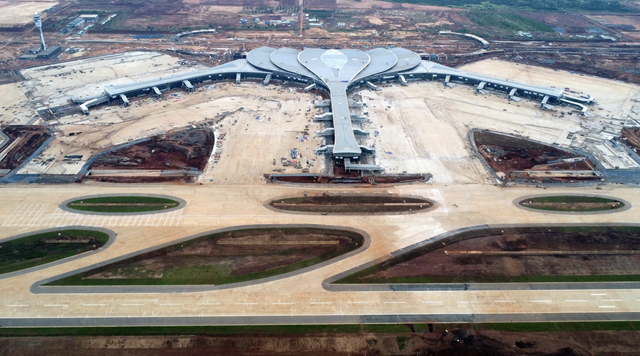
Runway No. 1 of Long Thanh International Airport in Dong Nai Province, southern Vietnam is being cleaned in preparation for welcoming its first flight. Photo: A Loc / Tuoi Tre
Terminal construction races the clock
Ahead of the December 19 milestone, work inside the passenger terminal of Long Thanh International Airport is entering a decisive phase.
While many components are nearing completion, others are still being built or fitted with equipment.
At the heart of the terminal, steel structures and glass facades are largely complete, forming a modern architectural space.
Hundreds of engineers and workers operated at height to weld the roof’s steel arches.
Meanwhile, areas designated for baggage handling systems, security screening equipment, escalators, elevators, passenger boarding bridges, and their control systems are still awaiting full installation.
ACV, the investor of the project, reported that 26 of the planned 64 passenger boarding bridges have arrived on site, with 16 currently being installed.
Security screening equipment is also arriving on schedule, with 53 of 57 checked-baggage scanners and 145 of 256 carry-on scanners already delivered.
Teams are simultaneously installing supports and nearly 100 visual docking guidance systems, reaching about 80 percent completion.
Complex systems such as baggage handling, passenger stairs, escalators, and elevators are being installed continuously to meet trial-operation schedules.
On Friday, power was successfully supplied from the reception station to the airport’s energy center and five terminal substations.
This milestone enables synchronized testing of internal systems, rather than isolated equipment installation.
Besides, the 123-meter-tall air traffic control tower, invested in by Vietnam Air Traffic Management Corporation, has been completed, along with auxiliary facilities across 24,000 square meters.
At the control cabin on the 21st floor, equipment has been installed, calibrated and tested, while air traffic controllers practice managing the ‘new airspace’ through simulation scenarios ranging from routine to complex.
Primary and secondary radar systems, navigation aids, and radio transmission stations have also been installed over an area of about 70,000 square meters.
An engineer shared that the technical test flight would act as a ‘real-world field test’ for the entire chain of the runway, lighting, navigation, meteorology, air traffic control, and inter-agency coordination.
A failure in any link could require adjustments to the entire trial plan.
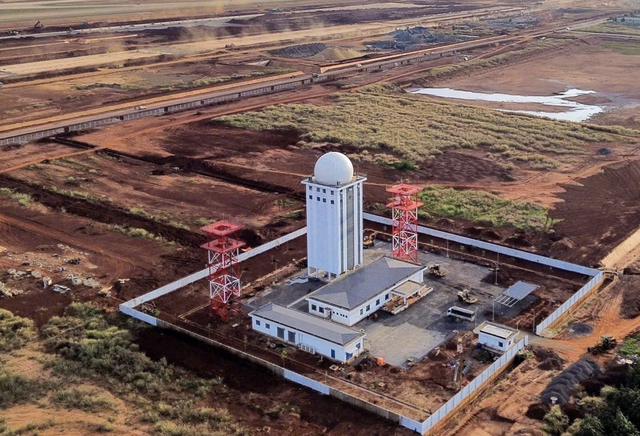
The radar system has been completed. Photo: A Loc / Tuoi Tre
Strong interest from enterprises
Although Friday next week (December 19) is primarily a technical milestone, Long Thanh’s progress is being closely watched by the business community for its expected impact on investment, travel, and supply chains in southern Vietnam.
Logistics firms see the airport as a potential catalyst for cold storage ecosystems, distribution hubs, and express cargo transshipment.
A representative of a transport and warehousing company in Dong Nai Province said stronger aviation infrastructure would lighten supply chains, reduce logistics costs, and directly improve competitiveness.
Many companies are accelerating preparations to capture the coming flow of air cargo.
Nguyen Thanh Tung, chairman of New Era Cold Storage JSC (NECS), said his firm aims to build an integrated logistics chain linking seaports, cold warehouses, and Long Thanh International Airport, while connecting to the Cai Mep-Thi Vai port complex in Ho Chi Minh City.
NECS has just put into operation a smart automated cold storage facility with a capacity of 110,000 pallets in Tay Ninh Province, with a total investment of about VND2 trillion ($76 million).
From a tourism perspective, a travel firm in Ho Chi Minh City expects Long Thanh to expand international arrivals, open new air routes, and ease slot congestion for Tan Son Nhat International Airport.
“Air routes are the lifelines of tourism. When a gateway airport has greater capacity, opportunities will emerge,” said a representative of the firm.
Aviation expert Associate Professor Nguyen Thien Tong noted that in the long term, Long Thanh should not merely relieve pressure on Tan Son Nhat, but aim to become a regional transit hub, provided that ground services, logistics, and multimodal connectivity – road and rail – are developed in sync.
Key upcoming flights
As planned, technical test flights from Tan Son Nhat to Long Thanh and back will take place on Monday, with a flight time of about 40 minutes.
On Friday next week, another special flight will depart from Noi Bai International Airport in Hanoi and land at Long Thanh.
Vietnam Airlines has registered flight VN5001 departing Tan Son Nhat at 3:00 pm and landing at Long Thanh at 3:40 pm, followed by flight VN5002 departing Long Thanh at 6:00 pm and returning to Tan Son Nhat at 6:40 pm.
The aircraft used will be a Boeing 787-9, carrying no passengers, to comprehensively test operational conditions.
ACV has been committed to completing Phase 1 by the end of December and putting the airport into operation in the first half of 2026.
Expanding connectivity around Long Thanh airport
Travelers along Ho Chi Minh City - Long Thanh - Dau Giay Expressway, National Highway 51, and nearby connecting projects can clearly see Dong Nai Province transforming into a vast construction zone.
The locality is carrying multiple major infrastructure projects to connect with the airport.
Alongside existing expressways, the government has hinted at expanding the section from Ring Road No. 2 to Bien Hoa-Vung Tau Expressway to 10 lanes.
The 11.2-kilometer segment of Ring Road No. 3 through Dong Nai Province is nearing completion, providing smoother connectivity from Ho Chi Minh City toward the airport and regional expressways.
Access routes include the T1 road from National Highway 51 to the airport (about 4.2km) and the T2 route running along Bien Hoa-Vung Tau Expressway (about 3.5km).
A local official said that Long Thanh’s operation will generate strong development momentum thanks to dense road connections and proximity to seaports and commercial centers.
In addition to the existing expressways, projects such as the Thu Thiem-Long Thanh light rail line and an urban railway from Bien Hoa to the airport are also being planned.
Several provincial roads have been approved to enhance airport connectivity, including Provincial Road 769 (nearly 30km), Road 770B (over 42km), Road 773 (39km), Road 769E (8.5km), and Road 25C (eight lanes).








Max: 1500 characters
There are no comments yet. Be the first to comment.