


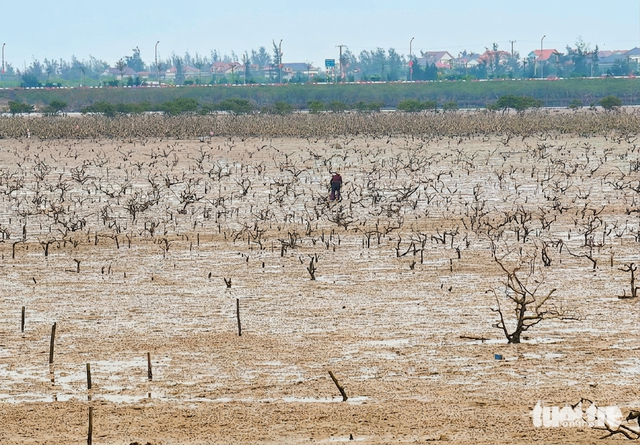
Mangrove trees die off in a coastal protection forest in Hai Ninh Ward, Ha Tinh Province, north-central Vietnam. Photo: Le Minh
Local officials in Hai Ninh Ward said around three hectares of mangroves have died completely and cannot recover, while the remaining area shows signs of decline such as yellowing leaves, wilting, and gradual dieback from the canopy.
The affected area is located in a designated protection forest managed by local authorities, where clusters of dead trees have formed gaps along tidal creeks.
Field inspections found that only one species, the grey mangrove (Avicennia marina), had died, while other species in the same area continued to grow normally.
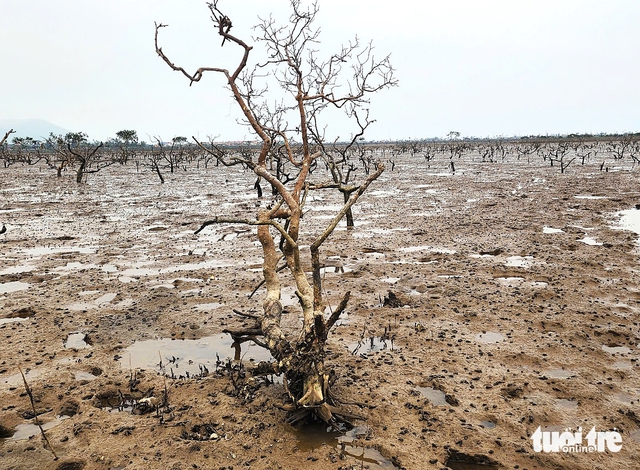
Mangrove trees die off in a coastal protection forest in Hai Ninh Ward, Ha Tinh Province, north-central Vietnam. Photo: Le Minh
Authorities said the die-off began in November 2025, after prolonged heavy rains brought by Storm Bualoi triggered widespread flooding. Combined with unusual tidal changes, these conditions disrupted the environment and affected the trees’ growth.
Initial assessments found no signs of pests or marine organisms damaging the trees, and no major pollution sources were identified in the surrounding area.
Water quality monitoring showed key indicators within permitted limits, with pH and salinity levels broadly suitable for mangrove growth, officials said.
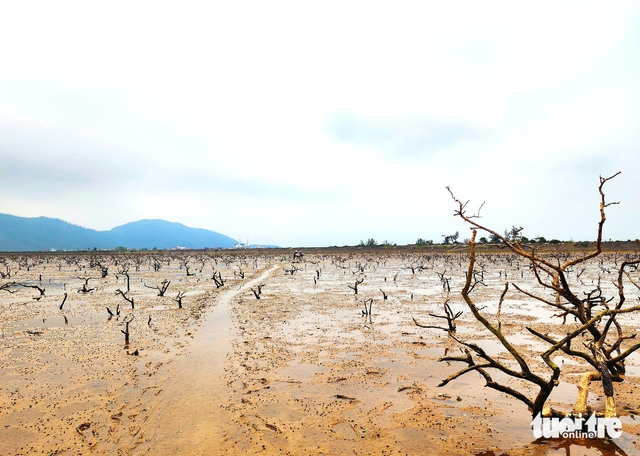
Dead grey mangrove trees leave large gaps in a coastal protection forest in Hai Ninh Ward, Ha Tinh Province, north-central Vietnam. Photo: Le Minh
Based on current findings, authorities said the dieback was unlikely caused by pests or water pollution, though further analysis is ongoing.
Local authorities have been instructed to preserve the site, monitor developments, and compile documentation to support further assessment and potential forest clearance measures.
Officials said scientists would be invited to conduct additional studies to determine the exact cause and recommend appropriate responses.








Max: 1500 characters
There are no comments yet. Be the first to comment.