


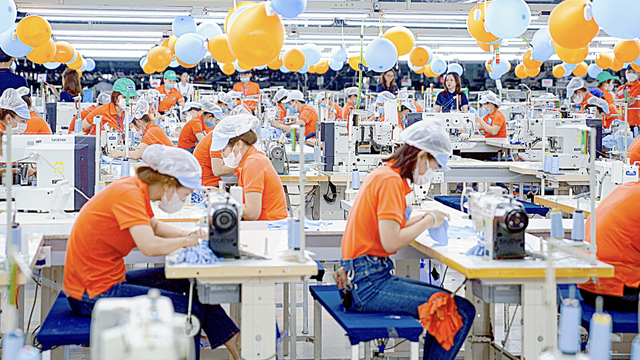
Textile and garment businesses exporting to the U.S. expect to receive more new orders after the U.S. government imposed new temporary tariffs. Photo: P. Son / Tuoi Tre
The U.S. imposed a 10-percent tariff effective February 24 after President Donald Trump signaled the rate could rise to as high as 15 percent under Section 122 of the Trade Act of 1974, alongside potential additional duties under Sections 301 and 232.
The move followed a U.S. Supreme Court ruling that struck down the administration’s reciprocal tariffs under the International Emergency Economic Powers Act (IEEPA), briefly raising hopes among export-reliant economies such as Vietnam and other Southeast Asian countries.
That relief, however, proved short-lived. With the White House maintaining a hardline trade stance, observers and U.S. partners remain cautious.
Thailand’s Bangkok Post described the circumstance as the 'Plan B' tariff, suggesting Washington retains alternative legal pathways to sustain its tariff policy.
The U.S high import taxes were already a variable in global trade in 2025.
Their continued prominence at the start of 2026 risks prolonging uncertainty, forcing investors, businesses, and policymakers to repeatedly recalibrate expectations.
Section 122 allows the president to impose tariffs of up to 15 percent for 150 days unless Congress approves an extension.
While that statutory limit fuels hopes the 10-percent, or even a higher 15-percent, rate may be temporary, it also heightens market anxiety over what follows.
Varg Folkman, an analyst at the European Policy Center, said the developments signal “a new period of uncertainty” for global trade, as economies attempt to anticipate Washington’s next move.
Associate Professor Dr. Tran Hoang Ngan, a Vietnamese National Assembly deputy, described the global environment as increasingly unpredictable, with U.S. tariff projections fluctuating between 10 percent, 15 percent, and 20 percent.
Given that the U.S. remains one of Vietnam’s largest export markets, any adjustment would have direct implications, he said.
Beyond headline rates, sector-specific tariffs under Sections 301 and 232 remain in force, leaving open the possibility of further trade investigations.
Vietnam’s wood industry is among sectors affected by Section 232 scrutiny.
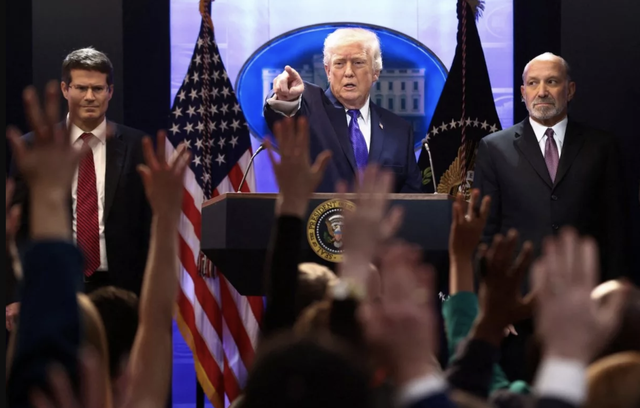
U.S. President Donald Trump promises there will be more measures on his taxing foreign goods policy. Photo: Reuters
In late 2025, President Trump signed a proclamation adjusting import tariffs on timber, lumber and derivative wood products, postponing planned increases on certain finished goods — including upholstered seats, kitchen cabinets, and bathroom vanities — from January 1, 2026 to January 1, 2027.
Nguyen Chanh Phuong, vice-chairman and secretary-general of the Handicraft and Wood Industry Association of Ho Chi Minh City (HAWA), said Vietnam’s wood exports to the U.S. had continued to expand even under a 20-percent reciprocal tariff.
The greater risk, he noted, lies in the possibility that Section 232 investigations could trigger additional duties.
He expressed hope that government negotiations, coupled with stronger corporate compliance with U.S. requirements, would help maintain tariffs at levels competitive with other exporting countries.
Beyond increasing imports of U.S. timber, Vietnamese firms must strengthen traceability systems, tighten supply chain management, and enhance competitiveness.
At the same time, retired professor David Dapice of Tufts University added that another unpredictable factor is how the Trump administration defines “transshipped goods.”
Washington is likely to demand that a larger share of value added in Vietnamese exports be generated domestically, he said.
Garment exporters expect orders to rebound as U.S. tariff drops
Speaking to Tuoi Tre News, Nguyen Duc Thang, chief executive of Dap Cau Garment JSC, an apparel exporter to the U.S., said orders and unit prices had fallen 15-20 percent since October last year, when the tariff measures took effect, leaving the company unable to operate at full capacity.
With the U.S. lowering tariffs to 10 percent for all countries, Vietnamese textiles and garments now enjoy a clearer competitive edge over several rivals, Thang said, expressing optimism that exporters could secure more orders in the early months of the year.
“In particular, Vietnam remains more competitive than many Southeast Asian peers thanks to skilled labor, consistent product quality, and fast delivery times,” he said.
“Our ability to meet buyers’ requirements and maintain flexible pricing means Vietnamese suppliers are still preferred when markets turn volatile.”








Max: 1500 characters
There are no comments yet. Be the first to comment.