


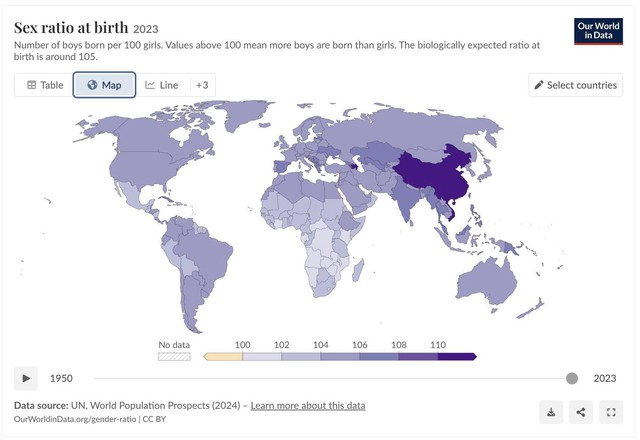
Vietnam and China's sex ratios at birth are among the world's highest. The darker the color on the chart, the greater the sex imbalance. Data: United Nations (UN) statistics released in 2024. Photo: Provided by Dr. Ho Manh Tuong
Speaking to Tuoi Tre (Youth) online newspaper, Dr. Ho Manh Tuong, general secretary of the Ho Chi Minh City Society for Reproductive Medicine (HOSREM), said many couples visit fertility centers not to seek infertility treatment but to select the sex of their embryos.
Even couples undergoing in vitro fertilization (IVF) to treat infertility sometimes request embryo screening to select embryos of a particular sex.
The practice is more common in northern Vietnam but it has recently begun to emerge in the south, where some newly opened IVF centers face pressure to increase patient numbers, revenue, and profits.
A growing imbalance with long-term consequences
Dr. Tuong cited a study which found that China, India, and Vietnam had some of the world's highest sex ratios at birth.
Between 1970 and 2017, China was estimated to have 11.9 million 'missing' female births, or around 240,000 a year, while India had 10.6 million, or approximately 210,000 a year.
Meanwhile, in Vietnam, the estimated number exceeds 40,000 girls a year. This may be due to couples terminating pregnancies after knowing the fetus's sex or undergoing IVF, discarding female embryos and selecting only male embryos.
"The fact that so many girls are denied the chance to be born because of sex selection is a deeply troubling reality that reflects a lack of social progress," Dr. Tuong stressed.
"In the long run, it will have serious consequences for society, leaving a large surplus of men who cannot find life partners or get married."
In 2024, Vietnam’s General Statistics Office reported a sex ratio at birth of 111.4 boys per 100 girls. Among children aged 0 to 14, there were 109.7 boys for every 100 girls.
Some localities recorded particularly wide disparities.
The Red River Delta had a sex ratio at birth of 113.2 boys per 100 girls, while the northern midlands and mountainous region recorded 115.3, among the highest rates in the country.
Population experts estimate that if the current sex imbalance at birth is not curbed, Vietnam will have a surplus of around 1.5 million men of marriageable age by 2034, rising to 1.8 million by 2059.
They warn that this trend could disrupt family structures, making it harder for men to find wives and potentially leading to delayed marriage or lifelong singlehood.
According to the 2024 Mid-term Population Survey by the General Statistics Office, Vietnam had approximately 415,200 more men than women in the marriageable age group of 20 to 39.
Regulating embryo screening, changing gender stereotypes
To prevent the misuse of assisted reproductive technologies for sex selection, Dr. Tuong said authorities need to regulate embryo chromosome screening procedures and the disclosure of results to doctors, couples, and embryologists. Monitoring and penalties are also needed.
However, the issue is also rooted in social, cultural, and historical factors. The preference for sons over daughters stems from Confucianism.
Dr. Khuat Thu Hong, an expert in gender studies and psychology, said Vietnam's geographical proximity to China had exposed the country to Chinese cultural influences, particularly Confucianism.
Northern Vietnam, being closer to China, had been more heavily influenced.
In central Vietnam and the Mekong Delta, where historical roots are more closely associated with Southeast Asian cultures, families have traditionally placed less emphasis on having sons and have regarded the birth of either a boy or a girl as equally good.
Historical changes also played a role, as southern Vietnam was exposed to Western cultures, particularly that of the U.S., after the French colonial period.
Western lifestyles and attitudes, building on the openness already present in Southeast Asian culture, have further encouraged people in the southern region to believe that having a son is not essential.
They place less emphasis on carrying on the family line or ancestral worship.
Addressing these root causes will take time and require a combination of interventions, Dr. Tuong said.






Max: 1500 characters
There are no comments yet. Be the first to comment.