


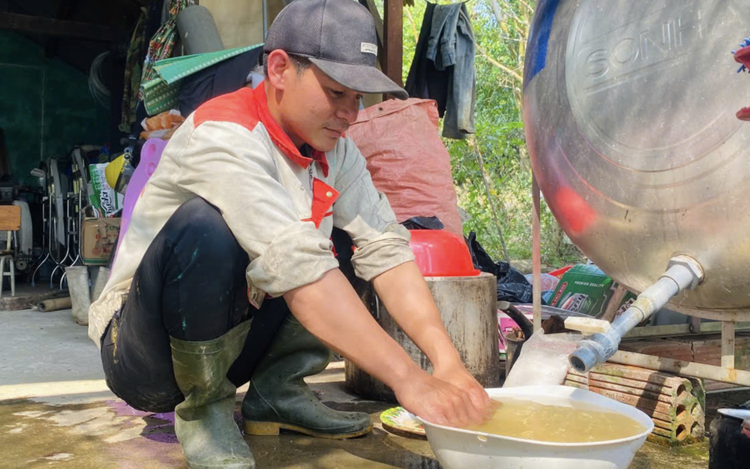
Residents of Huong Thinh Village in A Luoi 4 Commune, Hue City, central Vietnam regularly use murky, impurity-laden water that does not meet hygiene standards for daily use. Photo: Bao Phu
Whether during the dry season or periods of heavy rain, access to safe water remains one of the most pressing concerns for communities in this mountainous area.
For years, locals have depended on gravity-fed water systems that channel water directly from streams.
However, this water source is far from safe.
It is often contaminated, carries sediment and impurities, and poses significant health risks.
Nguyen Van Phuc, head of Huong Thinh Village in the commune, said all 87 households in the village rely entirely on untreated stream water.
“There is no filtration system in place,” he explained.
To secure water, villagers have constructed reservoirs at upstream points and installed pipelines to transport water to homes, he elaborated.
However, without proper treatment, the water quality remains poor.
During the rainy season, it becomes murky and filled with debris.
Pipes and storage tanks have deteriorated after years of use, further degrading water quality and heightening residents’ concerns.
Faced with these challenges, some families have taken matters into their own hands.
Those with financial means invest in household filtration systems, while others purchase 20-liter bottles of water at a cost of around VND20,000 (US$0.75) each.
Nguyen Van Phu, a 33-year-old resident of Huong Thinh Village, said that the water from the streams often carries garbage and mud, exuding an unpleasant smell.
During the rainy season, the water turns heavily turbid.
In contrast, the dry season brings reduced flow, forcing residents to walk nearly two kilometers through forest paths to fetch water for washing and storage.
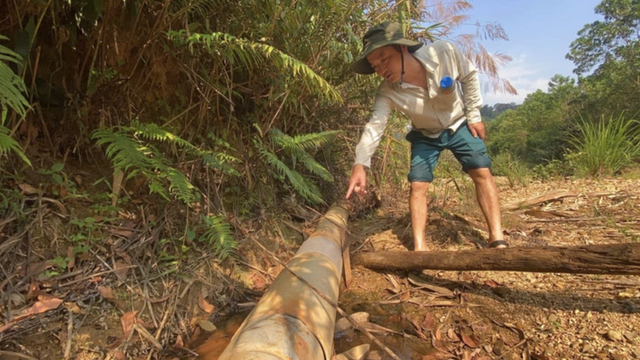
Nguyen Van Phuc, head of Huong Thinh Village in A Luoi 4 Commune, Hue City, central Vietnam, inspects pipelines and cleans water reservoirs to ensure a continuous water supply to residents. Photo: Bao Phu
Delayed clean water project
According to a report by the People’s Committee of A Luoi 4 Commune, the commune is home to 2,681 households.
Of these, only 648 have access to clean water supplied by Hue Water Supply Joint Stock Company, while the remainder still relies on natural stream sources, which have not been tested or monitored in accordance with current safety standards.
Tran Ly Son, vice-chairman of the commune, said there are currently 13 small-scale gravity-fed water systems operating in the area, partially meeting basic needs.
Yet, they are frequently damaged and fail to ensure a stable supply.
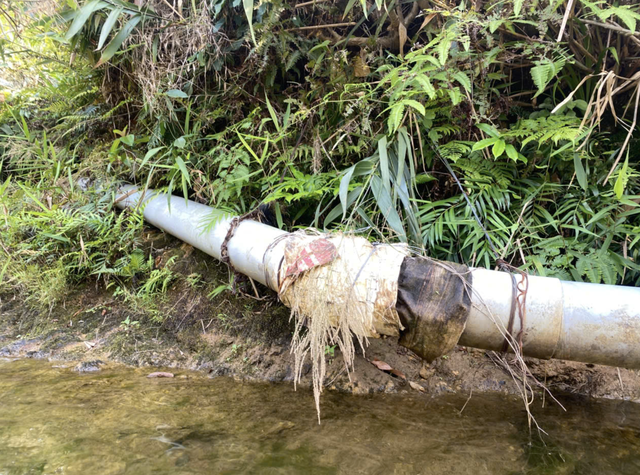
After more than 10 years of use, a water pipeline has deteriorated, forcing residents to make temporary repairs to prevent leaks and pipe bursts, ensuring their daily water supply. Photo: Bao Phu
In 2023, the People’s Council of Thua Thien-Hue Province, now Hue City, approved an adjustment to a rural water supply project for the 2021-25 period, which included plans to upgrade and expand clean water networks in areas such as Lam Dot and Huong Phong, now part of A Luoi 4 Commune.
Hue officially became a centrally-governed city from January 1, 2025.
Despite the approval, the project has yet to be implemented in the commune.
Son said that local authorities had submitted formal requests urging the municipal People’s Council to accelerate the roll-out of the clean water infrastructure.
However, no clear timeline has been provided.
“We are eagerly waiting for clean water to serve our people,” Son said.
“We hope the project will be carried out soon so residents can live and work with peace of mind."








Max: 1500 characters
There are no comments yet. Be the first to comment.