


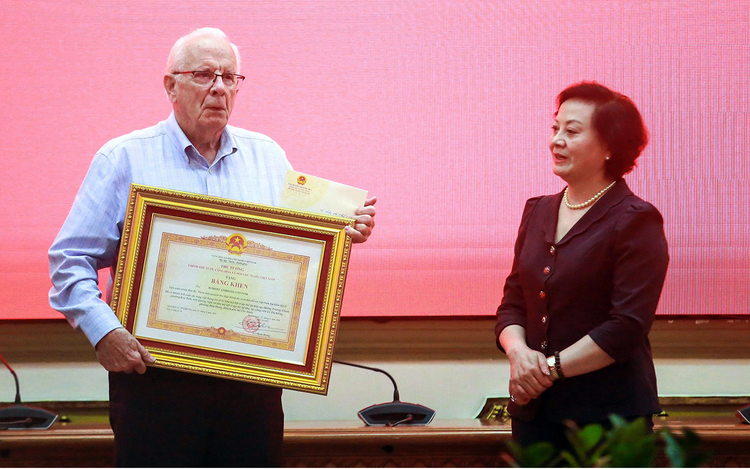
Pham Thi Thanh Tra (R), member of Vietnam’s Party Central Committee, deputy prime minister and head of the National Steering Committee 515, presents the Prime Minister's certificate of merit to Robert A. Connor.
Connor told Tuoi Tre (Youth) Online that he had enlisted in the U.S. Air Force to gain experience that would help him become a Pennsylvania State Police officer.
He volunteered to serve in Vietnam on April 5, 1967, and remained there until April 5, 1968.
During his service, he came into contact with local marine corps and army personnel and heard many stories about the war.
Those experiences led him to conclude that the United States should not have been involved in Vietnam.

Robert A. Connor (wearing a hat) at a search site for war martyrs' remains at Bien Hoa Airbase in 2017.
He said empathy had inspired him to begin helping search for the remains of Vietnamese war martyrs.
His first attempt to contact Vietnam came in 1987 after reading an article about the country. He wrote to the Vietnamese Consulate in New York to report a mass grave containing about 150 Vietnamese soldiers buried at Bien Hoa Airbase during the 1968 Tet General Offensive and Uprising.
Connor said his only priority had always been helping reunite the remains of fallen soldiers with their families.

An aerial view of Bien Hoa Airbase
He recalled that in October 2016, his oldest granddaughter had initially suggested working on a school project about Vietnam but changed her mind two weeks later.
On October 16 that year, he used Google Earth to mark the location of the mass grave at Bien Hoa Airbase. At the time, Google had an agreement with Panoramio that allowed users to place markers anywhere in the world and describe what had happened there.
He marked the site with a note stating that approximately 150 Vietnamese soldiers had been buried there on February 2, 1968, during the Tet General Offensive and Uprising.
On October 26, 2016, he received an email from former Vietnamese soldier Che Trung Hieu, who described unsuccessful efforts to locate graves around the air base.
After replying, Connor was asked to find a second witness to confirm the information. He contacted his former commander, Marty Stones, who confirmed the location and said he had personally counted the bodies.
Connor forwarded the information to Hieu, who replied that Colonel Mai Xuan Chien, former deputy political commissar of the Dong Nai High Command, hoped they would return to Vietnam.


Based on information provided by Robert A. Connor, Vietnamese authorities discovered a mass grave containing the remains of soldiers killed in 1968 at Bien Hoa Airbase.
Connor and Stones returned to Vietnam in March 2017, and the mass grave was discovered on April 13, 2017.
Only 80 sets of remains were recovered because underground drainage pipes installed in the 1980s had disturbed part of the burial site.
A reburial ceremony was held at Dong Nai Martyrs' Cemetery on July 17, 2017.
Connor said a short video of the ceremony convinced him to continue searching for more graves.
Watching the funeral procession, he focused on the honor guard carrying a coffin draped with the Vietnamese flag. Walking behind it was a female relative holding the martyr's portrait and staring at the coffin without looking away. She had not seen her loved one for 49 years.
When he zoomed in further, he saw tears in her eyes that she could no longer hold back. Connor said that moment convinced him to continue helping as many families as possible.
His wife reinforced that conviction by telling him they might be the families' only hope.
He said his greatest wish was to one day meet the woman holding the portrait.

A memorial service for the war martyrs whose remains were recovered from the mass grave at Bien Hoa Air Base following information provided by Robert A. Connor.
Connor said he began by researching battles in areas around Bien Hoa, including Long Binh, Ho Nai, Ho Chi Minh City, and Tan Son Nhat, before gradually expanding his search to places such as Loc Ninh, Duc Lap, and Kon Tum.
He studied documents, mapped battle patterns and retreat routes, and gathered details that might provide clues to burial sites, describing the effort as an investigation rather than simply a search.
The next step, he said, was identifying people who might possess small but crucial pieces of information and piecing those fragments together until a complete picture emerged.
Most of the witnesses were now in their late 60s to mid-70s.
Connor said contacting people who had never spoken about the war with their families or friends and asking them to recall events that occurred decades earlier was difficult.
Whenever someone replied expressing a willingness to help, he believed he had found a valuable witness.
Connor credited architect Nguyen Xuan Thang with serving as his bridge to Vietnam. They had worked together from the very beginning because he knew he needed an intermediary to work with provincial and district-level officials.
He added that he had always been warmly welcomed wherever he traveled in Vietnam.
He said science was the final direct path to locating graves, not only for Vietnam's missing soldiers but also for American servicemen, and expressed hope that people would continue providing factual information about the graves of both sides.
Reflecting on his recent reunion with former Saigon Special Forces fighters, Connor said it represented closing the past and moving forward. With the right people at the right moment, he said, it took less than 15 seconds to set aside the past and exchange smiles, handshakes, and warm embraces.
Now in the later years of their lives, they wanted to leave the stories of the past behind and focus on a shared future and common purpose, he said, adding that he sincerely wished Vietnam continued prosperity.
U.S. veteran keeps Vietnamese soldier's cap for 54 years
Connor also recalled the story of a Vietnamese soldier's cap that had been kept by a U.S. veteran for 54 years.
He said the veteran had written that he wanted to return the cap.

According to Robert A. Connor, 80 sets of remains were recovered out of an estimated 150 because underground drainage pipes installed in the 1980s altered the original burial site.
A friend of Connor's saw the post on Facebook and suggested that Connor might be able to locate the soldier's family.
Connor received photographs of the cap, which bore the martyr's name, enlistment date, military unit, and an unidentified symbol.
He forwarded the information to Nguyen Xuan Thang so Vietnamese authorities could verify it.
Authorities identified seven people with the same name, enlistment date and military unit.
The decisive clue was the unidentified symbol, which turned out to be a Chinese medical insignia. Only one of the seven soldiers had received medical training.
Connor said he later gave the cap to Thang to take back to Vietnam and hand it over to the martyr's family.
A family member embraced the cap tightly against her chest, and Connor said her closed eyes suggested she was seeing her loved one's face in her memories.
When he later told the U.S. veteran what had happened, Connor said the man was so overwhelmed with emotion that he appeared close to slipping from his chair and falling to the floor.
Vietnamese government expresses appreciation for Robert A. Connor's contributions
Pham Thi Thanh Tra, member of the Party Central Committee, deputy prime minister and head of the National Steering Committee 515, which oversees the search, recovery, and identification of war martyrs' remains, thanked Robert A. Connor and fellow U.S. veterans for their dedicated support and valuable information, saying their contributions had provided Vietnamese authorities with invaluable practical evidence.
She said the Vietnamese government greatly appreciated their assistance.
In recognition of his contributions to the search for war martyrs, Connor was awarded a certificate of merit by the Prime Minister of Vietnam.








Max: 1500 characters
There are no comments yet. Be the first to comment.