


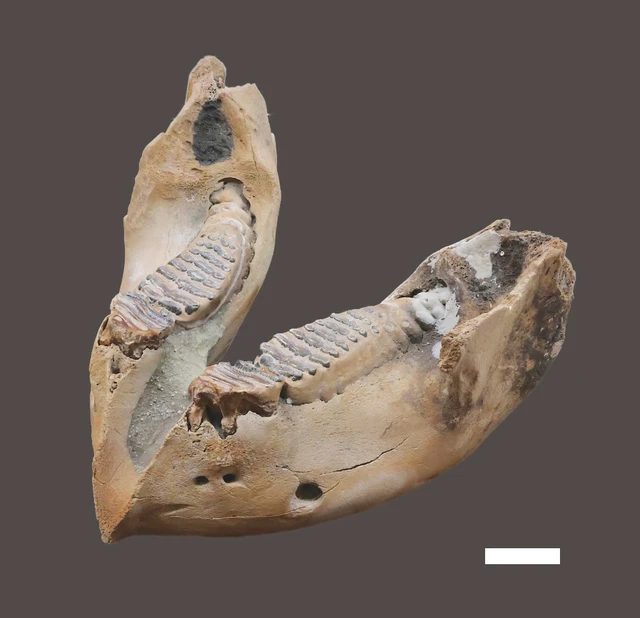
The lower jawbone of a Naumann's elephant preserved at the Murakami Kaizoku Museum in the city of Imabari, Ehime Prefecture, western Japan. Photo: Jiji Press
The findings by the team were published in British journal Scientific Reports on Tuesday.
The team comprised researchers from Tokai University, Tokyo Metropolitan University, the University of Tokyo and the Museum of Natural and Environmental History.
Up until now, the widely accepted theory was that Naumann's elephant, or Palaeoloxodon naumanni, disappeared from the Japanese archipelago about 24,000 years ago.
To determine the exact timing of the extinction, the team removed impurities from Naumann's elephant fossils discovered in the Seto Inland Sea off the city of Imabari, Ehime Prefecture, western Japan, and conducted high-precision radiocarbon dating.
After dating fossils found in other parts of the country as well, the researchers deduced that the animal went extinct about 33,000 to 35,000 years ago.
As humans are believed to have reached the Japanese archipelago around 38,000 to 39,000 years ago, their coexistence with Naumann's elephant lasted for about 4,000-6,000 years, much shorter than previously thought.
An analysis of data on archaeological site distribution also indicated that the areas of human activities and the habitat of Naumann's elephant did not significantly overlap in terms of both time period and location.
Some researchers believe that the stone tools used by humans at the time were not suitable for hunting large mammals.
The Japanese team said its research suggested the possibility that Naumann's elephant may have gone extinct from changes in its habitat environment caused by shifts between cold and warm periods, rather than hunting by humans.
Soichiro Kusaka, an associate professor in biological anthropology at Tokai University and a member of the team, said, "I think this research has helped weaken people's mental image that Paleolithic humans were hunting large mammals in the Japanese archipelago."










Max: 1500 characters
There are no comments yet. Be the first to comment.