


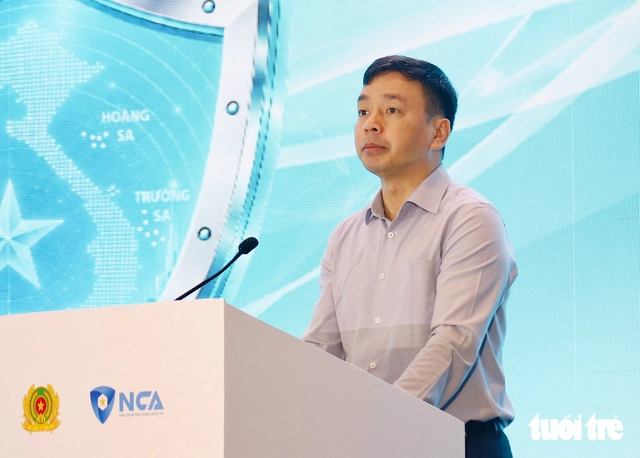
Lieutenant General Le Xuan Minh, head of the Department of Cybersecurity and Hi-Tech Crime Prevention under the Vietnamese Ministry of Public Security, speaks at a cybersecurity-themed conference in Hanoi, August 21, 2026. Photo: Danh Trong / Tuoi Tre
The event, organized by the Ministry of Public Security and the Vietnam National Cybersecurity Association, focused on implementing the Cybersecurity Law and the Personal Data Protection Law.
Speaking at the event, Lieutenant General Le Xuan Minh, head of the ministry’s Department of Cybersecurity and Hi-Tech Crime Prevention, stressed the importance of building awareness and a culture of cybersecurity and data protection.
Lieutenant Colonel Le Anh Tuan, deputy head of the department’s Division 5, said online fraud has become a new frontier for organized crime.
While fraud cases declined in the first half of 2026 thanks to coordinated enforcement, criminals are increasingly using advanced technologies such as deepfake images, videos, and voice cloning to deceive victims.
Police agencies nationwide reported that 219 foreign nationals had been arrested in Vietnam from the beginning of the year for operating online scams from luxury apartments, often targeting overseas citizens.

Lieutenant Colonel Le Anh Tuan, deputy head of Division 5 under the Department of Cybersecurity and Hi-Tech Crime Prevention, addresses a cybersecurity-themed conference in Hanoi, August 21, 2026. Photo: Danh Trong / Tuoi Tre
Tuan warned that online fraud is now a transnational crime linked to human trafficking, illegal immigration, and the trade of personal data.
He predicted that deepfakes and voice cloning would become key tools in many scam scenarios, particularly schemes impersonating relatives or corporate executives to make urgent requests for money transfers.
The widespread leakage and open sale of personal data also provide an important source of information that scammers can exploit to approach potential victims.
The official said protecting national sovereignty in cyberspace, cybersecurity and data security must be treated as an urgent and essential part of Vietnam's digital transformation.
The nearly 63,000 new mobile malware strains recorded by nTrust, a mobile app developed by the Vietnam National Cybersecurity Association to combat online fraud in the country, in 2025 reflect the growing focus of cybercriminals on mobile devices.
Hundreds of fake applications imitating popular apps were among the threats detected.
Such applications can be used to steal personal information or gain control of users' devices.
“Cybercrime is clearly shifting toward mobile platforms, where users are less cautious than on computers,” Tuan said.
Small and medium-sized businesses have also become prime targets, facing ransomware attacks, fake banking notices, and phishing schemes.
The State Bank of Vietnam has introduced monitoring systems that issued 3.5 million fraud alerts, helping more than 1.1 million customers halt or cancel transactions worth more than VND3.99 trillion (US$152 million).
The Ministry of Public Security has continued to work with the central bank and relevant agencies to establish a specialized mechanism for blocking, tracing and handling money flows linked to online fraud.
Telecommunications companies are also working with police to identify and remove junk SIM cards and improperly registered mobile subscriptions, which are frequently used by scammers as communication tools.
Authorities are further implementing technical measures to warn users about suspected scam calls, filter spam and fake brand messages, and send mass alerts to mobile subscribers about emerging fraud tactics.








Max: 1500 characters
There are no comments yet. Be the first to comment.