


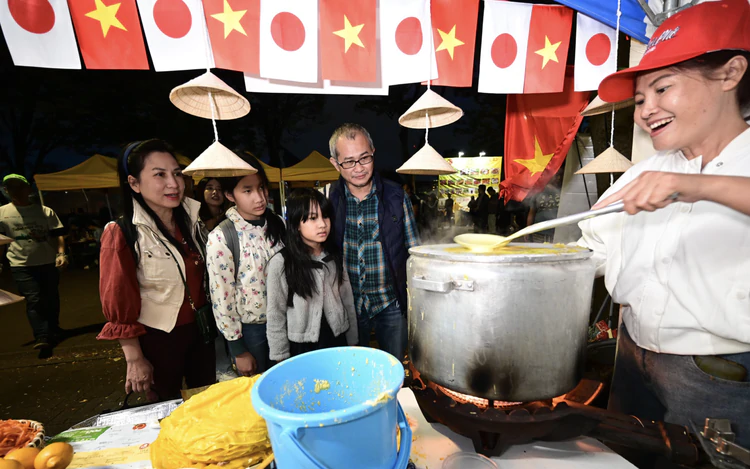
A Vietnamese chef introduces 'banh xeo' (Vietnamese sizzling pancakes) to Japanese diners at the Vietnam Pho Festival in Tokyo in 2023. Photo: Quang Dinh / Tuoi Tre
Ta Duc Minh, Vietnam's trade counselor in Japan, made the remarks in a recent interview with Tuoi Tre (Youth) online newspaper.
As of the end of June, approximately 693,800 Vietnamese were living in Japan, making them the country's second-largest foreign community, Minh said.
The community offers Vietnamese businesses a potential customer base while providing people who can help them navigate the Japanese market and reach local consumers.
Minh said these advantages could help Vietnamese people expand beyond serving fellow Vietnamese to reach Japanese customers and gradually participate in the host country's supply chains.
Vietnamese entrepreneurs eye broader business opportunities in Japan
According to Minh, the Vietnamese community has three groups of business opportunities worth exploring, particularly as Japan faces an aging population, labor shortages, and rising production costs.
The first involves services catering to everyday needs, including restaurants, food businesses, e-commerce, and retail.
Vietnamese businesses should target Japanese customers rather than limit their operations to the Vietnamese community, he said.
Models such as 'Banh Mi Xin Chao,' a Vietnamese 'banh mi' chain, and Seso Foods, a Vietnamese food store, show how businesses offering Vietnamese products and services can establish a foothold by adapting to local customers.
However, Minh cautioned that not every business model would achieve the same success or be readily replicated.
Businesses must also comply with Japanese regulations on residency status, business licenses, food safety, taxation, and labor, he said.
The second opportunity lies in importing and distributing Vietnamese goods through Japanese retail chains, restaurants, and food-processing companies, which requires professional logistics, quality control, and customer service.
The third involves knowledge-intensive services, including information technology, design, market consulting, high-skilled recruitment connections, and digital transformation support for small- and medium-sized enterprises.
Minh hopes Vietnamese businesses will move beyond small-scale, fragmented operations to build business alliances, distribution networks, and professional service networks, giving Vietnamese products a more sustainable foothold in Japan.

Ta Duc Minh, Vietnam's trade counselor in Japan. Photo: Huu Hanh / Tuoi Tre
Expanding Vietnamese products' presence in Japan
Two-way trade between Vietnam and Japan reached approximately US$51.43 billion in 2025, with Vietnam's exports to Japan totaling around $26.77 billion.
However, Minh noted that strong trade figures did not necessarily translate into greater recognition of Vietnamese brands among Japanese consumers.
Many Vietnamese products are still sold under the brands of Japanese importers or distributors, or used as ingredients by local businesses.
Vietnamese pangasius has recently attracted interest as an ingredient in Japan's seafood-processing industry, illustrating how Vietnamese suppliers can tap into emerging market demand.
To build their own brands and secure long-term contracts, Vietnamese businesses need to invest in quality standards, Japanese-language packaging, product storytelling, trademark protection, after-sales services, and distribution partnerships.
They must also ensure consistent quality, traceability, food safety, and reliable delivery, while tailoring product specifications to individual customers.
"The most important thing is to shift from the mindset of selling a single shipment to maintaining a lasting presence on Japanese store shelves and in the country's supply chains," Minh said.
Potential opportunities extend to processed seafood, coffee, cashew nuts, fruit and fruit-based products, spices, convenience foods, wooden furniture and certain supporting-industry products.
Promotional events such as Foodex Japan, Vietnam Goods Week at Aeon stores, and the Specialty Coffee Association of Japan's exhibition allow businesses to meet buyers directly, gauge consumer preferences, and adapt their products to market demand.
Vietnamese workers could serve as bridge for technology transfer
According to the Japanese Ministry of Health, Labor and Welfare, 605,906 Vietnamese workers were employed in Japan at the end of October 2025, accounting for 23.6 percent of the country's foreign workforce.
Through their work in Japan, these Vietnamese workers have opportunities to gain hands-on experience in industrial practices, quality management, automation, equipment maintenance, and the operating standards of Japanese companies.
Minh said the key was to turn this individual experience into organizational capabilities that could benefit Vietnamese businesses.
Companies in Vietnam could recruit or cooperate with Vietnamese engineers and specialists who have worked in Japan, drawing on their practical knowledge to improve production lines, train production managers, introduce lean management, digitalize manufacturing processes, and develop products that meet Japanese customers' requirements.
He also proposed building a network of Vietnamese experts in Japan and strengthening links among businesses, universities, professional associations, and technical training programs in the two countries to facilitate the exchange of expertise and technology.
Any technology transfer, however, must respect intellectual property rights, business secrets and agreements with employers, and be driven by businesses' actual needs rather than stop at formal meetings or signing ceremonies.



Max: 1500 characters
There are no comments yet. Be the first to comment.