



Foreign tourists wait to withdraw cash at an ATM in Nha Trang. Photo: Xuan Hoat / Tuoi Tre
On Wednesday, Tuoi Tre (Youth) online newspaper reported long lines of Russian tourists at ATMs in Nha Trang, prompting questions from readers, including foreign visitors, about where they can exchange foreign currency when they need cash during their holidays in the coastal city.
Where can tourists exchange foreign currency?
Government Decree No. 340/2025/ND-CP, which took effect on February 9, 2026, imposes hefty penalties for administrative violations in the monetary and banking sectors.
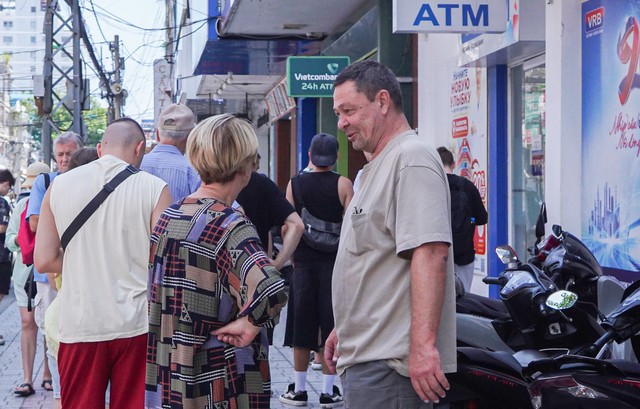
Foreign tourists should receive guidance from tour operators on Vietnam’s foreign currency exchange regulations. Photo: Xuan Hoat / Tuoi Tre
For foreign tourists seeking to exchange foreign currency into Vietnamese dong, the State Bank of Vietnam’s Regional Branch 10 recommends contacting tour operators for assistance.
Travelers can also visit commercial banks such as Vietcombank, BIDV, VietinBank and Agribank, although they should check whether a branch offers foreign currency exchange services. Banks may require passports and additional paperwork, while processing times and opening hours vary.
Alternatively, tourists can use licensed foreign exchange agents located at eligible hotels, tourist areas, entertainment complexes, airports and shopping malls.
Some hotels offer exchange services through authorized agents, but rates may be less favorable than those at banks. Travelers should compare exchange rates and fees, confirm the amount they will receive and check that the exchange point is licensed.
Travelers should not assume that gold shops or street money changers are authorized, as Vietnam’s Decree No. 340/2025/ND-CP, effective February 9, 2026, provides for penalties for unauthorized foreign currency transactions.
In Nha Trang, foreign tourists can exchange foreign currency at commercial banks that offer the service or at licensed exchange agents.
These can be found at prominent locations such as Gold Coast shopping mall, Nha Trang Center and major hotels along Tran Phu Street, including Novotel Nha Trang, InterContinental Nha Trang and Yasaka Saigon Nha Trang.
Travelers should confirm that the specific branch or counter is authorized to exchange currency before visiting, as not all banks, hotels or shopping malls provide the service.
Under Decree No. 340/2025/ND-CP, transactions involving unauthorized foreign currency exchanges worth less than US$1,000 may receive a warning, while larger transactions can incur fines of VND10 million to VND100 million ($380-$3,800), depending on the amount. Authorities may also confiscate the currency involved.
Unlicensed organizations exchanging foreign currency face fines of up to VND500 million (about $19,000), while unlawful foreign currency payments can incur fines of up to VND200 million (about $7,600).
Tourism boom raises concerns over illegal currency exchange
British tourist Joshua said exchanging foreign currency had become a challenge during his visit to Nha Trang.
“I last visited Nha Trang before the COVID-19 pandemic, when exchanging money was easy. You could simply go to a gold shop and exchange as much as you wanted. Now, under the new rules, gold shops can no longer exchange foreign currency, so I have to search Google to find out about Vietnam’s currency exchange regulations,” he said.
Other international tourists have also struggled to exchange foreign currency for Vietnamese dong to cover their expenses during their holidays in Nha Trang.
Bui Quoc Dai, deputy director of sales at Anex Vietnam, an international tour operator, said some tourists were unaware of the new regulations or had not been informed about them by their tour operators.
“The new rules took effect in early 2026, and tourists who have not been informed or are unfamiliar with them may face difficulties. Our company holds a certificate authorizing it to operate a foreign currency exchange agency at a location registered with the State Bank of Vietnam, making the process convenient,” Dai said.
“When customers book tours, we make arrangements for them to exchange currency and inform them of the regulations they must follow when visiting Vietnam,” he added.
Tuoi Tre (Youth) online newspaper reporters surveyed several gold and jewelry shops in Nha Trang, all of which declined requests to exchange foreign currency, saying they were not authorized to provide the service.
Cung Quynh Anh, deputy director of Khanh Hoa Province’s Department of Culture, Sports and Tourism, said the province’s tourism industry had continued to grow strongly, with international arrivals rising significantly.
Khanh Hoa welcomed more than 18 million tourist visits in the first eight months of 2026, driven in part by the recovery of direct international flights, particularly from China, South Korea and Russia, he said.
However, the rapid growth of tourism businesses could also bring renewed risks of violations, including listing goods and services in foreign currencies and conducting unauthorized foreign currency transactions, Anh said.








Max: 1500 characters
There are no comments yet. Be the first to comment.