


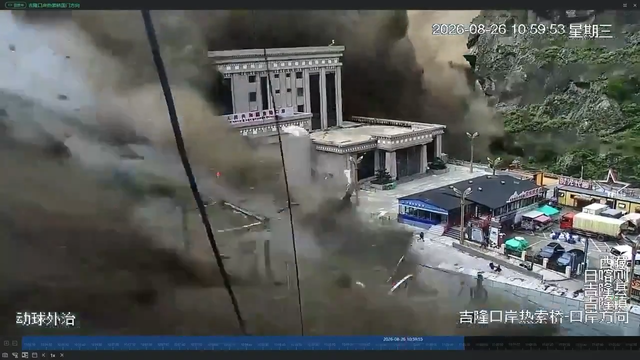
A devastating flash flood along the Nepal-China border. Photo: Screenshot from video
Speaking to Tuoi Tre (Youth) online newspaper on Saturday, Dr. Nguyen Ngoc Huy, a climate change and disaster risk management researcher, said studies have pointed to the collapse of a glacier or large mass of ice on a mountain as the likely cause of a devastating flash flood along the Nepal-China border earlier this week.
The devastating flash flood hit central and northern Nepal on August 26, with the resulting surge of water, mud, and debris destroying homes, roads, bridges, and hydropower facilities, while disrupting a key Nepal-China trade route.
Rescue teams have been searching for victims and missing people. As of Sunday, authorities reported 734 deaths and 2,498 people missing, including 589 foreign nationals.
More deadly flash floods may be on the way
The collapse of the glacier or large ice mass likely formed a temporary dam that blocked a river, Huy explained.
As water accumulated behind the dam, the pressure eventually became strong enough to break through it, sending a huge volume of water downstream.
"It took about two hours and 20 minutes from the tremor to the flash flood," Huy said.
"This means the temporary dam had been quietly filling with water for more than an hour before it broke and sent water rushing into the valley."
The flash flood was initially suspected to have been triggered by a magnitude-4.4 earthquake, later revised to 5.2, which was thought to have caused a reservoir to collapse.
However, earthquake data showed that the epicenter was at a depth of zero meters, meaning the tremor occurred at the surface and was likely caused by the collapse of a large geological mass.
The earthquake was therefore ruled out as the cause.
Heavy rainfall was also ruled out, as there was no heavy rain before or during the flash flood and the weather was sunny.
Huy said the peaks of the Himalayas are home to glaciers and glacial lakes because of their low temperatures.
However, rising global temperatures could be contributing to ice melt, he said.
The extent of ice loss can be difficult to determine from a single visit to an area.
Local residents may notice changes, but without scientific monitoring or risk assessments, they may not recognize them as potential warning signs.
"In my personal view, by 2030, without even waiting until 2050, the Himalayan peaks will lose many large masses of ice," Huy said.
"This trend cannot be denied because science has recorded rising global temperatures in recent years. As temperatures rise, ice is more likely to melt."
Similar flash floods could therefore occur in the near future, he warned.
Many ice masses could become disconnected from the underlying geology, while there are not enough cameras or vibration sensors to monitor the process and issue warnings, Huy said.

Dr. Nguyen Ngoc Huy, a climate change and disaster risk management researcher
What lessons can Vietnam learn?
According to Huy, calculations showed that water released when the temporary dam broke in the Nepal-China incident reached speeds of up to 180 kilometers per hour, leaving little chance to issue a warning once the flash flood had begun.
However, warnings could be issued if a tremor were detected.
The period between the tremor and the accumulation of enough water to trigger a flash flood could last more than two hours, he said.
This makes early warning systems critical.
If a warning system detects a tremor, authorities could assess the likelihood of a temporary dam forming and estimate how long it might take for enough water to accumulate to trigger a flash flood.
This would give authorities time to warn people in at-risk areas and help minimize damage, particularly loss of life.
"The lessons from Nepal and flash floods in northern Vietnam over the past three years show that the risk of flash floods is very high in areas with narrow streams," Huy said.
"Therefore, early warning systems for landslides and flash floods are very necessary, given that Vietnam has steep mountainous terrain and many narrow streams."
Areas frequently exposed to heavy rain, high mountainous areas, and narrow valleys where waterways could be blocked by landslides should undergo risk assessments and have warning systems installed, he said.
These systems could use cameras or vibration sensors and connect to automatic warning systems serving downstream communities through sirens, text messages, and public-address systems.
"Such measures could help prevent avoidable losses when disasters strike," Huy said.








Max: 1500 characters
There are no comments yet. Be the first to comment.