


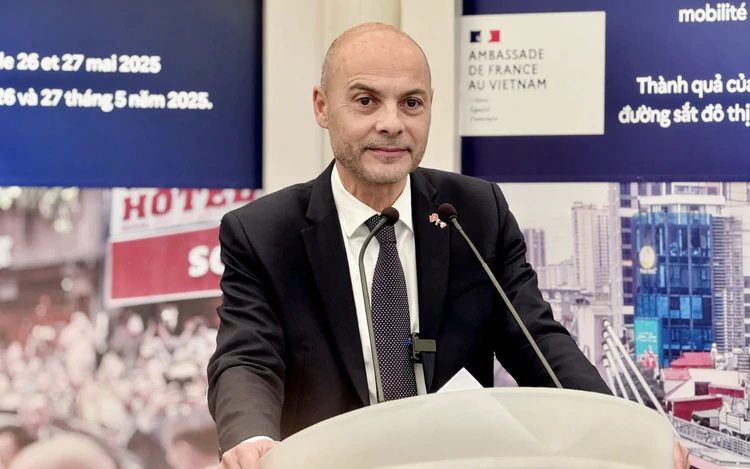
Newly-appointed French Ambassador to Vietnam Didier Le Bret meets with the press on October 30, 2026. Photo: Duy Linh / Tuoi Tre
Nearly a month after presenting his credentials and officially beginning his tenure in Vietnam, with a demanding schedule taking him from north to south, Ambassador Bret finally had the opportunity to sit down with the press for the first time in Hanoi on Friday.
The new French ambassador made no secret of his Vietnamese roots.
He shared his personal story toward the end of the meeting, after outlining his priorities for the coming term and the state of France-Vietnamese relations, as a ‘gift’ to the journalists who had stayed until the very last moment.
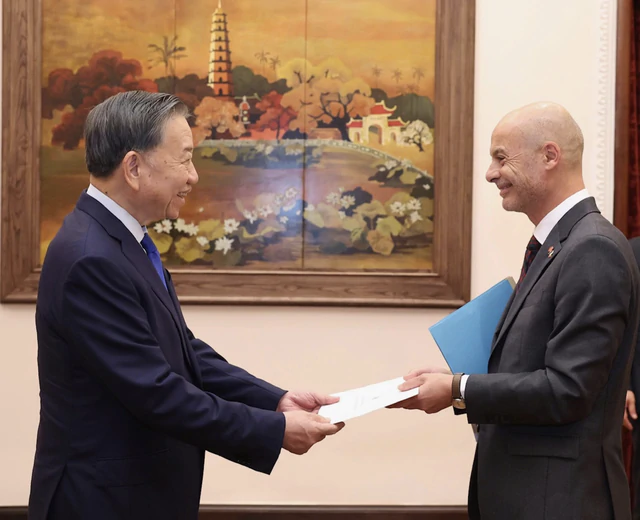
French Ambassador to Vietnam Didier Le Bret (R) presents his Letter of Credence to Vietnam’s Party chief and State President To Lam on October 3, 2026. Photo: Embassy of France
A Vietnamese connection
France enjoys a significant advantage in its relationship with Vietnam compared with many other countries, its large Vietnamese-origin community, he said,
What particularly impresses the ambassador is the community’s educational achievements.
He said it holds a record among foreign-origin communities in France for educational attainment, with 93 percent of the second-generation Vietnamese-origin residents holding qualifications.
“That represents an extraordinary pool of talent for your country and for the bond between our two nations,” Bret emphasized.
He then made a personal revelation, as he had previously done in an interview with a French newspaper in 2017: he has one-quarter Vietnamese ancestry.
“I wanted to become France’s ambassador to Vietnam, of course because Vietnam is a wonderful country, but also because my father was born here and my grandmother was Vietnamese,” he said.
In his imagination, his paternal grandmother was a very beautiful Vietnamese woman, although he never had the opportunity to meet her in person.
She was a young woman from Hue City who married his grandfather, who had spent time working in southern Vietnam.
Their son, Bret’s father, was born in Ho Chi Minh City.
His father later moved to France for his education and eventually worked there.
Bret was born in Paris in 1963.
Although he grew up in France, the young man maintained a connection with Vietnam through gifts and letters sent by his grandmother.
“My grandmother’s relatives are still here. I would very much like to meet them," the diplomat said.
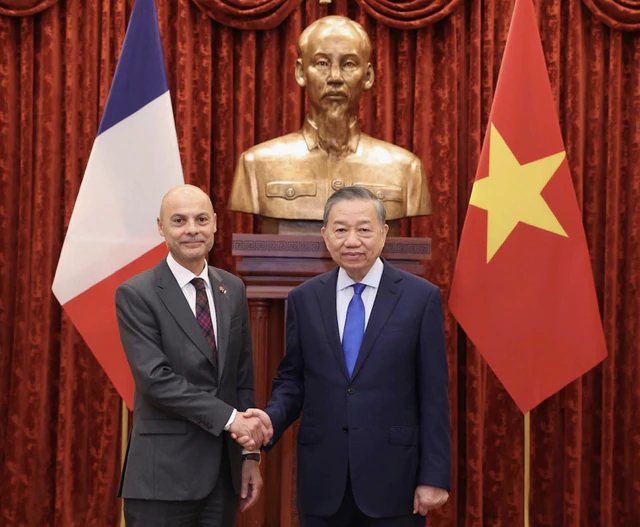
French Ambassador to Vietnam Didier Le Bret (L) meets Vietnam’s Party chief and State President To Lam. Photo: Vietnam News Agency
Honored to be France’s ambassador to Vietnam
“Before arriving in Vietnam, I had already read the figures on the country's economic growth," he said.
However, it was only after coming that he truly began to appreciate what those numbers mean in reality.
When Vietnam embarked on its Doi Moi (Renewal) reforms, its GDP was worth only a few billion U.S. dollars.
Today, the economy has grown to more than US$500 billion, he shared.
Economists describe this as a ‘development miracle.’
Alongside China, Vietnam is one of the two countries that have achieved the fastest reductions in the number of people living on less than $2 a day in the history of the global economy.
“The last time I visited Vietnam was around 15 years ago," Bret recalled.
“Back then, Hanoi and Ho Chi Minh City still had large numbers of bicycles on their streets.
“Today, motorcycles dominate, alongside fleets of modern electric taxi cabs booked through mobile applications.”
Looking at Ho Chi Minh City's skyline, one could almost imagine being in New York, São Paulo or Paris's La Défense business district, he said.
“Riding Hanoi's metro line No. 3 gives me the impression of being in Paris, London or Rome," he remarked.
“Walking through Hanoi, I can visit modern shops that would not look out of place anywhere in the world, then turn a corner and find myself among ancient temples and pagodas.”
In Vietnam, people do not have to choose between modernity and rich cultural heritage.
Vietnamese people have confidence in their country's development.
With that outlook, Vietnam is open to everyone who wants to visit or invest.
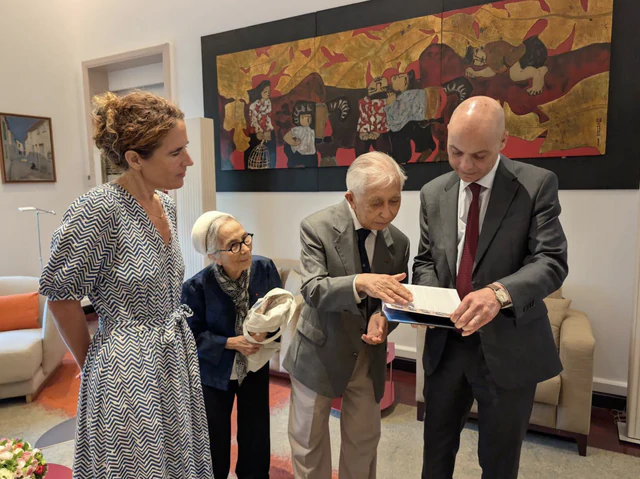
French Ambassador Didier Le Bret and his wife meet Professor Tran Thanh Van and his wife, Le Kim Ngoc, upon their arrival in Vietnam. Photo: Embassy of France
'We are not starting from scratch'
He shared that he was fortunate to have taken up this position with a very clear roadmap already in place, setting out the priorities to be pursued.
“When I presented my credentials, Party General Secretary and State President To Lam also shared his priorities for bilateral relations with me," he said.
The two nations have an exceptionally solid foundation for the continued development of their ties.
During his visit to Paris in September, the top Vietnamese leader visited research institutions, including the French Alternative Energies and Atomic Energy Commission.
The two sides signed several intergovernmental agreements and technical arrangements between ministries covering science, technology, and training.
“This is important because we are not starting from scratch," he said.
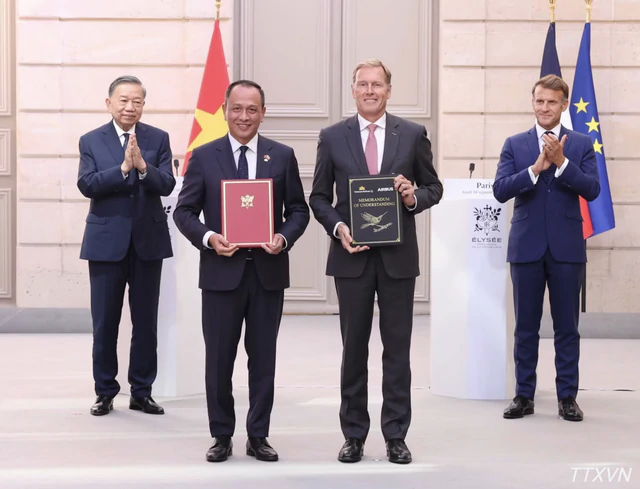
Party General Secretary and State President To Lam (2nd row, L) and French President Emmanuel Macron witness the exchange of cooperation agreements in the aviation sector during the top Vietnamese leader’s visit to France in September 2026. Photo: Vietnam News Agency
Nearly 7,000 Vietnamese students are currently studying in France, with around 1,500 new students arriving each year.
Vietnam also has something that few countries can boast: France-Vietnam training institutions specializing in precisely the strategic fields Vietnam needs, including engineering, management, digital technology, and space.
To date, three bilateral training programs have educated more than 17,000 students, he said.
“We also have two French schools in Hanoi and Ho Chi Minh City," the diplomat said.
“Around 40 Vietnamese schools have received the LabelFrancÉducation accreditation for teaching French as a second foreign language.
“The French Institute has branches in numerous locations across the country.”
The distinctive feature of France's scientific and educational network in Vietnam is that it serves Vietnam's development priorities.
These programs are designed entirely in the spirit of partnership.
“We want to be involved in every sector Vietnam identifies as a priority, particularly infrastructure such as expressways and energy," he stated.
“France and Europe are fortunate to have leading companies in all these fields.”
In aviation, Airbus is a European multinational, and most of the aircraft operated by Vietnamese airlines are Airbus planes.
“Party chief and President Lam asked us to help accelerate aircraft deliveries, given Vietnam's ambitious aviation development targets," Bret said.
More recently, Alstom signed a major contract with a Vietnamese partner to supply urban rail vehicles.
In maritime transport, CMA CGM has maintained a longstanding presence in Vietnam.
In renewable energy, a visit to wind power plants will reveal equipment from China and South Korea, but also a significant amount of European technology.
France's traditional areas of strength in Vietnam remain pharmaceuticals and agri-food.
France intends to maintain these established pillars of cooperation while expanding into new industries that Vietnam considers strategic for the years ahead.
In the past, Vietnam's market was not entirely ready to absorb large volumes of foreign investment.
Today, however, every country in the region wants to invest in Vietnam.
France was somewhat slower to enter the market, but it nevertheless maintains a solid presence, with around 250 companies operating in Vietnam.
Vietnam wants to work with France in a way that goes beyond simply manufacturing products in the country.
It wants production to be carried out together with Vietnamese partners and for the Vietnamese market.
“This is a highly partnership-oriented approach," the ambassador said.
Vietnam also has a clear political commitment to diversifying its sources of supply, including in security and defense.
Mentioning the obstacles facing foreign investors, he said that the cost of entering the Vietnamese market is relatively high.
However, this cost is declining as an increasing number of outstanding Vietnamese managers help French companies establish and expand their presence.
“What we built in the past, particularly through educational cooperation, is now helping to serve the future," Bret said.
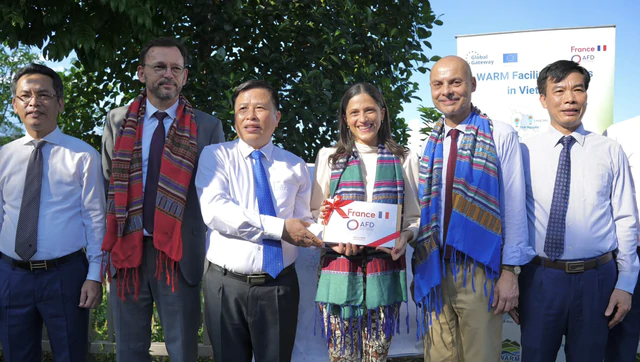
French Ambassador Didier Le Bret (R, 2nd) visits Hoa Binh Hydropower Plant in Vietnam in October 2026. Photo: Embassy of France
Building win-win partnership
There are three major areas in which Vietnam has substantial needs, he noted.
The first is earth observation satellites.
Most of the phenomena that concern people, including climate change, are monitored from space.
France previously supplied Vietnam with an earth observation satellite, which is now approaching the end of its operational life.
“We are in the final stages of negotiations with the Vietnamese side to replace it," he said.
This is not only a matter of supplying equipment, but also an opportunity for scientific communities in both countries to learn to work together and to transfer technological capabilities.
The second area is quantum technology, where the top Vietnamese leader has asked France to step up its support.
The third area is critical minerals and rare earth elements.
The dual transition toward a low-carbon economy and a digital economy requires substantial quantities of strategic raw materials, including critical minerals and rare earths.
The good news is that Vietnam possesses significant reserves.
Vietnam and France, together with the European Union, have already held discussions on this issue, paving the way for cooperation programs covering the entire value chain: accurately identifying reserves, extraction, and processing.
“This is a win-win partnership.”
Vietnam can become a key link in a sector of significance to global supply chains, while France and Europe can secure agreements that, although not necessarily exclusive, will help diversify their sources of supply.
“On transport, I would particularly like to highlight railways," he said.
Vietnam's ambitions are considerable, including the north-south high-speed railway linking Hanoi and Ho Chi Minh City, as well as railway connections to major ports such as Hai Phong.
France is a pioneer in high-speed rail technology, desiring to accompany Vietnam throughout the entire process, from design and manufacturing to operations, maintenance, and management.
Major French railway companies are already present, involved or preparing to participate in Vietnam’s major projects such as the north-south high-speed railway.
France's experience since the early 1980s has shown that high-speed trains can fundamentally transform a country's geography and economic landscape.
Cities that once seemed distant suddenly become much closer.
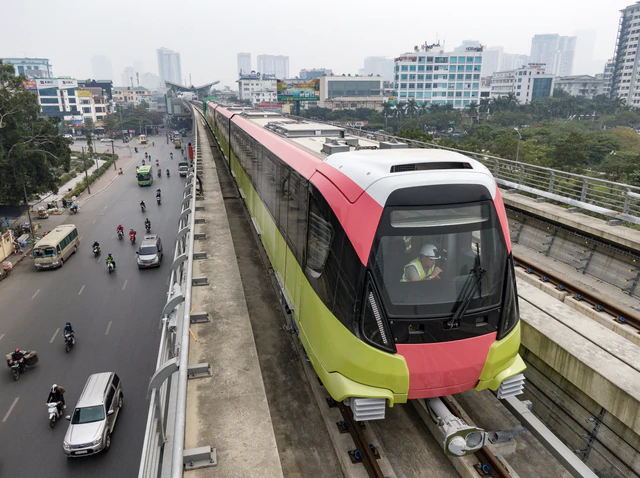
A train, built with French funding, runs on a metro line in Hanoi. Photo: Tuoi Tre
The Provence-Alpes-Côte d'Azur region around Marseille, Aquitaine around Bordeaux, Lille and northern France have all experienced remarkable economic momentum.
“I believe something similar will undoubtedly happen across the approximately 20 provinces and cities along the Hanoi-Ho Chi Minh City railway corridor," Bret said.
In Morocco, France successfully cooperated with the country to develop a high-speed railway line.
The process went very smoothly, from training to technology transfer, enabling Morocco to operate the system as efficiently and effectively as possible.
Building on that success, France's national railway company SNCF worked with Morocco to invite several Vietnamese experts and officials to learn from the country's experience.
“In the energy sector, we will continue to support major renewable energy projects," the diplomat promised.
Europe, through an initiative led by France, has joined the Just Energy Transition Partnership (JETP) with Vietnam, which has a total financing commitment of $15.5 billion.
An allocation of €500 million ($560 million) has already been specifically designated for renewable energy.
The projects include expanding electricity generation capacity and upgrading the power grid.
The grid also has regional significance, involving neighboring countries such as Laos and Cambodia, within the framework of the European Union's Global Gateway strategy.


Max: 1500 characters
There are no comments yet. Be the first to comment.