


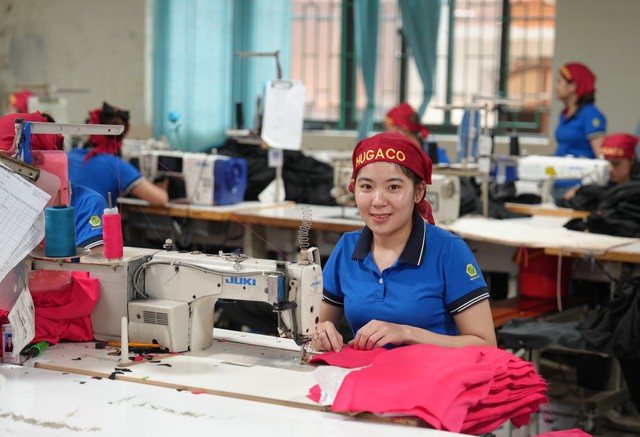
Workers at a textile factory in Vietnam. New U.S. tariffs are expected to intensify competition and influence the movement of orders across regional supply chains. Photo: P. Son
A new 12.5-percent U.S. tariff on certain imports from Vietnam could prompt shifts in textile orders and supply chains, Vietnamese textile and garment giant Vinatex said.
Tariff impact goes beyond finished garments
Hoang Manh Cam, chief of Vinatex’s board office, said the new tariff was changing the competitive balance among textile and garment exporters.
Differences in tariff rates among countries could affect not only finished garments but also sourcing decisions and supply chains for yarn, fabric, and other materials, Cam said.
Businesses should therefore assess the impact by product category, export market, and position in the value chain instead of relying solely on comparisons of average tariff rates across countries.
Le Tien Truong, chairman of Vinatex, said companies also needed to consider existing most-favored-nation tariffs, the additional duties actually imposed, product composition, the origin of raw materials, and the potential movement of orders between exporting countries.
Although U.S. clothing retail sales have continued to edge higher in nominal terms, declining imports and broadly stable inventories suggest that the increase has been driven largely by higher prices and tariffs rather than stronger consumption volumes.
Against this backdrop, companies need to reassess their competitive positions across product categories, market segments, and stages of the value chain.
They should also identify both the risks facing garment exports and emerging opportunities in yarn, fabric, raw materials, and intermediate production so they can develop appropriate responses.
Positive growth despite challenging market
Vietnam’s textile and garment exports have continued to grow despite subdued global economic conditions.
According to the Vietnam Textile and Apparel Association (VITAS), the industry’s total export turnover reached an estimated US$22.2 billion in the first half of 2026, up 1.7 percent from a year earlier.
Growth was led by raw materials and semi-finished products, with fabric exports rising 8.9 percent to $1.48 billion, fiber and yarn exports increasing nearly 10 percent to $2.29 billion, and textile and garment accessories gaining 10.81 percent.
Garment exports, which account for the largest share of the industry’s total shipments, edged down 0.32 percent to more than $17.25 billion as demand in several major markets had yet to recover strongly.
The United States remains Vietnam’s largest textile and garment export market, followed by the European Union, Japan, China, and ASEAN.
Stronger shipments to China and the EU point to a recovery in key markets and reflect efforts by Vietnamese exporters to diversify their destinations.
However, growth has varied significantly among competing exporting countries, showing that competitiveness increasingly depends not only on export scale but also on product mix, tariff advantages, and the ability to adapt to shifts in global supply chains.
The United States began imposing import tariffs on goods from 60 economies on July 24, following a months-long investigation into its trading partners' policies on preventing the circulation of products made with forced labor.
The new tariffs were set at either 10 percent or 12.5 percent, replacing the previous 10-percent levy that expired on the same day.
Vietnam was among the 60 economies investigated by the Office of the U.S. Trade Representative under Section 301. Vietnamese goods, including textile and garment products, are subject to a 12.5-percent tariff, except for items exempted under the memorandum's annex.
- REFERENCE MORE










Max: 1500 characters
There are no comments yet. Be the first to comment.