


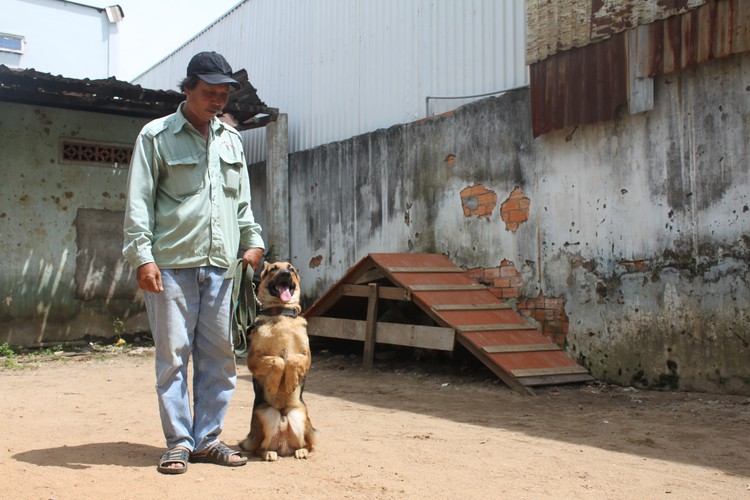
A decades-old dog training school in Ho Chi Minh City has been a familiar address over the last eight years for many dog lovers who wish to have a well-trained pet, especially those who want their best friends to be taught using foreign languages.
The Vu Hung Dog Training School in Tan Phu District was established 32 years ago by Vu Viet Hung, 75, a dog enthusiast.
For the last eight years, the school has become more popular thanks to its program that uses foreign languages to teach canines.
‘Students’ attending Vu Hung school include dogs from a wide range of breeds, from the small and cute to the big and aggressive.
Dog training curriculum in English, French, Chinese
Pham Le Dung, the school’s manager, said her husband, Hung, decided to establish the school with the aim of churning out well-trained dogs that can protect their owners from danger.
After 32 years of hard work, Hung, who loves dogs, has invested not only money but also effort to transform the school from a small, run-down place to a professional, well-equipped center which currently teaches around 80 ‘students’ per day.
A wide variety of dogs have been sent to the school, including tiny breeds that weigh only one kilogram or less such as Miniature Poodles, Chihuahuas and Pomeranians, as well as big dogs that weigh over 60 kilograms such as Bergers, Rottweilers and Samoyed.
The school initially used Vietnamese to train dogs. Over the past eight years, the owners of dogs at the school have included foreigners from Singapore, South Korea, the U.S., and France who want their dogs to be taught via foreign languages, Dung said.
Dog trainers teach the ‘students’ in English, French or Chinese following requests from their owners. Canines are trained fundamental behavior in Vietnamese before switching to foreign languages.
Every time trainers say ‘stand up’ or ‘sit down,’ the ‘students’ repeatedly, smoothly move from a standing position to a sitting posture. In a corner of the training yard, one dog was seen trying to take his trainer’s hand after hearing the ‘handshake’ command.
Tran Quoc Tinh, a dog trainer with 28 years of experience, teaches dogs in Chinese while Nguyen Van Minh, who has spent 10 years working at the school, uses English.
“Hung taught us dog training skills including fundamental and complicated behaviors in both Vietnamese and foreign languages,” Minh said.
Rocky, one of Minh’s ‘students,’ is a Rottweiler that is able to perform basic gestures such as sitting, crawling, greeting and lying down after hearing orders in English following two years of training.
The canine is currently learning how to confront strangers to protect its owner from danger, which requires a higher learning level.
Smart dogs that can grasp lessons quickly will be allowed to learn the most complicated behavior, in which they receive commands through a special type of whistle that emits ultrasonic sound, rather than trainers’ voice.
Luu Chi Hung, Rocky’s owner, from Tan Phu District, said that his dog has become more friendly and obedient since beginning his training at the Vu Hung school, not to mention that he can now understand commands in English and act accordingly.
Another owner, Nguyen Dang Thi Mai Huong, who lives in the same district, said she sent her 1.2 kilogram Pomeranian to the school in September. Huong, who used to be afraid that the dog was too small to be trained, said her canine seems to be very happy going to school.
“It wakes up at around 6:00 am every day and excitedly waits for the trainer to pick it up from home to go to school,” Huong shared.
Expensive services
Except for a few ‘students’ that are local dog breeds, most of the dogs sent to Vu Hung are among the rare, expensive types such as Husky, Alaskan Malamute and Samoyed.
Rocky, the 60-kilogram Rottweiler, was carefully selected from nearly 30 other dogs at a canine center in Tan Phu Trung Commune of Ho Chi Minh City’s suburban district of Cu Chi at a price of around US$2,000, while Huong spent $1,000 buying her small, cute Pomeranian.
That is why besides training, the school also offers extra services to the ‘students.’
From Monday to Saturday, the trainers pick up the dogs, drive them to school and then back home again after class. A morning class starts at 7:30 am and ends at 11:00 am, while the afternoon class begins at 12:00 pm and finishes at 5:00 pm.
The monthly fee costs VND1.2 million ($56) to VND2 million ($94) depending on the distance from home to school. Dog owners who live far from school can apply for boarding classes in which the animals stay at school and only go home on weekends or holidays for VND2.5 million ($118) per month.
Small pooches are allowed to skip classes on rainy days to keep their fur dry and have make-up classes on another day.
According to Minh, who teaches the dogs in English, it is easy and comfortable to train and take care of small dogs, while big breeds such as Rottweilers and Bergers are more dangerous as they can bite their trainers unexpectedly.
Like us on Facebook or follow us on Twitter to get the latest news about Vietnam!


Max: 1500 characters
There are no comments yet. Be the first to comment.