


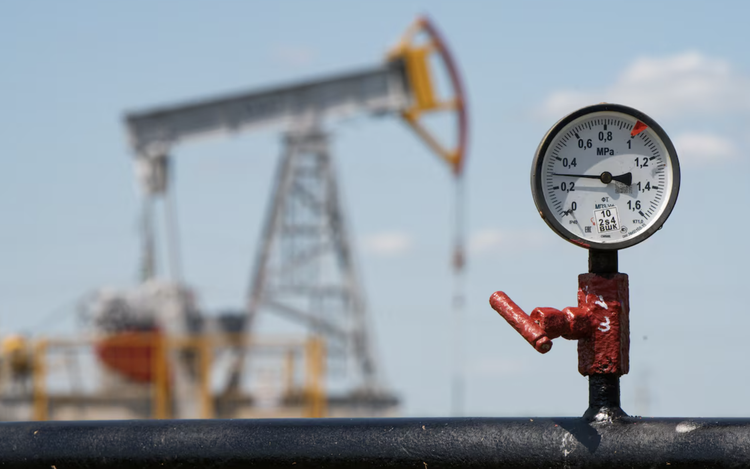
A view shows a pressure gauge near oil pump jacks outside Almetyevsk, in the Republic of Tatarstan, Russia July 14, 2025. Photo: Reuters
Brent crude futures shed about 19% in 2025, the most substantial annual percentage decline since 2020 and its third straight year of losses, the longest such streak on record. U.S. West Texas Intermediate crude logged an annual decline of almost 20%.
On the last day of the year, Brent futures settled at $60.85 a barrel, down 48 cents, or 0.8%. U.S. WTI crude fell by 53 cents, or 0.9%, to settle at $57.42 a barrel.
BNP Paribas commodities analyst Jason Ying anticipates Brent will dip to $55 a barrel in the first quarter before recovering to $60 a barrel for the rest of 2026 as supply growth normalises and demand stays flat.
"The reason why we're more bearish than the market in the near term is that we think that U.S. shale producers were able to hedge at high levels," he said.
"So the supply from shale producers will be more consistent and insensitive to price movements."
U.S. crude stocks fell last week, but distillate and gasoline inventories grew more than expected, according to data from the U.S. Energy Information Administration.
"It was a modestly supportive report on crude drawdown, but the inners of the report are not so great and it will probably be a rough January and February with the holidays in the rearview mirror," said John Kilduff, partner at Again Capital Markets.
Crude inventories fell by 1.9 million barrels to 422.9 million barrels in the week ended December 26, the EIA said, compared with analysts' expectations in a Reuters poll for an 867,000-barrel draw.
U.S. gasoline stocks rose by 5.8 million barrels in the week to 234.3 million barrels, the EIA said, compared with analysts' expectations for a 1.9 million-barrel build. Distillate stockpiles, including diesel and heating oil, rose by 5 million barrels to 123.7 million barrels, versus projections of a 2.2 million-barrel rise.
Oil production in the U.S. hit a record in October, according to the latest data from the EIA.
Oil markets had a strong start to 2025 when former President Joe Biden ended his term by imposing tougher sanctions on Russia, disrupting supplies to major buyers China and India.
The impact of the attack on Ukraine on energy markets intensified when Ukrainian drones damaged Russian infrastructure and disrupted Kazakhstan's oil exports.
The 12-day Iran-Israel conflict in June added to the threats to supply by disrupting shipping in the Strait of Hormuz, a major route for global seaborne oil, which fanned oil prices.
In recent weeks, OPEC's biggest producers, Saudi Arabia and the United Arab Emirates, have become locked in a crisis over Yemen. U.S. President Donald Trump has ordered a blockade on Venezuelan oil exports and threatened another strike on Iran.
OPEC+ Accelerated Output Increases
But prices eased after OPEC+ accelerated its output increases this year and as concerns about the impact of U.S. tariffs weighed on global economic and fuel demand growth.
OPEC+, the Organization of the Petroleum Exporting Countries and allied producing nations, paused oil output hikes for the first quarter of 2026 after releasing some 2.9 million barrels per day into the market since April. The next OPEC+ meeting is on January 4.
Most analysts expect supply to exceed demand next year, with estimates ranging from the International Energy Agency's 3.84 million barrels per day to Goldman Sachs' 2 million bpd.
"If the price really has a substantial fall, I would imagine you will see some cuts (from OPEC+)," said Martijn Rats, Morgan Stanley's global oil strategist. "But it probably does need to fall quite a bit further from here on - maybe in the low $50s."
"If today's price simply prevails, after the pause in Q1, they'll probably continue to unwind these cuts."
John Driscoll, managing director of consultancy JTD Energy, expects geopolitical risks to support oil prices even though market fundamentals point to oversupply.
"Everybody's saying it'll get weaker into 2026 and even beyond," he said. "But I wouldn't ignore the geopolitics, and the Trump factor is going to be playing out because he wants to be involved in everything."








Max: 1500 characters
There are no comments yet. Be the first to comment.