


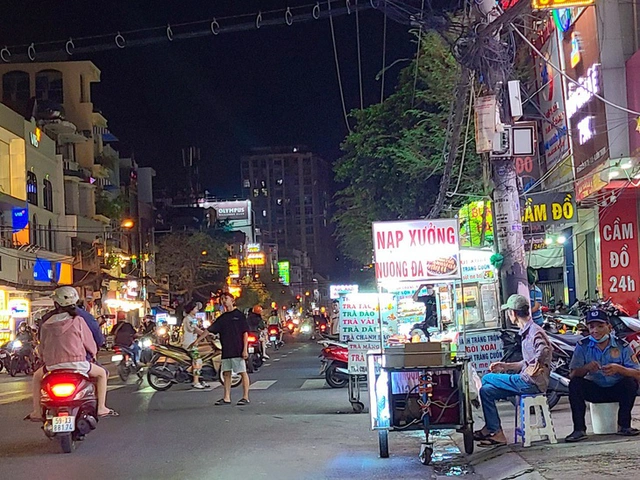
Street vendors place their carts on the roadway along a street in Ho Chi Minh City, Vietnam. Photo: Nhat Xuan / Tuoi Tre
Editor’s note: The following opinion was submitted to Tuoi Tre (Youth) newspaper by Huynh The Du, a PhD and lecturer in public policy at Fulbright University Vietnam.
The piece was translated from Vietnamese into English and edited by Tuoi Tre News, the daily’s English edition, for clarity, consistency, and coherence.
Behind the baskets and pushcarts on sidewalks are the livelihoods of hundreds of thousands of workers, particularly older people and women who have fewer opportunities to access formal employment.
In front of them, however, lies mounting pressure related to urban order, food safety, traffic flow, and the image of a modern city.
Addressing the challenge of street vending is not simply a matter of 'eliminating' or 'keeping' it, but of managing it in a way that supports civilized urban development while ensuring that no one is left behind.
Ho Chi Minh City can look to international experience in tackling this issue.
In the 1960s and 1970s, Singapore also faced a proliferation of street vendors, along with concerns about sanitation and traffic obstruction.
Instead of imposing an outright ban, authorities chose to regulate the trade and bring it into a formal system.
Hawker centers, or organized food complexes, were built across the island nation, equipped with standardized stalls, clean water, and facilities designed to ensure hygiene and food safety.
Vendors were licensed, trained, and required to pay reasonable fees.
In return, they gained stable places to operate and customers gained confidence in the quality of food.
Notably, hawker culture became more than a regulatory solution; it evolved into part of the country’s identity.
In 2020, UNESCO recognized Singapore’s hawker culture as an item of intangible cultural heritage.
From what was once a difficult urban management problem, Singapore transformed street vending into a cultural and tourism asset that contributes to the economy and the country’s global image.
Bangkok went through a period of strict enforcement, removing many street vendors in an effort to reclaim the sidewalks.
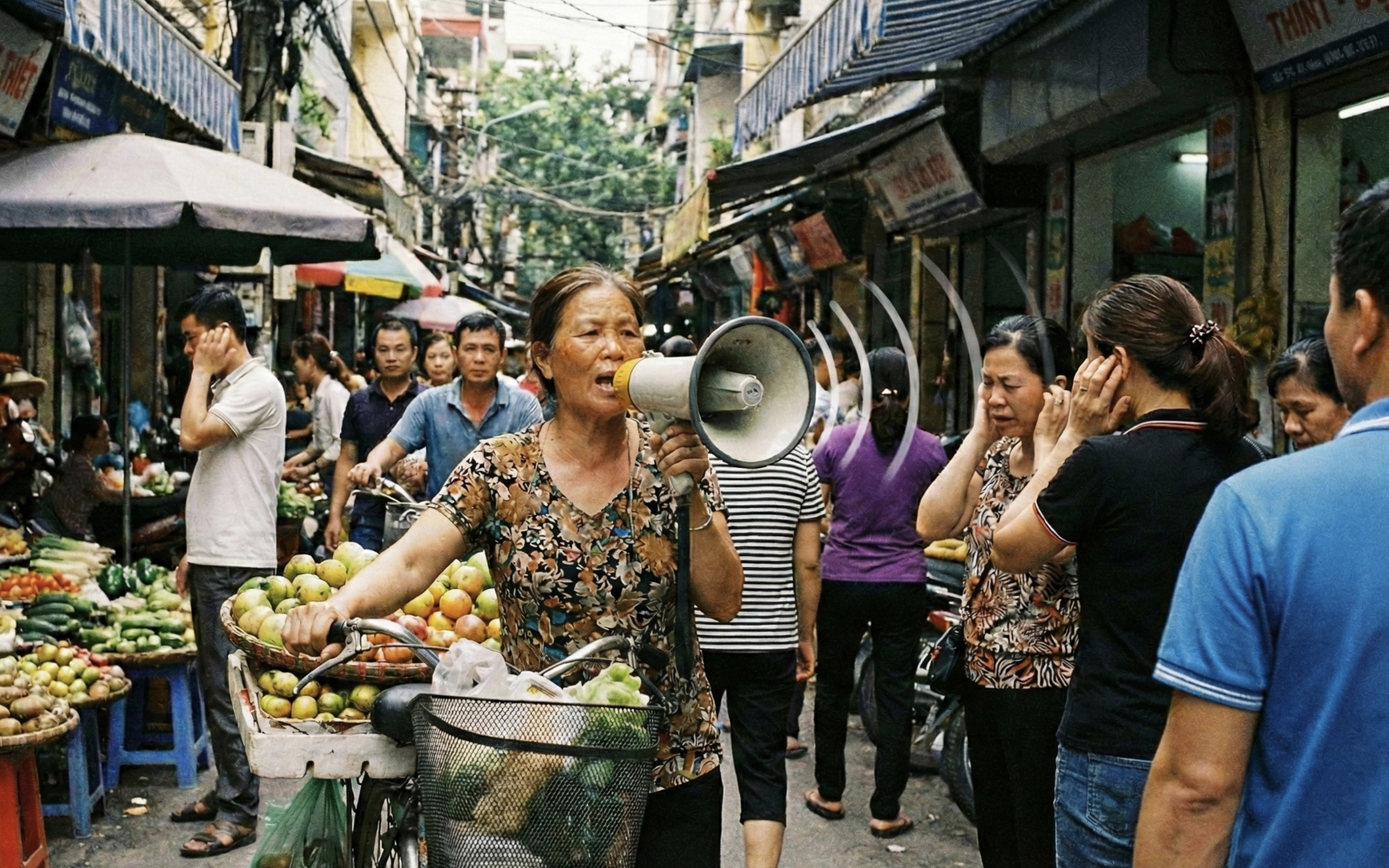
But after pushback from residents and tourists, Thai authorities adjusted their approach, establishing clearly designated zones: areas where vendors are permitted to operate during certain hours and areas where they are strictly prohibited.
Sanitation inspections were strengthened instead of carrying out sweeping crackdowns.
As a result, Bangkok’s street food remains a powerful tourism magnet while urban order has improved.
In Seoul, the street carts known as 'pojangmacha' were once viewed as unsightly.
The city introduced programs to standardize stall designs, provide loan support, and train vendors in food safety, even integrating electronic payment systems.
Vendors are required to comply with regulations but are also recognized as part of the urban economy.
The experience of these cities shows that when the state plays a constructive role, street vending can be upgraded rather than eliminated.
In reality, in Ho Chi Minh City, Hanoi, and many other major urban areas, periodic enforcement campaigns often produce only short-term effects.
When the pressure to earn a living remains, street vendors inevitably return.
This suggests the issue lies not in enforcement efforts but in the approach itself.
First, street vending should be recognized as a component of the economy -- one that absorbs low-skilled labor and helps reduce urban unemployment.
At a time when digital transformation and automation are shrinking many low-skill jobs, this sector also acts as a social buffer.
Without alternative livelihood solutions, simple bans risk pushing vulnerable groups into even greater insecurity.
Second, spatial planning must come first.
Authorities could pilot designated vending areas based on the hawker center model, night markets or food streets; establish flexible operating hours on certain roads; and standardize carts and stalls to ensure visual order.
Technology could also be applied to licensing, transparent fee collection, and food safety monitoring.
Third, policy must account for occupational transition.
Not every vendor will fit into a centralized model.
For some older vendors, programs may be needed to provide new skills training, facilitate access to microcredit or integrate them into broader urban social welfare programs.
Managing street vending cannot be separated from social policy.
Learning from other Asian cities does not mean copying their models wholesale.
Each Vietnamese city has its own characteristics in terms of population density, infrastructure, and consumer culture.
But the core lesson is clear: manage through planning, standards and support for transition, rather than relying solely on administrative orders.
A government that is of the people, by the people and for the people, and whose actions reflect public sentiment will earn public support in building a modern, orderly, and humane city where no one is left behind.








Max: 1500 characters
There are no comments yet. Be the first to comment.