


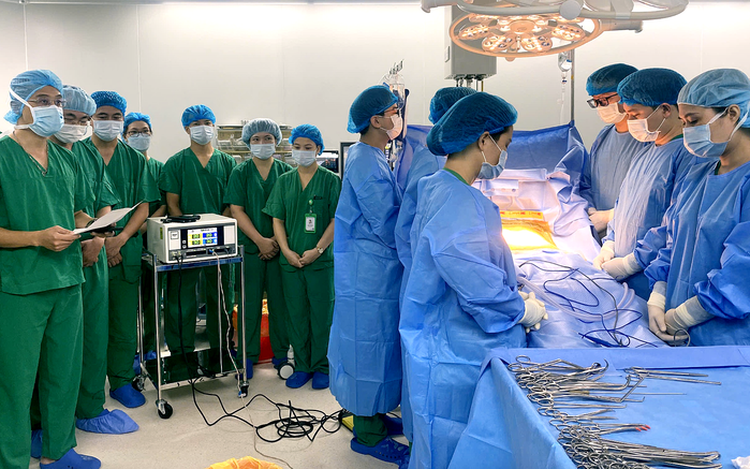
Doctors and medical staff observe a moment of silence to honor the organ donor before the organ retrieval procedure at Saint Paul General Hospital in Hanoi. Photo: Supplied
The donor, identified as N.D.D., was transferred to Saint Paul General Hospital with severe traumatic brain injuries after a motorcycle accident.
According to his family, he was involved in the crash on July 6 and was initially taken to Bac Thang Long Hospital for emergency treatment.
He had previously undergone surgery for a traumatic brain injury in 2012.
Upon his arrival at Saint Paul General Hospital, doctors immediately activated emergency protocols and assembled a multidisciplinary team.
He was diagnosed with severe traumatic brain injury and extensive bleeding in the frontal, parietal, and temporal lobes of both sides of the brain.
Despite undergoing two operations and receiving intensive treatment for several days, all clinical signs indicated that he had suffered brain death.
The hospital's medical council completed all required evaluations and consultations in accordance with regulations issued by Vietnam's Ministry of Health.
After his brain death was confirmed, doctors and nurses met with the patient's family to explain his condition and discuss the significance of organ and tissue donation.
Although the family initially struggled to accept the devastating news, they ultimately agreed to donate his organs to help save the lives of others awaiting transplantation.
Dinh Thi Thu Nga, a nurse with the hospital's social work department, said the donor had been involved in three traffic accidents during his lifetime.
He lived with his elderly parents after his wife passed away eight years ago.
He worked as a freelancer and is survived by a son born in 2006, who is studying at the Hanoi University of Science and Technology.
"We thought that if we could no longer keep our loved one with us, at least he could continue living in another way," said N.T.T., the donor’s younger sister.
Following the family's consent, Saint Paul General Hospital coordinated with specialist medical teams and the National Coordinating Center for Human Organ Transplantation to retrieve and allocate the donated organs.
The donor's heart was transported to the University Medical Center Ho Chi Minh City for transplantation.
The donor's liver was split into two grafts. One was sent to Viet Duc University Hospital, while the smaller graft was transferred to the National Children's Hospital to save a child in critical condition.
His two corneas were sent to Dong Do Hospital to restore sight to two recipients, while his two kidneys were transplanted into patients at Saint Paul General Hospital.
Vietnam continues to face a growing demand for organ transplantation as the number of patients suffering from heart, liver, kidney, and other organ failure increases. However, the shortage of donated organs means thousands of patients remain on transplant waiting lists.
Health authorities encourage people to register to donate organs and tissues after death or following a declaration of brain death, noting that a single donor can save multiple lives and improve the quality of life for many others.








Max: 1500 characters
There are no comments yet. Be the first to comment.